
A Certificate of Sponsorship is not a certificate at all — it is an electronic record a licensed employer creates for one worker, carrying a reference number the worker uses to apply for their visa. Which kind you assign, defined or undefined, depends on where the worker is applying from; the fee is £525 on the Worker routes, and the worker must use the certificate within three months. Here is how the system actually works.
On This Page

An Electronic Record, Not a Document
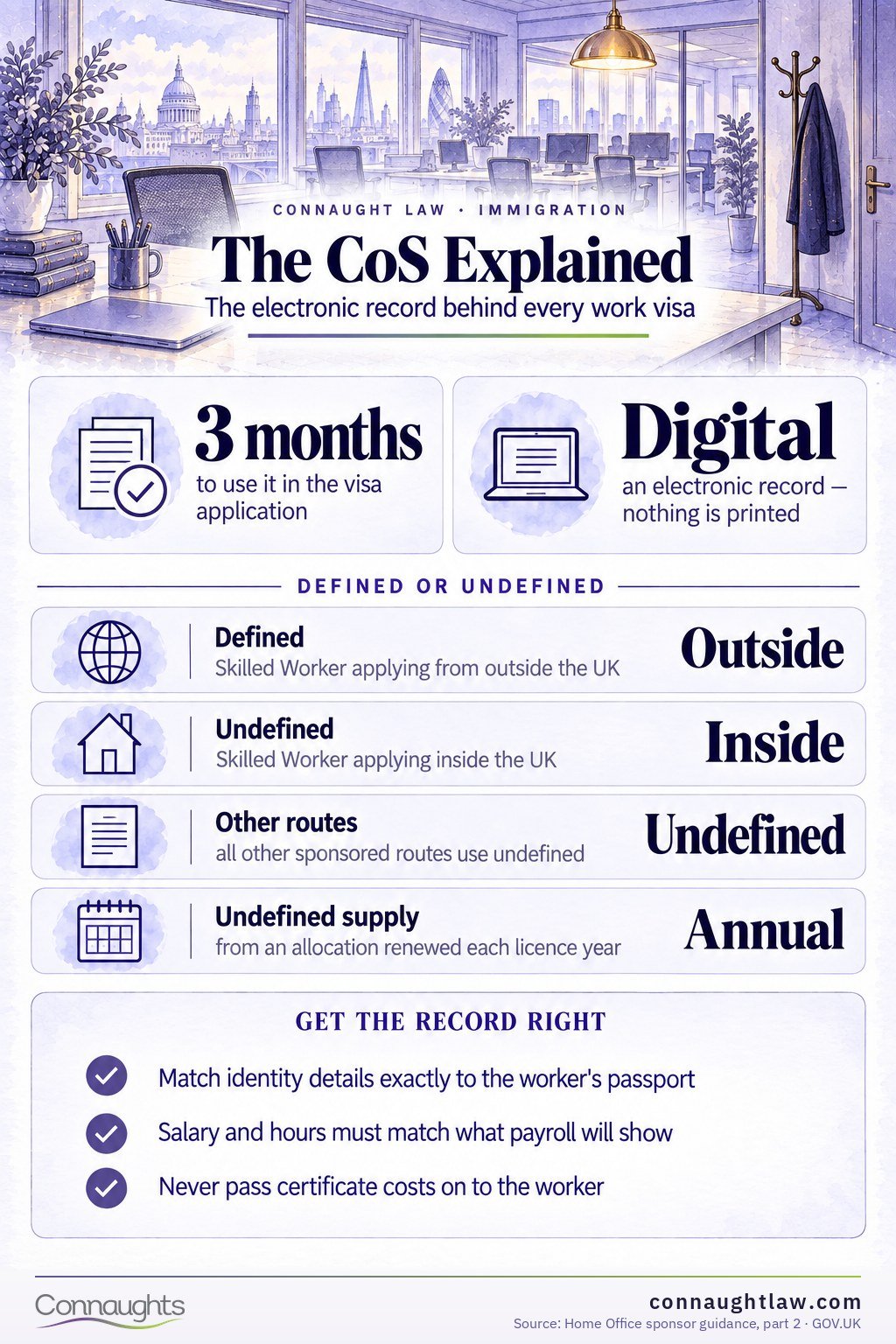
A Certificate of Sponsorship (CoS) is an electronic record created on the Home Office's sponsorship management system by a licensed sponsor for one named worker. It carries a unique reference number the worker enters in their visa application. Nothing is printed and nothing is posted — the "certificate" lives entirely in the system.
Every sponsored work visa starts here: no certificate, no application. The employer must already hold a sponsor licence — the route to one is covered in our sponsor licence application guide — and the certificate is where that licence meets a real hire, which is exactly why the Home Office polices what it says.
How the Certificate System Works
A Level 1 user assigns the certificate through the sponsorship management system. Once assigned, the clock runs: the worker must use the certificate to apply for their visa within three months, and cannot apply more than three months before the job's start date. An unused certificate simply expires, and the £525 fee with it.
What the Record Carries
- The occupation code, job title and duties — chosen honestly, because role-to-code mismatch is a classic enforcement finding.
- The salary and hours, which must meet the route's thresholds and match what payroll will actually show.
- Employment dates and work locations, including hybrid arrangements the sponsor must then keep current.
- The worker's identity details exactly as in their passport — small mismatches cause refusals out of all proportion to the error.
Defined vs Undefined Certificates
The split is about where the worker applies from, and it decides how the sponsor obtains the certificate. Per the gov.uk employer guidance, checked on 1 August 2026: defined certificates are for people applying for a Skilled Worker visa from outside the UK; undefined certificates cover Skilled Workers applying inside the UK and applicants on all other routes.
Before the points-based system relaunch, defined certificates were called "restricted" and undefined ones "unrestricted". Guides still using those names are describing the pre-2021 regime — the monthly allocation panels they refer to no longer exist, and relying on them will send your process in the wrong direction.
Requesting a Defined Certificate
Sponsors request each defined certificate individually through the sponsorship management system as the hire arises. There is no quarterly cycle and no bidding round: requests are usually approved within one working day, though the Home Office can hold a request for further checks. Once granted, the certificate is assigned to the named worker and the three-month application window opens.
Certificate Types Compared
| Type | Who it covers | How obtained | Usual timing |
|---|---|---|---|
| Defined | Skilled Worker applicants outside the UK | Individual SMS request per hire | Usually approved within 1 working day |
| Undefined | Skilled Workers in the UK; all other sponsored routes | Annual allocation, topped up on request | Top-ups usually 12 weeks; paid faster service available |
Undefined Certificates and the Annual Allocation
Undefined certificates come from an allocation the sponsor estimates at licence application and renews each licence year. Assigning one is immediate while the allocation lasts; increasing the allocation is the slow part, usually around 12 weeks unless the sponsor pays for a faster decision. The planning lesson is blunt: forecast in-country extensions and switches early, because the allocation request is where deadlines go to die.
What the Role Must Meet
Skill and Salary Rules Now
Since 22 July 2025, most Skilled Worker certificates must be for roles at degree level (RQF6) on the eligible occupations list, paying at least the £41,700 general threshold or the occupation's going rate if higher, with lower floors only through the shortage and transitional lists. The care route is closed to new overseas recruitment. Assigning a certificate for a role that fails these tests wastes the fee at best — and reads as a genuineness problem at worst.
Checks on the Worker
The certificate asserts a genuine vacancy filled by a qualified person, and both halves are tested — our genuine vacancy guide covers how. Since 8 January 2026 new Skilled Worker applicants must also meet the higher B2 English requirement, and sponsors certifying maintenance take on a financial commitment that should be a decision, not a default tick.
What a Certificate Costs
The Fee per Certificate
The Worker-route certificate fee is £525, the figure that has applied since the 9 April 2025 rise from £239 — a 120% jump that turned the CoS from rounding error into budget line. Temporary Worker certificates cost £55. Since 31 December 2024 the Skilled Worker certificate fee cannot be recouped from the worker, a prohibition extended to the other Worker routes from 9 April 2025 — recovering it risks the licence itself.
Current Certificate of Sponsorship Fees
| Certificate | Fee |
|---|---|
| Skilled Worker and other Worker routes | £525 |
| Temporary Worker routes | £55 |
| International Sportsperson — over 12 months | £525 |
| International Sportsperson — 12 months or less | £55 |
Immigration Skills Charge Rates
| Sponsor size | First 12 months | Each further 6 months | Five-year maximum |
|---|---|---|---|
| Small or charitable | £480 | £240 | £2,400 |
| Medium or large | £1,320 | £660 | £6,600 |
Budgeting the Assignment
- The Immigration Skills Charge is paid up front for the whole certificate period: a three-year assignment costs a small sponsor £480 + (4 × £240) = £1,440, and a medium or large one £1,320 + (4 × £660) = £3,960.
- Exemptions exist — including workers switching from the Student route and certain research and teaching occupations — and are listed on the gov.uk Skills Charge page.
- Neither the certificate fee nor the Skills Charge can be passed to the worker.
- The full employer cost picture, licence fees included, is in our sponsor licence fees guide.
Compliance Around Certificates
How Assignments Are Checked
Everything entered on a certificate is checkable, and the Home Office checks: assignments are compared against visa applications, reported changes and what compliance officers find at a visit. A certificate that says one salary while payroll says another is not an administrative slip — it is evidence, timestamped and signed by your own Level 1 user. The duties around keeping certificates truthful are set out in part 2 of the sponsor guidance.
Enforcement Context
Certificate accuracy has become a frontline enforcement issue because the wider climate has hardened — Home Office enforcement visits rose 58% in 2025, and sponsor suspensions and revocations have surged with them. Our sponsor compliance crackdown analysis tracks the published data; the short version for certificate practice is that errors once absorbed quietly now start investigations.
What Is Changing Next
Digital Status and eVisas
The certificate was born digital and the rest of the system is catching up: physical visa documents have given way to eVisas, and sponsors should expect the assignment-to-status pipeline to become more automated and more cross-checked, not less. The practical consequence is that data discipline — names, dates, codes entered right first time — is now the compliance skill that matters most.
Policy Signals
Of the May 2025 White Paper measures, the ones already in force — the RQF6 threshold, the higher Skills Charge, B2 English — all pass through the certificate. Still ahead: the Graduate route shortens for applications from 1 January 2027, the Temporary Shortage List runs only to the end of 2026 with a review live, and earned settlement remains a consultation, not law. Sponsors planning multi-year recruitment should budget rules, not just fees, moving annually.
Frequently askedQuestions about certificates of sponsorship
What is a certificate of sponsorship?
An electronic record a licensed sponsor creates for one worker on the sponsorship management system. It carries a unique reference number the worker uses in their visa application, and records the role, salary, hours and dates the sponsor is committing to. It is not a physical document.
How does an employer apply for a certificate of sponsorship?
Through the sponsorship management system, using a Level 1 user account. Defined certificates are requested individually per overseas hire and usually approved within one working day; undefined certificates are assigned from the sponsor's annual allocation, with top-ups requested through the same system.
How long does a certificate of sponsorship last?
Once assigned, the worker must use it to apply for their visa within three months, and cannot apply more than three months before the job's start date. A certificate that expires unused is not refunded — the sponsor assigns a new one and pays again.
How much does a certificate of sponsorship cost?
£525 on the Worker routes and £55 on the Temporary Worker routes, under the fee table in force from 8 April 2026. The Immigration Skills Charge is paid on top at assignment, and neither charge can lawfully be recovered from the worker.
What information does the worker need from it?
Just the certificate reference number, plus consistency: the name, date of birth and passport details on the certificate must match the worker's documents exactly, and the role and salary must match the offer. The worker enters the number in their online visa application.
Is a restricted certificate of sponsorship the same thing?
"Restricted" and "unrestricted" were the old names, retired when the points-based system relaunched. Restricted broadly became defined, unrestricted became undefined — but the mechanics changed too: the old monthly allocation panels are gone, and defined requests are now decided within about a working day.
Tell us the route, the occupation code and salary you intend to record, and whether your allocation is defined or undefined. We'll tell you what the assignment has to say and what your reporting duties are once it is used.
Get Expert Advice