
An interest-only mortgage is a legal structure as much as a financial one: the monthly payment covers interest alone, and the contract makes you responsible for repaying the full capital at term — through a repayment vehicle the lender can demand evidence of for decades. This guide covers the FCA rules that govern the product in 2026, your obligations while it runs, and the claims route where the loan should never have been sold as it was.
On This Page

Interest-Only Mortgages: The Legal Position in 2026
- Payments cover interest only; the entire capital falls due on the final day of the term.
- The mortgage conditions bind you to maintain a repayment vehicle and evidence it when asked — that duty is contractual, not advisory.
- FCA rules make the lender verify a credible repayment strategy before lending and monitor it during the term.
- Where the strategy was never credible, the mis-selling claims route runs through the lender's complaints process to the Financial Ombudsman.
Reading the Mortgage Documents
Essential Document Components
Four sets of clauses do the damage or the protecting: the repayment vehicle clause (what you promised to maintain, and what evidence the lender may demand), the review provisions (when and how the lender can reassess), the default and enforcement terms (what happens if the vehicle fails or the term ends unpaid), and any conversion rights (whether you can switch to repayment terms without a full new application). Most borrowers discover these clauses at year twenty; the time to negotiate them is before completion.
Review Before Signing
The offer document, the mortgage conditions and the repayment strategy declaration must tell one consistent story. Where the declared vehicle is an investment or pension, check whose projections the paperwork relies on and what happens if they miss. Independent legal review before exchange costs a fraction of what a defective structure costs at term.
FCA Rules: MCOB 11.6 and Consumer Duty
Regulatory Principles
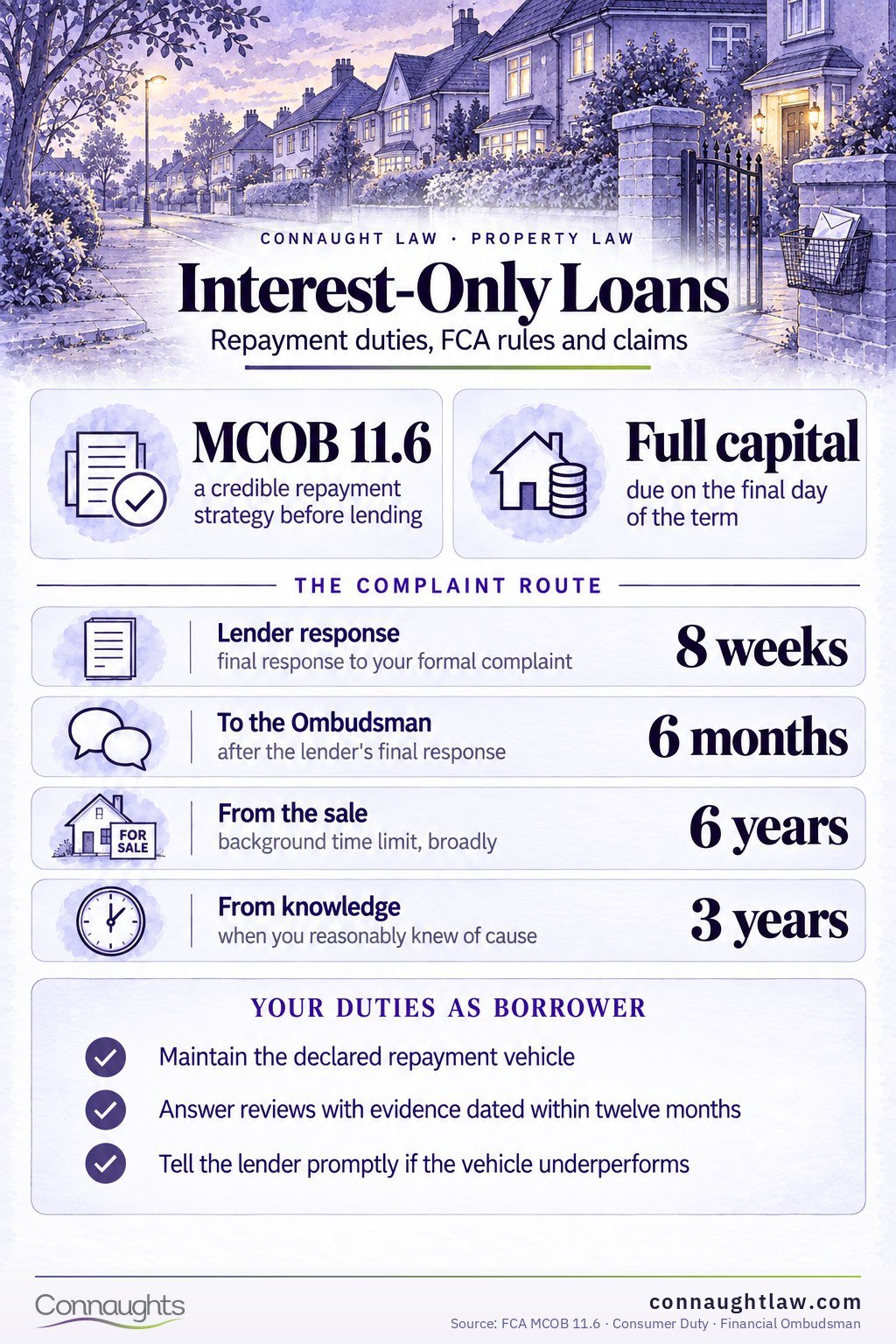
Under MCOB 11.6, a lender may only make an interest-only loan where there is a credible repayment strategy, assessed at the outset and checked at least once during the term. The Consumer Duty layers outcome obligations on top: the product must deliver fair value against alternatives and the lender must act to avoid foreseeable harm — including contacting borrowers approaching term without a visible repayment plan.
Lending Criteria in Practice
The rules do not fix numbers, but market criteria have hardened around them: loan-to-value ceilings commonly near 75%, minimum income thresholds frequently in the £75,000–£100,000 range, and — where sale of the mortgaged property is the declared strategy — substantial minimum equity requirements, often several hundred thousand pounds. These are lender policies rather than law, which means they move; what does not move is the requirement that the strategy be credible on evidence.
The Repayment Vehicle
What Lenders Accept
Accepted Repayment Vehicles
- Sale of the mortgaged property — accepted where the equity cushion is large enough to make downsizing realistic.
- Investment portfolios and endowments — evidenced by current statements, with performance risk sitting on you.
- Pension lump sums — typically the tax-free element, evidenced by provider projections.
- Savings plans, other property sales, or combinations — anything works on paper; what matters is documentation the lender will accept at review.
Evidence Standards
Lenders generally require evidence dated within the last twelve months: statements, professional valuations, provider confirmations, proof of ownership. Keep the file current on your own calendar rather than the lender's — a review demand answered late reads, in the lender's records, like a strategy that has stopped existing.
Interest-Only Against Repayment: The Arithmetic
A Worked Comparison
Worked Example Inputs
| Input | Value |
|---|---|
| Loan amount | £300,000 |
| Term | 25 years |
| Illustrative rate | 4.5% |
Results Comparison
On those inputs the interest-only payment is £1,125 a month against roughly £1,668 on repayment terms — £543 of monthly headroom, which is the product's entire attraction.
Total Cost Analysis
Over the full term the interest-only structure pays around £137,000 more in interest, because the capital never shrinks — and at year 25 the £300,000 is still owed in full. The cheaper month buys a more expensive mortgage and a debt that must be repaid from somewhere else.
Legal Considerations Summary
The arithmetic is why the law treats the repayment vehicle as the heart of the product: the structure only works if the vehicle does. Every legal obligation in this guide — verification, monitoring, evidence, the claims route — exists because that final balloon payment has historically gone unfunded.
Affordability Assessment
The Full-Term Test
Affordability is assessed against the interest payments AND the credibility of capital repayment — a lender cannot treat the loan as affordable merely because the monthly figure is low. Income, committed expenditure and the repayment strategy are tested together at application.
Stress Testing
Lenders must consider the effect of expected rate rises over at least the following five years, typically stressing the application at two to three percentage points above the initial rate. Borrowers who scraped through at the stressed rate should treat that as information about their own margin, not just the lender's box-ticking.
Consumer Duty
The Duty converts good practice into obligation: fair value against a repayment alternative, communications a borrower can actually act on, and proactive contact where the term end approaches without a funded strategy. For borrowers it also creates a paper trail — a lender that never asked, never reviewed and never warned has built the file a complaint is made from.
Your Obligations as Borrower
Monitoring the Vehicle
- Maintain the declared repayment vehicle — cancelling the endowment or raiding the ISA is a breach, not a private choice.
- Respond to review requests with current evidence.
- Notify the lender of material changes: income, the vehicle's performance, plans for the property.
- Track the vehicle against the balance yourself — annually, not at year twenty-four.
Reviews and Reporting
Expect at least one substantive mid-term review and increasing contact in the final years. Engagement is self-interested: the borrowers with options at term are the ones whose lenders knew the position early enough to extend, convert or re-plan.
Default Consequences
An unpaid balance at term is a default like any other: the lender can demand payment, refuse further extensions and ultimately seek possession. Courts expect lenders to have exhausted forbearance first — but forbearance is a negotiation, and it goes better two years before term than two months.
The 2025–26 Rule Changes
PS25/11 and the Wider Review
The FCA's mortgage rule review produced PS25/11, in force since 22 July 2025, simplifying advice requirements and easing remortgaging friction, with a continuing consultation programme examining whether interest-only availability should widen. The direction of travel is more flexibility at the point of sale — which makes the repayment vehicle discipline more important, not less, because easier access has historically been how the shortfall problem was built.
Market Response
Lenders have responded with cautious re-entry: more interest-only products at the affluent end, retirement interest-only for older borrowers, and hybrid part-and-part structures. The products differ; the legal spine — credible strategy, evidenced and monitored — is the same in each.
The Numbers
UK Finance's interest-only data recorded around 541,000 pure interest-only homeowner mortgages outstanding at the end of 2024 — down 18.5% in a year as the legacy book keeps shrinking — while FCA figures show some 257,000 borrowers used temporary interest-only arrangements under the Mortgage Charter between July 2023 and April 2025. Two different populations: a legacy problem being worked out, and a payment-relief tool being worked hard.
Enforcement
How the FCA Enforces
Supervision runs through thematic reviews of lenders' interest-only books, with enforcement concentrating on affordability failures at origination and inadequate monitoring during the term. The regulator's findings feed directly into individual complaints: a lender criticised in a thematic review defends the same conduct badly at the Ombudsman.
Protections for Borrowers
Borrowers hold three layers of protection: the mortgage conditions themselves, the MCOB rules and Consumer Duty standing behind them, and the Financial Ombudsman Service as the free adjudicator when the lender's answer disappoints. None of the layers acts by itself — each has to be invoked, in order, with evidence.
Interest-Only Mortgage Claims
Common Grounds for a Claim
- No credible repayment strategy ever existed — the box said "sale of property" or "investments" with nothing behind it.
- Affordability was assessed on the interest-only payment alone, ignoring the capital.
- The risks — endowment shortfall, rate rises, the balloon payment — were never explained.
- The lender failed to monitor or warn during the term despite obvious strategy failure.
- Consumer Duty breaches in recent conduct: unfair value, unusable communications, no term-end support.
The Complaint Route and Time Limits
The route is fixed: a formal complaint to the lender, which has eight weeks to give a final response, then the Financial Ombudsman within six months of that response. Background limits apply — broadly six years from the sale or three years from when you reasonably knew you had cause to complain — and they are argued hard in interest-only cases, because the shortfall often surfaces decades after the advice. Late knowledge is arguable; ignoring the six-month deadline after a final response usually is not.
Where Legal Help Changes the Outcome
The winnable claims are evidence cases: the original fact-find, the strategy declaration, the review correspondence — assembled into a timeline that shows what the lender knew and when. That is document work our property law team does alongside term-end options: bridging where a sale needs time, remortgaging through the lender panel, or negotiated extensions where the vehicle needs one more year. A claim and a plan usually work better than either alone — our real estate team runs both.
Frequently askedQuestions about interest-only mortgages
What are the main legal considerations with an interest-only mortgage?
The repayment vehicle obligations in the mortgage conditions, the lender's MCOB duty to verify and monitor a credible strategy, your duty to evidence it on request, and what the contract says happens at term. The monthly payment is the simple part; the capital promise is the legal one.
What repayment vehicles do lenders accept?
Sale of the property (with a substantial equity cushion), investments and endowments, pension lump sums, savings, other property, or combinations — all evidenced by documentation typically no more than twelve months old and kept current through the term.
What are the criteria for an interest-only mortgage now?
Lender policies commonly require loan-to-value near or below 75%, higher minimum incomes — frequently £75,000-plus — and a documented repayment strategy assessed at application. Criteria vary by lender and move with the market; the credible-strategy requirement is the constant.
Can I claim for a mis-sold interest-only mortgage?
Yes, where the loan was sold without a credible repayment strategy, affordability ignored the capital, or the risks were never explained. The route is a complaint to the lender, then the Financial Ombudsman within six months of the final response — with time limits that reward acting when the problem first surfaces.
What happens if my repayment vehicle underperforms?
Tell the lender promptly and re-plan: additional contributions, a part-conversion to repayment, a term extension, or an orderly sale strategy. Silence is the worst option — it wastes the years in which every fix is cheaper, and it weakens any later complaint.
What if my interest-only term is ending and I cannot repay?
Engage before the term date: lenders must consider forbearance, and options — extension, conversion, retirement interest-only, bridging to a sale — narrow with every month of silence. Take advice on both the options and whether the original sale supports a complaint.
Tell us when the term expires, what the outstanding balance is and what repayment vehicle was recorded at the outset. We will tell you what the lender can require of you and whether you have a complaint worth making.
Get Expert Advice