
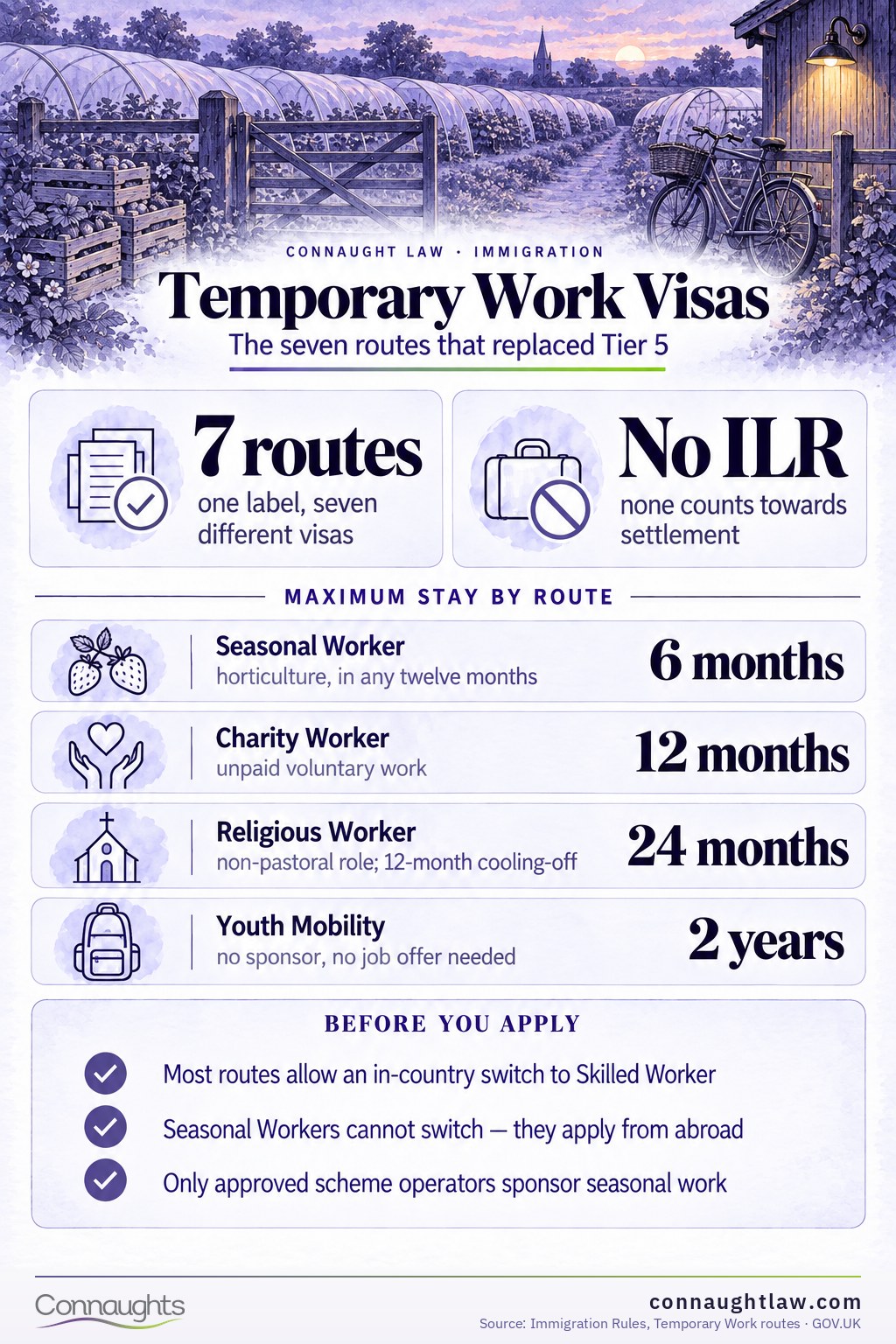
The UK's temporary worker visas are seven different routes wearing one label: Seasonal Worker, Creative Worker, Religious Worker, Charity Worker, Government Authorised Exchange, International Agreement and the Youth Mobility Scheme — the old Tier 5 family under its modern names. Each has its own duration, sponsor model and family rules, and none leads to settlement by itself. This guide maps all seven at the fees in force for 2026.
On This Page

One Label, Seven Different Visas
Temporary worker is a family name, not a visa — and choosing the wrong member of the family is the commonest error in this corner of the system. The routes share a shape: sponsorship (except Youth Mobility), fixed maximum durations, no settlement path, and a £340 application fee. They differ on everything else, from who can sponsor to whether your family can come — which is what the comparison below is for.
The Categories at a Glance
Temporary Worker Visa Categories Comparison
| Route | Maximum stay | Dependants | Core requirement |
|---|---|---|---|
| Seasonal Worker | 6 months (horticulture); seasonal poultry window | No | Approved scheme operator sponsorship |
| Creative Worker | 12 months, extendable to 24 | Yes | Creative contribution at industry standards |
| Religious Worker | 24 months | Yes | Non-pastoral religious role; 12-month cooling-off |
| Charity Worker | 12 months | Yes | Unpaid voluntary work; 12-month cooling-off |
| Government Authorised Exchange | 12–24 months by scheme | Yes | Approved training or research exchange scheme |
| International Agreement | 2 years (longer for some treaty roles) | Mostly yes | Work covered by international law or treaty |
| Youth Mobility Scheme | 2 years, +1-year extension for Australia, Canada, New Zealand | No | Eligible nationality, age 18–30 or 18–35 |
From Tier 5 to Today's Names
The Tier 5 label died in December 2020, but recruiters, sponsors and search boxes still speak it fluently. Translation is direct: Tier 5 (Temporary Worker) subcategories became today's named routes, and Tier 5 (Youth Mobility) became the Youth Mobility Scheme. Anyone told they need "a Tier 5" needs one of the routes on this page — the rules that matter are the current ones, not the old tier's folklore.
Seasonal Worker: Horticulture and Poultry
The scheme's two halves run on different clocks: horticulture workers stay up to six months in any twelve, while the poultry window runs to the year's end with its own application deadline. The government confirmed 43,000 horticulture and 2,000 poultry places for 2025, and allocations are set year by year — check the current year's announcement before planning recruitment around a number.
Scheme Operators and Conditions
Only a small panel of approved scheme operators can sponsor — individual farms cannot hold seasonal licences — and operators may not pass their fees to workers. Pay must meet at least the national living wage at the current rate, with premium rates for specified poultry roles. The route is deliberately closed-ended, as the gov.uk guidance sets out: no dependants, no switching in-country, and a cooling-off period between horticulture stints.
Creative, Religious and Charity Worker Visas
These three carry most of the family's professional traffic. Creative Workers — performers, artists, film crew — need sponsorship at industry-standard terms, with exemptions smoothing short engagements for touring professionals. Religious Workers take non-pastoral roles for up to 24 months, with a 12-month cooling-off before returning. Charity Workers give 12 months of genuinely unpaid voluntary service — the full route, including the £340 fee and £1,270 maintenance rule, is in our Charity Worker guide. All three permit dependants, and all three can be left for the Skilled Worker route from inside the UK when a qualifying sponsored offer appears.
Government Authorised Exchange and International Agreement
The Government Authorised Exchange route runs on approved schemes — internships, research placements, professional training — lasting 12 to 24 months depending on the scheme, with the scheme operator rather than the host employer sponsoring. The International Agreement route covers work the UK has promised to admit by treaty, from international organisation staff to private servants in diplomatic households, on terms set by the underlying agreement. Both are niche; both are also the only lawful door for exactly the people they cover.
Youth Mobility Scheme
The family's outlier: no sponsor, no job offer, just nationality and age. Nationals of participating countries aged 18–30 or 18–35 get two years of open work rights — extendable by a further year for Australians, Canadians and New Zealanders — for a £340 fee and £2,530 in savings, per the scheme rules. Some countries run capped ballots, so timing an entry matters. YMS holders can switch into sponsored routes in-country, which makes the scheme a genuine career on-ramp rather than a gap year.
Fees and Costs in 2026
Temporary Worker Visa Cost Breakdown
| Item | Amount | Paid by |
|---|---|---|
| Application fee | £340 | Applicant — all categories including Youth Mobility |
| Health surcharge | £1,035 per year | Applicant — stays over 6 months; Seasonal Workers exempt |
| Certificate of sponsorship | £55 | Sponsor |
| Temporary Worker sponsor licence | £611 | Sponsor |
| Priority services | £500 / £1,000 | Applicant — 5 working days / next working day, where offered |
Processing and Applying
Standard processing runs three weeks from outside the UK and up to eight weeks for in-country applications where the route permits them. Applications can go in up to three months before the certificate's start date, with entry allowed 14 days before work begins. None of these routes accrues settlement time — anyone whose UK plans outgrow their visa should plan a switch into a settlement-bearing route, mapped in our switching guide, rather than stacking temporary grants.
Application Requirements Checklist
- Passport and the certificate of sponsorship reference — valid three months from assignment (Youth Mobility needs no certificate).
- Maintenance: £1,270 held 28 days for sponsored routes, £2,530 for Youth Mobility, unless the sponsor certifies.
- TB certificate for listed countries; ATAS clearance for certain research placements.
- Dependant documents where the route allows family — and a route check first where it does not.
Sponsors on these routes carry the standard duties — reporting, record-keeping, genuine-role discipline — and our business immigration team acts for scheme operators and sponsored organisations as well as applicants. Anyone weighing a temporary route against a five-year plan should read the settlement requirements first and choose with the end in view.
Frequently askedQuestions about temporary worker visas
Can a temporary worker visa lead to permanent residence?
Not directly — no temporary route counts towards the five-year settlement clock. The path runs through switching in-country into a settlement-bearing route such as Skilled Worker, which most temporary categories (though not Seasonal Worker) permit with a qualifying sponsored offer.
What does a temporary worker visa cost?
£340 across the categories, including the Youth Mobility Scheme, plus the £1,035-a-year health surcharge for stays over six months — Seasonal Workers are exempt. Sponsors pay the £55 certificate and hold a £611 Temporary Worker licence.
How long can I stay?
By route: six months for seasonal horticulture, 12 months for Charity Workers, 12–24 for Creative Workers and exchange schemes, 24 for Religious Workers, two years on Youth Mobility with a one-year extension for Australians, Canadians and New Zealanders.
Can I bring my family?
On the Creative, Religious, Charity, Government Authorised Exchange and most International Agreement routes, yes — dependants apply with their own fees and surcharge. Seasonal Worker and Youth Mobility admit no dependants at all.
What is the Seasonal Worker quota?
Allocations are set annually — 43,000 horticulture and 2,000 poultry places were confirmed for 2025 on gov.uk. Check the current year's Defra announcement for the figure in force, and remember only approved scheme operators can sponsor.
Can I switch to a Skilled Worker visa?
From most temporary routes, yes — in-country, with a licensed sponsor, an eligible degree-level role and qualifying salary. Seasonal Workers are the exception and must apply from abroad. Time only starts counting towards settlement once the switch is granted.
Tell us the work, the timescale and who is coming with you. We'll match the route, confirm the sponsor position and — if the UK plan is really a long-term one — map the switch that starts the settlement clock.
Get Expert Advice