
Most people lawfully in the UK can switch into the Skilled Worker route without leaving the country — students, Graduate visa holders, temporary workers and business mobility transferees among them. A short list cannot switch at all, and everyone who can must clear the same July 2025 requirements: a degree-level role, the right salary, a licensed sponsor. This guide maps who switches, who applies from abroad, and how the process actually runs.
On This Page

Who Can Switch Into Sponsored Work
Switching is now the immigration system's main event: in the year ending December 2025 the Home Office granted 782,000 permissions to stay on work routes — people extending or switching in-country, up 12% — against 168,000 work visas issued from abroad, per the latest immigration statistics. For anyone already here with a sponsorship offer, the in-country switch is almost always faster, cheaper and lower-risk than leaving to apply — provided the current visa is on the right side of the eligibility line.
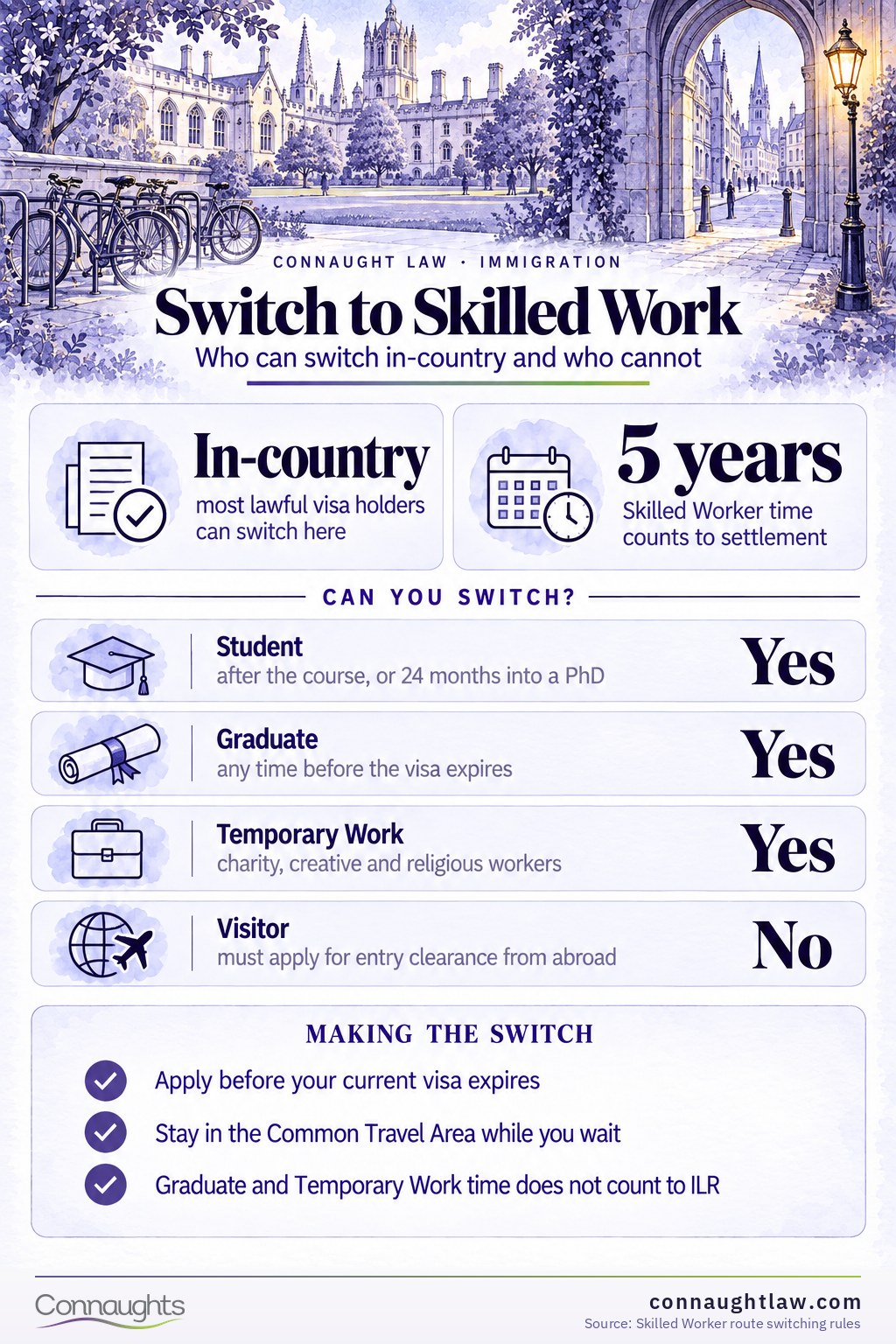
Eligible Categories in 2026
Students, Graduate visa holders, all Global Business Mobility routes, the Temporary Work routes (charity workers, creative workers, religious workers and the rest), International Sportsperson, Scale-up, High Potential Individual, Innovator Founder and Youth Mobility holders can all switch in-country. Visitors, short-term students, seasonal workers and parents of child students cannot — they apply for entry clearance from abroad.
Student and Graduate Route Switching
Study Routes Switching Table
| Current visa | When you can switch | New entrant discount | Sponsor's skills charge |
|---|---|---|---|
| Student | After course completion — or after 24 months of a PhD; the job starts after the course ends | Yes | Exempt, including later extensions |
| Graduate | Any time before the visa expires | Yes, within the four-year combined cap | Payable |
The mechanics of each are covered in depth in our student switching guide and Graduate route strategy guide — including the timing traps around course end dates and the shortened Graduate window. The Graduate route itself and the wider student visa changes have their own guides for readers a step earlier in the journey.
Business Mobility and Temporary Work Switchers
Global Business Mobility workers — Senior or Specialist Workers, Graduate Trainees and their siblings — switch routinely, converting time-limited transfers into a settlement-bearing status. So do the Temporary Work routes: the charity worker asking whether they can stay is asking a switching question, and the answer is yes with a qualifying sponsored offer, as our Charity Worker guide explains — the twelve-month visa cannot be extended, but it can be left for something permanent. International Sportsperson holders switch on the same basis.
Applying From Abroad Instead
Categories That Cannot Switch
Visitors, short-term students, seasonal workers, and parents on Parent of a Child Student visas must leave and apply for entry clearance. The bar is absolute — no job offer, salary or sponsor unlocks an in-country application from these categories. For a visitor with a UK offer, the practical path is entry clearance from home, usually decided within three weeks; attempting to negotiate the bar wastes months that the overseas application would have used productively.
The July 2025 Requirements
Switching applications meet the same tests as any Skilled Worker application: an eligible occupation at RQF Level 6 — or a listed exception — and salary at £41,700, the going rate, or a discounted floor the applicant actually qualifies for. Most switchers from study routes ride the new entrant discount to a £33,400 floor at 70% of the going rate; the full framework is in our salary guide and the requirements overview in our Skilled Worker hub.
What the Numbers Show
The same release puts new Skilled Worker entry clearance (outside health and care) at 48,000 main-applicant visas, down 36% year on year, while in-country permissions climbed to 782,000. The system is visibly tilting towards people already here converting status — which is exactly what a well-timed switch does, and why sponsors increasingly recruit from the domestic visa population first.
How the Switch Runs
- The sponsor assigns an in-country certificate of sponsorship — the "Skilled Worker (switching immigration category)" label sponsors see, marked ISC liable or ISC exempt.
- The skills charge falls on the sponsor: £480 then £240 per six months for small sponsors, £1,320 then £660 for larger ones — with student switchers exempt.
- Apply online before the current visa expires; in-country decisions typically arrive within 8 weeks, faster on paid priority.
- Do not leave the UK, Ireland, the Channel Islands or the Isle of Man while the application is pending — travel withdraws it.
Pathway Planning
A switch is also a clock decision: Skilled Worker time counts towards five-year settlement, while Graduate and Temporary Work time does not — so every month spent deciding is a month added to the settlement date. Switch timing interacts with the new entrant cap, course end dates and sponsor licence status, and the right sequence differs for a final-year student, a Graduate visa holder at month twelve, and a charity worker at month six. Our business immigration team plans the sequence with both the worker and the sponsor in the room.
Frequently askedQuestions about switching to the Skilled Worker route
Which visas can switch to Skilled Worker in-country?
Student, Graduate, all Global Business Mobility routes, the Temporary Work routes, International Sportsperson, Scale-up, High Potential Individual, Innovator Founder and Youth Mobility, among others. Visitors, short-term students, seasonal workers and parents of child students cannot.
Can I switch from a Tier 5 or charity visa?
Yes — the old Tier 5 categories are today's Temporary Work routes, and all of them can switch in-country with a qualifying sponsored job at the right skill and salary level. The twelve-month charity worker visa cannot be extended, but switching replaces it entirely.
What does "switching immigration category — ISC liable" mean?
It is the certificate label sponsors select for in-country switches, flagging whether the immigration skills charge applies. Most switches are ISC liable — £480 or £1,320 for the first year by sponsor size — but sponsoring someone switching from a Student visa is exempt.
Do switchers get the new entrant salary discount?
Students and Graduate visa holders usually do — 70% of the going rate with a £33,400 floor — subject to the four-year combined cap on Graduate and new entrant time. Other switchers qualify only if they fit a new entrant category, such as being under 26.
How long does an in-country switch take?
Typically up to 8 weeks from application to decision at the standard service, with paid priority options where available. Apply before the current visa expires and stay in the Common Travel Area throughout — leaving withdraws the application automatically.
What if my category cannot switch?
Apply for entry clearance from outside the UK — usually a three-week decision once documents are complete. The requirements are identical; only the location and the certificate type change. Attempting to switch from an ineligible category wastes the fee.
Tell us your current visa, the job on offer and its occupation code. We'll confirm whether you can switch in-country, which salary floor applies, and the sequence that starts your settlement clock soonest.
Get Expert Advice