
The Senior or Specialist Worker visa is the Tier 2 ICT visa under its Global Business Mobility name: intra-company transfers for established staff, now at a £52,500 salary threshold, with twelve months' overseas group employment unless pay reaches £73,900. It still leads nowhere permanent by itself — but unlike the old ICT rules, holders can now switch into the Skilled Worker route and start a settlement clock. This guide covers the 2026 position in full.
On This Page

The ICT Visa Under Its New Name
Search for "ICT visa" and this is the route you are looking for: the mechanism by which multinational groups post senior and specialist staff into their UK entities. The rebrand into the Global Business Mobility family changed more than the name — thresholds, duration ceilings and, most usefully, the ban on switching into settlement-bearing routes all moved. Old ICT instincts now mislead as often as they help.
What the Route Is
Core Purpose and Applications
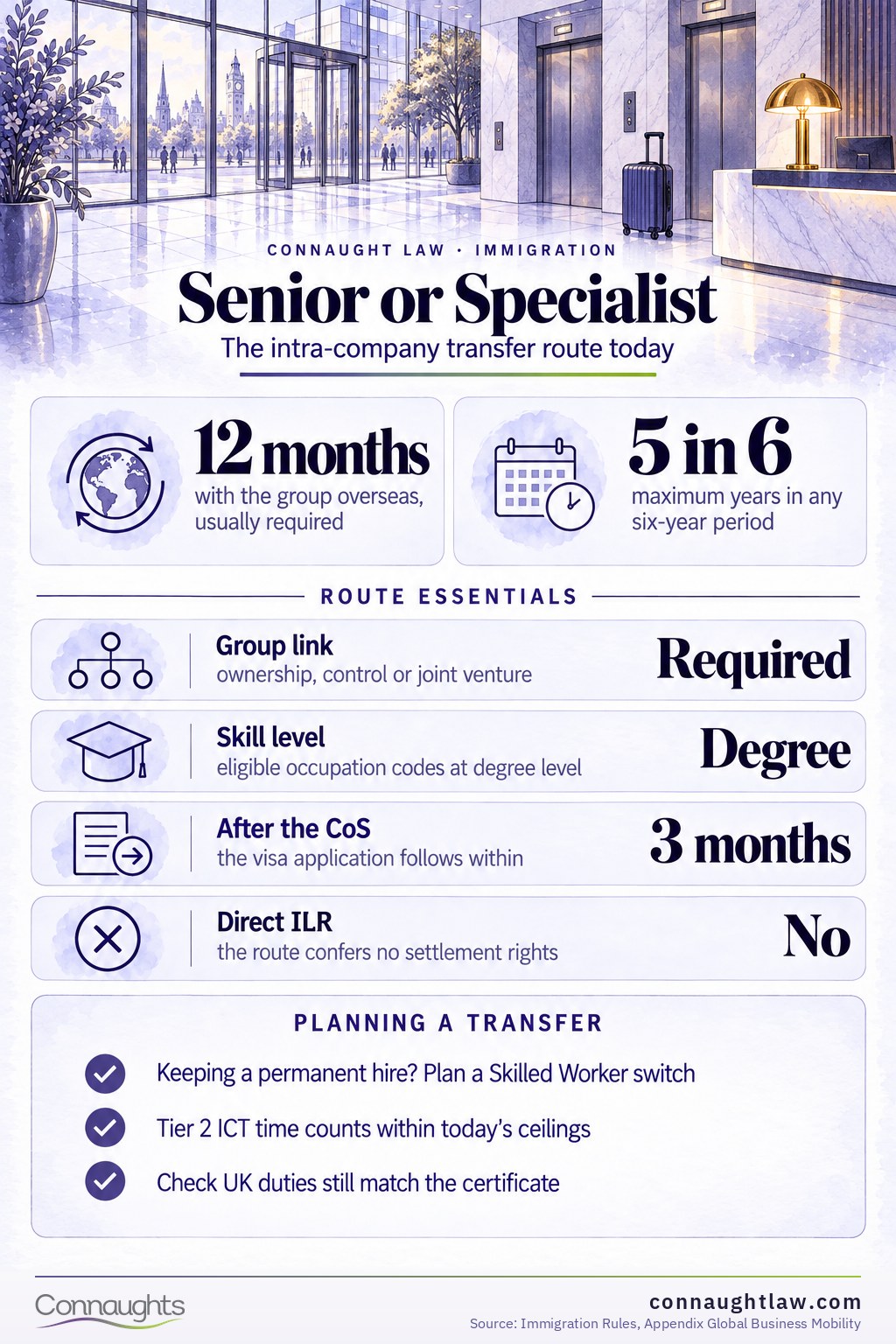
A sponsored transfer for existing group employees into a UK entity linked by ownership or control: twelve months' overseas employment with the group (waived at £73,900+ pay), a degree-level role paying £52,500 or the going rate, stays of up to five years in any six (nine in ten for high earners), and no direct settlement — though switching to Skilled Worker now opens that door.
Legal Framework and Compliance
The route runs under Appendix Global Business Mobility with its own caseworker guidance, and the compliance centre of gravity sits with the sponsor: group links evidenced, roles genuinely senior or specialist, salaries at the certificate figure. Transferees inherit the consequences of sponsor-side shortcuts, which is why the corporate paperwork deserves applicant-level attention.
From Tier 2 ICT to Global Business Mobility
Continuity for Existing ICT Holders
Time on Tier 2 ICT counts within today's duration ceilings, and long-serving transferees carry their history into the current framework. The practical translation questions — how much headroom remains under the five-in-six cap, whether the high-earner nine-year ceiling applies, when a switch beats another extension — are arithmetic on dates and salary, best done before assignment renewals are promised.
ICT and Current Route Compared
| Aspect | Tier 2 ICT | Senior or Specialist Worker |
|---|---|---|
| Framework | Points-based Tier 2 | Appendix Global Business Mobility |
| Salary threshold | £48,500 at closure | £52,500 since 22 July 2025 |
| Settlement | None, and switching barred | None directly — switching to Skilled Worker permitted |
| Duration | Cooling-off rules | 5 years in 6, or 9 in 10 at £73,900+ |
The 2025 Changes
Fee Structure Changes
Application fees now run £819 for up to three years and £1,618 for longer from outside the UK, or £943 and £1,865 in-country, plus the £1,035-a-year health surcharge — figures per person, dependants included. Employers pay the £525 certificate, and the immigration skills charge applies with a narrow exemption for certain intra-company moves set out on the skills charge page.
Salary Threshold Adjustments
The 22 July 2025 uplift took the floor from £48,500 to £52,500, applied without transitional relief to new applications — assignments priced under the old figure needed repricing, not arguing. The threshold is the floor, not the test: the occupation code's going rate governs where it runs higher.
Eligibility Requirements
Employment History and Experience
Twelve continuous months with the group outside the UK immediately before applying — the rule that separates genuine transfers from opportunistic hires — waived entirely where UK pay will reach £73,900. The link between overseas employer and UK sponsor must be corporate (ownership, control or joint venture), evidenced in the sponsor's records rather than asserted.
Skill Level and Occupation
Roles must sit in eligible occupation codes at degree level, same as the wider system since July 2025 — the skill-level logic is identical to the RQF Level 6 rules, assessed on the code, not the transferee's certificates. Senior job titles do not exempt junior duty descriptions; the certificate's duties decide the code and the code decides everything else.
Financial Requirements and Maintenance
£1,270 held for 28 days unless the sponsor certifies maintenance — and for corporate transfers the sponsor certifying is the professional norm. Dependants carry their own maintenance figures unless certified alongside.
Applying and Timelines
Certificate of Sponsorship and Sponsor Requirements
The UK entity assigns the certificate under its Global Business Mobility licence; the application follows within three months. Where a group lacks a UK licence entirely, the UK Expansion Worker route exists for first-footprint scenarios — a different tool for a different corporate moment, compared across our routes directory.
Documentation Standards
Applicant documents are standard — passport, certificate reference, TB certificate where applicable. The route-specific evidence is the employment history: twelve months of group payroll that survives verification. Gaps, agency interludes and entity changes within the group are where transfers stall, and where pre-application checking pays for itself.
Fees and Processing Times
| Item | Up to 3 years | Over 3 years |
|---|---|---|
| Fee — applying outside the UK | £819 | £1,618 |
| Fee — applying inside the UK | £943 | £1,865 |
| Health surcharge | £1,035 per year, per person | |
| Standard decision | 3 weeks overseas · 8 weeks in-country | |
Implications for Businesses
Planning for Talent Mobility
The old "ICT to ILR" question has a new answer: the route itself still yields no settlement, but a transferee the business wants to keep can switch into the Skilled Worker route in-country — our switching guide covers the move — and the five-year clock in our settlement guide starts from that grant. Plan the switch early for anyone who is really a permanent hire.
Compliance and Risk Management
Groups running rotating transfer programmes should track each transferee's ceiling arithmetic, keep group-structure evidence current, and audit that UK duties match certificates as roles evolve. The same licence carries every route the group uses, so a compliance failure on one transfer programme endangers all of them — the standing reason our business immigration team reviews GBM programmes as systems rather than as individual visas.
Frequently askedQuestions about the Senior or Specialist Worker visa
What replaced the Tier 2 ICT visa?
This route — Senior or Specialist Worker, within the Global Business Mobility framework since 2022. The intra-company mechanics survived; the salary threshold, duration ceilings and switching rules all changed, mostly in ways that reward checking the current rules over ICT memory.
What is the minimum salary in 2026?
£52,500 or the occupation code's going rate, whichever is higher — raised from £48,500 on 22 July 2025 with no transitional relief. Pay of £73,900 or more also waives the twelve-month overseas employment requirement and unlocks the longer duration ceiling.
How long can I stay?
Up to five years in any six-year period, or nine years in any ten for high earners at £73,900+. Tier 2 ICT time counts within those ceilings, so long-serving transferees should check their remaining headroom before renewal promises are made.
Can I get ILR from this visa?
Not directly — the route confers no settlement rights. The path is switching in-country to a Skilled Worker visa, which the old ICT rules prohibited and the current rules allow; settlement then follows five qualifying years on that route.
What does it cost?
£819 or £1,618 from overseas by length of stay, £943 or £1,865 in-country, plus £1,035 a year in health surcharge per person. The sponsor pays the £525 certificate and, in most cases, the immigration skills charge.
What employment history do I need?
Twelve continuous months with the corporate group outside the UK immediately before applying, in an entity linked to the UK sponsor by ownership, control or joint venture. The requirement is waived entirely where the UK salary is £73,900 or more.
Tell us the group structure, the transferee's salary and history, and how long the assignment really is. We'll confirm the route, the ceiling arithmetic, and whether a Skilled Worker switch serves everyone better.
Get Expert Advice