
The Graduate Trainee visa moves a multinational's own graduates through the UK leg of a structured training programme: three months' overseas employment with the group, a £27,300 salary or 70% of the going rate, and a stay capped at 12 months. It is a rotation visa, not an immigration route — no settlement path, no in-country switching in, and a five-years-in-six ceiling shared across the Global Business Mobility family. This guide covers the 2026 rules end to end.
On This Page

Training Placements Inside the Corporate Family
Every Graduate Trainee application tells the same story: a graduate on a multinational's structured development programme, employed by the group overseas, posted to the UK entity for the programme's British rotation. The route on gov.uk exists for exactly that story and resists every other — it is routinely confused with the post-study Graduate visa, and the two share nothing but a word.
Three months' employment with the corporate group overseas immediately before applying; a structured graduate programme role paying £27,300 or 70% of the going rate; a stay of up to 12 months applied for from outside the UK; and a five-years-in-six ceiling shared with the other Global Business Mobility routes. No settlement path attaches at any point.
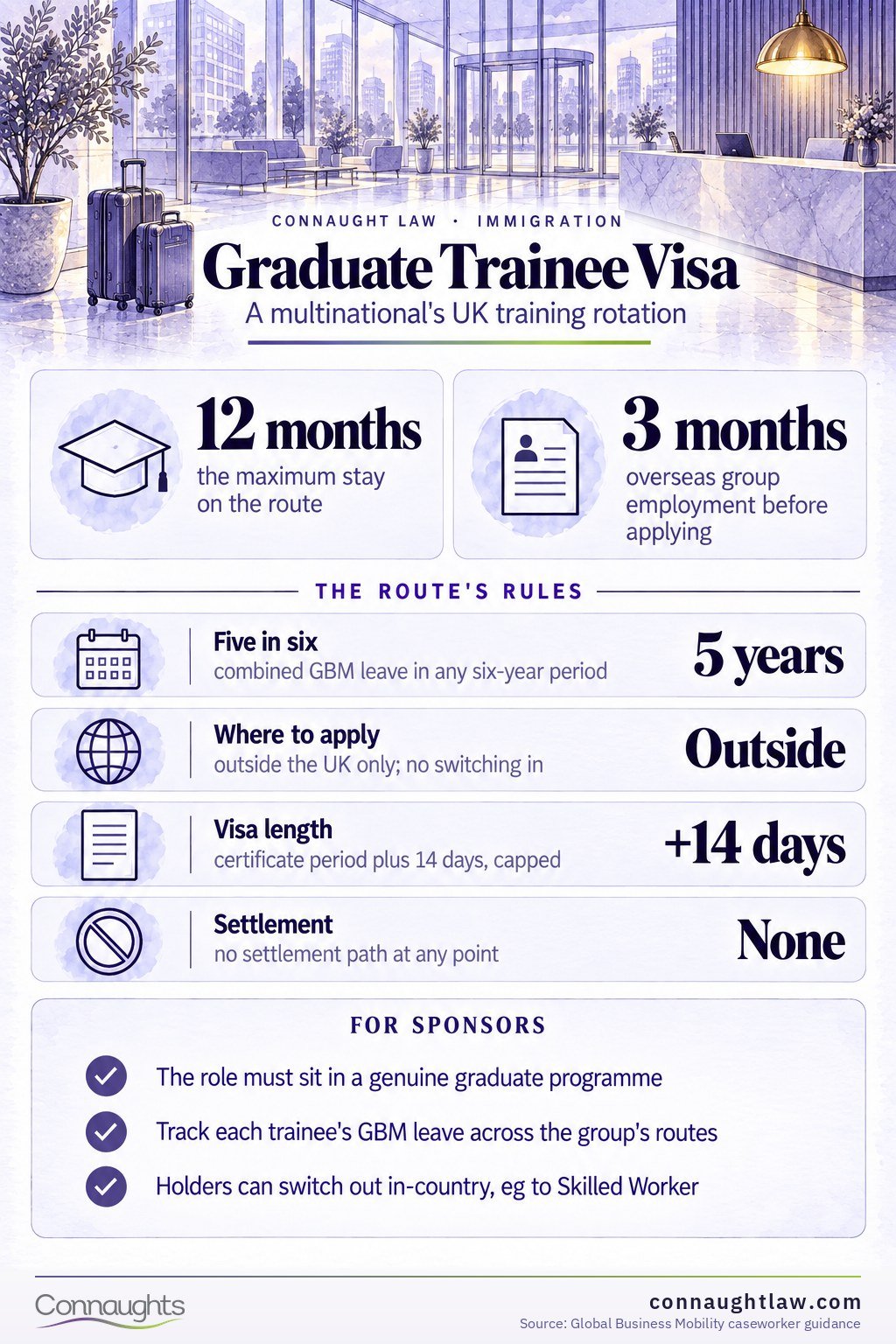
What the Graduate Trainee Visa Is
Purpose and Training Programme
The sponsored role must sit inside a genuine graduate development scheme aimed at a managerial or specialist position — with rotations, objectives and progression the sponsor can evidence. A UK posting that is simply a junior job with the word "programme" attached fails the point of the route, and caseworkers read training-programme descriptions with exactly that suspicion.
The Global Business Mobility Framework
Graduate Trainee is one of five Global Business Mobility routes for moving people within corporate groups — alongside the Senior or Specialist Worker and UK Expansion Worker routes and the service supplier and secondment variants. The family shares plumbing: sponsorship by the UK entity, qualifying corporate links to the overseas employer, and a combined cap of five years' GBM leave in any six-year period.
What Changed in 2025
Salary Threshold Adjustments
The 22 July 2025 changes lifted the route's flat threshold to £27,300, keeping the structure — flat floor or 70% of the occupation's going rate, whichever is higher, with full going rates for listed health and education roles. For most genuine graduate programmes the salary test is comfortably met; it bites where groups try to run the route on stipend-level pay.
Administrative and Compliance Updates
The wider GBM tightening — closer certificate scrutiny, group-link evidence, genuine-programme checks — arrived through the GBM caseworker guidance rather than headline rules. Sponsors should assume the training programme itself, not just the salary line, will be read.
Requirements Before and After
| Requirement | Before | Now |
|---|---|---|
| Flat salary floor | £25,410 | £27,300 |
| Going-rate leg | 70% | 70% — unchanged |
| Overseas employment | 3 months | 3 months — unchanged |
| Maximum stay | 12 months | 12 months — unchanged |
Eligibility in Detail
Employment and Training Requirements
The applicant must have worked for the sponsor group outside the UK for at least three months immediately before applying, in an entity linked to the UK sponsor by ownership, control or joint venture. The three months are strict and continuous — a programme that hires graduates and posts them to London in month two has built a refusal into its own design.
Sponsorship and Certificate Requirements
The UK entity holds the GBM sponsor licence and assigns a certificate stating the role, the going-rate occupation code and the training programme context. Applications are made from outside the UK only — there is no switching into this route in-country — and the visa runs to the certificate period plus 14 days, capped at 12 months.
Financial and Maintenance Requirements
The standard maintenance rule applies: £1,270 held for 28 days unless the sponsor certifies support on the certificate — which, for corporate programmes, it almost always should. The application fee is £340, with the £1,035-a-year immigration health surcharge on top for the applicant and each dependant.
How It Compares
Graduate Trainee vs Senior or Specialist Worker
Same family, different ends of a career: the Senior or Specialist route moves established professionals at a £52,500 threshold for up to five years; Graduate Trainee moves early-career staff at £27,300 for one. Groups often use both in sequence — the trainee returns overseas, gains seniority, and comes back years later on the senior route or, better, on a settlement-bearing Skilled Worker sponsorship.
Against the Post-Study Graduate Visa
The names collide; the routes do not. The Graduate visa is for international students finishing UK degrees — unsponsored, no salary rules. Graduate Trainee is for a multinational's existing overseas employees. Recruiters advertising "graduate trainee visa sponsorship" to UK graduates are, at best, confused — and the confusion wastes application fees.
Routes Compared
| Aspect | Graduate Trainee | Senior or Specialist | Graduate visa |
|---|---|---|---|
| Who it serves | Group graduates on training rotations | Experienced intra-group transferees | UK degree completers |
| Salary rule | £27,300 / 70% going rate | £52,500 / going rate | None |
| Maximum stay | 12 months | 5 years in 6 | 2 years now; 18 months from 2027 applications; 3 for PhDs |
| Settlement | No path | No path | No path — switch out |
Applying in Practice
Certificate of Sponsorship and Documents
The bundle is corporate-light: passport, certificate reference, evidence of the three months' group employment, maintenance unless certified, and TB certificate where the country of application requires one. The heavy documentation — group structure, programme design, going-rate mapping — lives on the sponsor's side and should be settled before any certificate is assigned.
Processing Times and Decisions
Entry clearance decisions usually arrive within three weeks of biometrics, with paid priority services in most posts. Programmes should sequence UK rotations with that timeline plus contingency — a cohort's start date is corporate scheduling, but each visa is an individual application capable of individual delay.
Dependants and Family
Partners and children can accompany the trainee, each paying the fee and surcharge, with work and study rights while here. For one-year rotations many families sensibly stay put — but the entitlement exists, and for trainees with working partners the dependant's open work rights can make the UK year financially viable.
Strategic Implications for Businesses
Programme Design Considerations
The route rewards programmes designed around its rules: overseas hires seasoned for three months or more before rotation, UK legs of a year or less, salaries set against the going rate for the actual occupation code, and the five-in-six GBM ceiling tracked per trainee across the group's routes. Designed late, each of those becomes a per-cohort emergency instead.
Cost Analysis and Budget Planning
Per trainee, budget the £340 fee, the surcharge, certificate costs and the salary floor — and weigh the alternative: a Skilled Worker sponsorship costs more but buys longer stays, settlement prospects and retention. For genuine rotations the Graduate Trainee route is cheaper and cleaner; for de facto permanent hires it is the wrong tool, as our business immigration team regularly ends up explaining after the fact. The full menu of sponsored options sits in our routes directory.
Frequently askedQuestions about the Graduate Trainee visa
What is the minimum salary in 2026?
£27,300 a year or 70% of the going rate for the occupation code, whichever is higher — with full going rates for listed health and education roles. The threshold rose from £25,410 with the 22 July 2025 changes.
How long can I stay?
Up to 12 months, or the certificate period plus 14 days if shorter. The route cannot be extended beyond that, and time counts towards the five-years-in-any-six ceiling shared across the Global Business Mobility routes.
What employment history do I need?
At least three continuous months working for the sponsor group outside the UK immediately before applying, in an entity linked to the UK sponsor by ownership, control or joint venture, as part of a structured graduate programme.
Can I switch to this visa inside the UK?
No — Graduate Trainee applications are made from outside the UK only. Holders already here can, however, switch out of the route in-country, including into the Skilled Worker route with a qualifying sponsored offer.
Is this the same as the Graduate visa?
No. The Graduate visa is the unsponsored post-study route for people completing UK degrees. The Graduate Trainee visa is a sponsored Global Business Mobility route for a multinational's own overseas employees on training rotations.
What does it cost?
£340 per applicant plus the £1,035-a-year immigration health surcharge, with maintenance of £1,270 unless the sponsor certifies it. Dependants pay their own fees and surcharge; certificate and licence costs sit with the sponsoring employer.
Tell us the programme structure, the cohort's overseas employment dates and the salaries on offer. We'll confirm the route fits, the codes and rates that apply, and the timeline that lands the cohort on schedule.
Get Expert Advice