
The Skilled Worker visa is the UK's main sponsored work route: a licensed employer, a job at degree level, a salary of at least £41,700 or the role's going rate, and English at B2 (B1 for workers whose current Skilled Worker permission was granted at B1). Since 22 July 2025 the skill bar sits at RQF Level 6, with two lists keeping selected mid-skill roles alive. This guide covers the requirements as they stand in 2026 — points, salary, fees, process and the road to settlement.
On This Page

The Sponsored Route Most Workers Use
Every Skilled Worker application stands on the same four legs: a sponsor with a licence, a job that clears the skill bar, a salary that clears the money bar, and English. The route on gov.uk runs in five-year cycles with settlement at the end — which is why it remains the destination visa even after the 22 July 2025 tightening moved the goalposts on skill and salary.
Who Qualifies
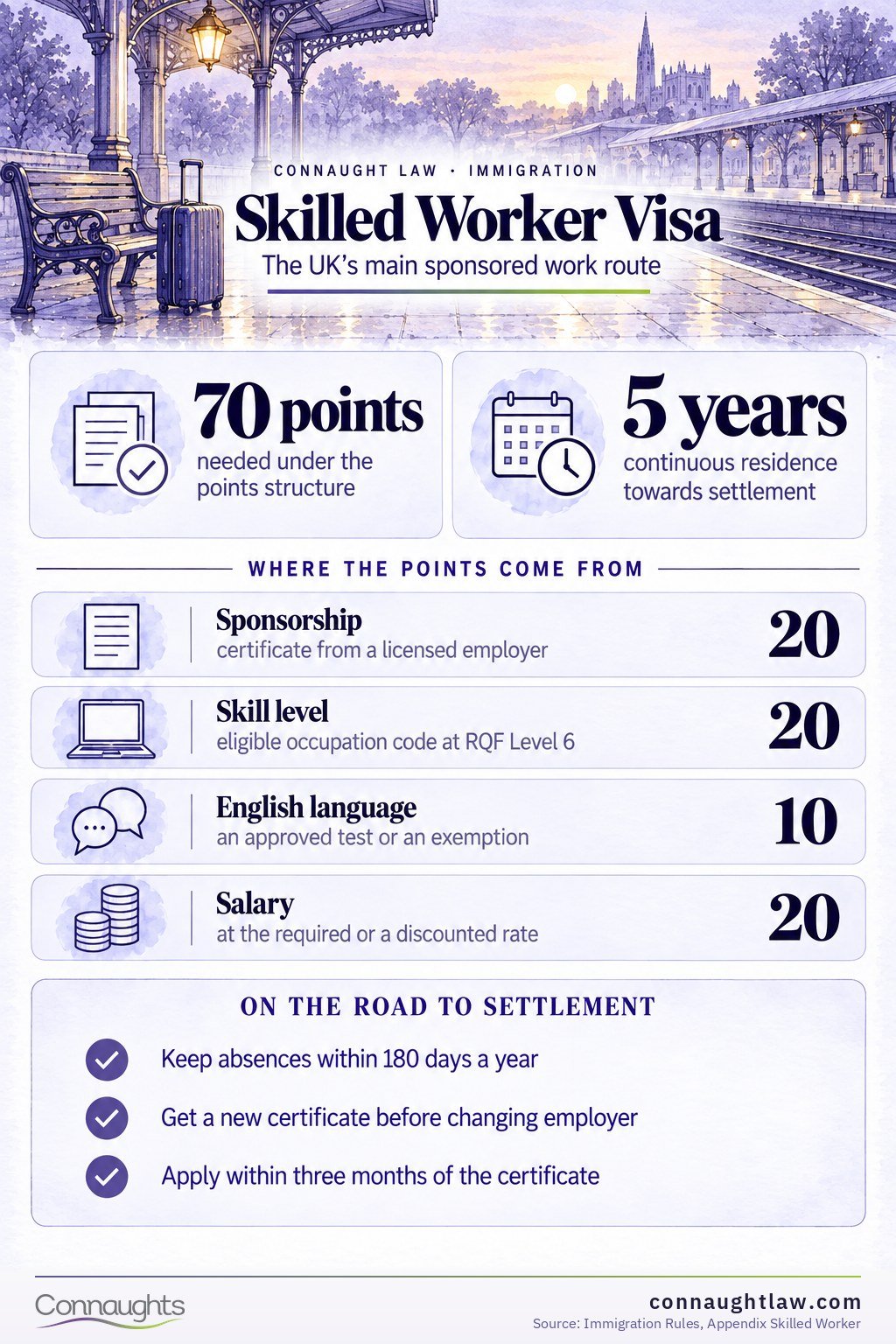
Mandatory Points
Skilled Worker Points Breakdown
| Element | Points | What it requires |
|---|---|---|
| Sponsorship | 20 | A certificate of sponsorship from a licensed employer |
| Skill level | 20 | A job in an eligible occupation code at RQF Level 6, or a listed mid-skill role |
| English language | 10 | B2 on an approved test (B1 if already sponsored at B1), or an exemption |
| Tradeable points | 20 | Salary at the required level — full rate, or a discounted rate you qualify for |
English Language and Its Exemptions
B2 — required since 8 January 2026 — is proved by an approved test, a UK degree, or a degree taught in a majority-English-speaking country confirmed by Ecctis. Nationals of listed majority-English countries are exempt altogether. The requirement is met once — a worker who proved English on a previous grant does not prove it again on extension.
Salary Thresholds at a Glance
The general threshold is £41,700 a year or the occupation's going rate, whichever is higher. Discounts exist, but every one keeps its own floor — the full mechanics, going-rate tables and worked examples live in our salary requirements guide, which is the post to open before relying on any figure here in an offer negotiation.
New Entrant Reductions
New entrants — under-26s, recent graduates, Graduate visa holders and those training towards a regulated profession — qualify at 70% of the going rate with a £33,400 floor, for a maximum of four years in the status. It is the standard bridge from student status into sponsored work, priced for early-career salaries.
PhD Discounts
A PhD relevant to the job earns a 90% going-rate discount with a £37,500 floor; a STEM PhD deepens that to 80% with £33,400. Listed postdoctoral research roles carry their own 70% provision. The doctorate must genuinely relate to the role — the discount is assessed, not self-certified.
Occupation Codes and Skill Level
Every role maps to a four-digit occupation code, and the code decides everything: whether the job is eligible, what its going rate is, and which discounts can attach. Sponsors who pick a code by job title rather than actual duties build refusals into their own certificates — the classic example being construction, where bricklayers, roofers and carpenters are eligible and general labourers are not.
What RQF6 Removed and the Lists That Soften It
From 22 July 2025 new applicants need a job at RQF Level 6 — degree level — which removed a swathe of mid-skill roles from the route. Two safety valves remain: mid-skill jobs on the Immigration Salary List or the interim Temporary Shortage List stay sponsorable, and workers already sponsored in affected roles before the change keep their position for extensions and employer moves. The sector-by-sector fallout — who lost eligibility and who kept it — is mapped in our RQF Level 6 guide.
Applying Step by Step
The Certificate and the Employer's Side
The sponsor assigns a certificate of sponsorship stating the role, code and salary — the application's foundation document, covered in detail in our certificate of sponsorship guide. The application must be made within three months of assignment, and errors on the certificate are the sponsor's to fix by reissuing before submission, not the applicant's to explain after refusal.
Documents on the Applicant's Side
- Passport and the certificate of sponsorship reference number.
- English evidence: test certificate, degree confirmation or exempt nationality.
- £1,270 in savings held for 28 consecutive days (day 28 within 31 days of applying), unless the sponsor certifies maintenance or you have been in the UK for 12 months.
- TB certificate where the country of application requires one; criminal record certificate for listed occupations.
Timelines and Outcomes
Standard processing runs three weeks for entry clearance and eight weeks for in-country applications, with paid priority services where available. The fee depends on length and location: from £819 outside the UK (£1,618 over three years) and £943 inside (£1,865 over three years), with discounted rates of £628 and £1,235 for Immigration Salary List roles — plus the £1,035-a-year health surcharge in every case.
If the Application Is Refused
Most refusals trace to the certificate: wrong code, salary below the applicable threshold, or sponsor-side compliance doubts. Administrative review challenges caseworking errors but cannot cure genuine ineligibility; where the defect is a missing or wrong-format document, the evidential flexibility rules occasionally rescue a file. The better path is diagnosing the true failure point — often a reissued certificate and a fresh application beats any challenge.
From Visa to Settlement
Five years of continuous Skilled Worker residence, absences within 180 days a year, ongoing sponsored employment and the settlement tests open indefinite leave to remain — the detail lives in our Skilled Worker settlement guide. Along the way, moves between sponsors are routine but procedural: a change of employer needs a new certificate and application before the switch, and workers arriving from other routes plan the timing through our switching guide. Partners and children under 18 can join throughout, with their own fees and surcharge.
Frequently askedQuestions about the Skilled Worker visa
What salary do I need in 2026?
£41,700 a year or your occupation code's going rate, whichever is higher. New entrants qualify at £33,400 with a 70% going-rate discount, relevant PhDs at £37,500 (90%), STEM PhDs at £33,400 (80%), and Immigration Salary List roles at £33,400 with the full going rate.
What does the visa cost?
From £819 for up to three years applied for overseas (£1,618 for longer), or £943 and £1,865 in-country, with £628 and £1,235 discounts for Immigration Salary List roles — plus the £1,035-a-year immigration health surcharge and £1,270 maintenance unless certified.
Does my job need a degree-level code?
Since 22 July 2025, yes — RQF Level 6 — unless the role sits on the Immigration Salary List or the Temporary Shortage List, or you were already sponsored in the role before the change and are extending or moving employer within it.
How long does a decision take?
Usually three weeks for applications made outside the UK and eight weeks inside, once identity and documents are complete. Priority services shorten both where offered. The three-month validity of the certificate of sponsorship sets the overall clock.
Can my family come with me?
Partners and children under 18 apply as dependants with their own fees and health surcharge. Dependants can work — except as professional sportspeople — and study, and they build their own five-year path towards settlement alongside yours.
What happens after five years?
You can apply for indefinite leave to remain if you have kept continuous residence within the absence limits, remain sponsored in a qualifying role, and pass the English and Life in the UK requirements. Citizenship typically follows twelve months later.
Tell us the occupation code, the salary on offer and when the certificate of sponsorship was assigned. We'll tell you which threshold applies, whether the role survives the RQF6 rule, and what the application must evidence.
Get Expert Advice