
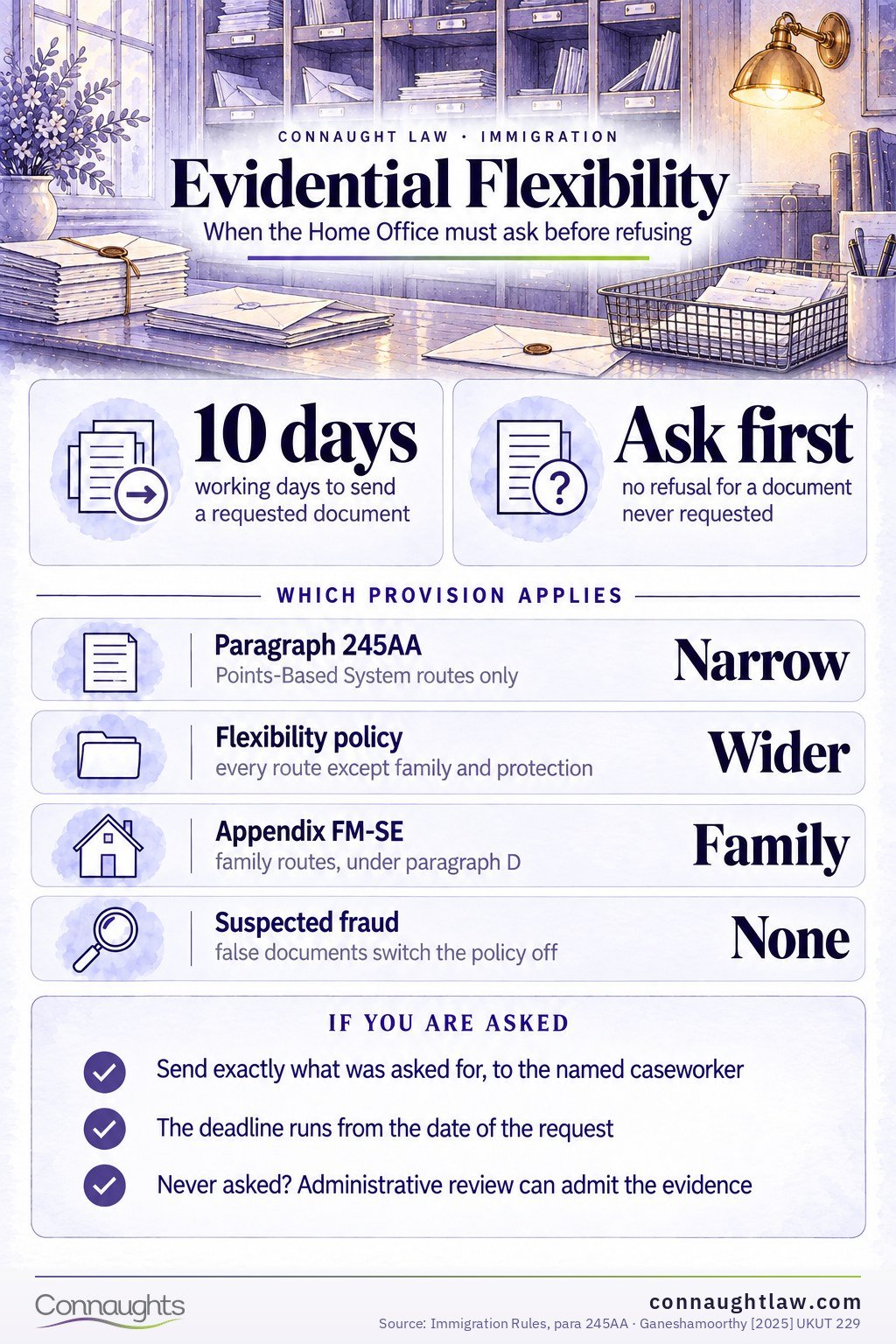
Evidential flexibility is two things wearing one name. Paragraph 245AA of the Immigration Rules is narrow and reaches only Points-Based System applications. The Home Office guidance of the same name is much wider, reaches almost every other route, and covers documents you never sent at all. Which one applies decides whether a caseworker should have written to you before refusing — and, if they should have, whether an administrative review can now put that right.
On This Page

Two Systems, Not One
The confusion in this area is structural rather than accidental. There is a rule and there is a policy, they were once close to identical, and they are not close to identical any more. A refusal that looks unfair often turns on which of the two the caseworker was obliged to follow, and applicants routinely argue the wrong one.
The Upper Tribunal put the distinction beyond argument in 2025. Paragraph 245AA continues to apply only to Points-Based System applications. The published guidance applies to every route except the family rules in Appendix FM, protection claims under Part 11, and Appendix Victims of Domestic Abuse. The two are, in the tribunal's words, no longer coterminous.
Quick answer — which one applies to you
If you applied under a Points-Based System route, both the rule and the guidance are engaged. If you applied under almost any other route, only the guidance applies, and it is wider. If you applied under Appendix FM, neither applies and a separate provision in Appendix FM-SE governs instead.
The Guidance and What It Requires
The current evidential flexibility guidance was published for Home Office staff on 10 June 2026, and its cover page numbers it version 12.0. It replaced the January 2021 version, and the June change was made to reflect the position of applications under Appendix Victims of Domestic Abuse, which is now excluded along with Appendix FM and protection claims.
The obligation it creates is stated as a norm, not a discretion. Where it appears that an applicant has made an error with, or omitted, supporting evidence, or where further information or verification is needed to decide the case, the caseworker should normally provide an opportunity for that to be supplied. The guidance gives two examples: where evidence is missing that the applicant has or could obtain, and where evidence is inadequate but could be clarified.
Ten working days — not seven, and not calendar days
When information is requested under evidential flexibility, the caseworker must ask for it within ten working days. The same period appears in paragraph 245AA. It is not seven days, and it is working days rather than calendar days — a distinction worth checking against whatever the request letter actually says.
Two prohibitions matter more than the rest, because they are the grounds on which refusals are most often successfully challenged. A caseworker must not refuse an application because the applicant has not provided a specific document if the applicant was not asked to provide it. And a caseworker must not refuse because evidence is not in a particular format. Neither is qualified.
The policy switches off entirely where false information or false documents are suspected, or where material facts have not been disclosed. In those cases the caseworker is directed to the suitability guidance instead, which is a different and considerably less forgiving exercise. Part Suitability sets out where that leads.
Paragraph 245AA and What It Reaches
Paragraph 245AA is still in force in Part 6A, and it is narrower than most descriptions of it. It bites only where Part 6A or an appendix referred to in Part 6A specifies documents. In practice that means the legacy Points-Based System routes, and it does not reach the newer appendix-based routes on its own force.
Its mechanism is precise. Where the applicant has submitted the specified documents but specified evidence is missing from them, or a document is in the wrong format, or a document does not contain all the specified information, the decision maker may write and request the correct documents, which must be received within ten working days. It does not reach a document that was never submitted at all.
Two further limbs are worth knowing. Documents will not be requested where the decision maker does not think that supplying them will lead to a grant, because the application will be refused for other reasons anyway. And where the missing information is verifiable from other documents provided or from elsewhere, the decision maker may grant the application despite the error, if satisfied every other requirement is met.
Three Provisions Compared
| Provision | Which applications | Time to respond |
|---|---|---|
| Paragraph 245AA | Points-Based System routes only — where Part 6A or an appendix referred to in it specifies documents | 10 working days |
| Evidential flexibility guidance | All routes except Appendix FM, Part 11 protection claims and Appendix Victims of Domestic Abuse | 10 working days |
| Appendix FM-SE paragraph D | The family routes governed by Appendix FM | A reasonable timescale specified in the request |
The family route provision deserves a word of its own, because applicants under Appendix FM are frequently told that evidential flexibility does not exist for them. It does; it simply lives elsewhere. Appendix FM-SE paragraph D covers omitted sequences of documents, wrong formats and incomplete documents, and unlike paragraph 245AA it expressly reaches a specified document that was not submitted at all.
What the Courts Have Decided
The governing decision is Ganeshamoorthy [2025] UKUT 229 (IAC), promulgated on 30 June 2025. It held that the policy applies to all routes other than Appendix FM and protection routes; that paragraph 245AA continues to apply only to Points-Based System applications; and that the two are no longer coterminous, the policy applying to more types of application. It construed the January 2021 version, and the wording it relied on is carried into the current one.
Two of its findings do the practical work. Unlike paragraph 245AA and the older versions of the policy, the current guidance applies to documents which were omitted from an application. And the caseworker must consider not only whether missing information exists but whether the applicant could obtain it — a lower bar for the applicant than the old requirement that the caseworker have reason to believe the document was already held.
No error, no policy — the limit set in 2026
In Singh [2026] EWCA Civ 766, decided on 22 June 2026, the Court of Appeal held that the policy applies where the applicant has made an error with, or omitted, supporting evidence. Where there was no valid criticism of how the form was completed, the policy had no application at all and there was no failure to follow it.
Behind both sits Mandalia [2015] UKSC 59, which is why any of this is enforceable. The Supreme Court held that where a public authority has adopted a practice representing how it proposes to act, the law requires that practice to be honoured unless there is good reason not to — a requirement of good administration, not of legitimate expectation. It remains good law and is still being applied.
One citation circulates in a form that will not survive scrutiny. Rodriguez (Flexibility Policy) is [2013] UKUT 42 (IAC), not [2014], and it was overturned by the Court of Appeal in SSHD v Rodriguez [2014] EWCA Civ 2 on 20 January 2014. It is not good law, and Mandalia did not restore it.
Being Contacted for a Missing Document
A request under evidential flexibility is an opportunity with a short life. It will specify what is wanted and where it must be sent, and the ten working days run from the date of the request rather than from the date you read it. Sending the document to a general address, or to a caseworker who is not the one named, is the most common way a compliant applicant still gets refused.
Send exactly what was asked for, and send it whole. Where a bank statement sequence is incomplete, supply the sequence rather than the missing page in isolation. Where a letter was rejected for format, supply the same content properly issued rather than an explanation of why the first version should have been accepted. Keep proof of what was sent and when.
If the deadline cannot be met because the document has to come from a third party, say so in writing before the deadline passes rather than after. The guidance gives the caseworker room where a valid reason exists why a document cannot be supplied, and a request made in time is a different conversation from an explanation offered late.
Administrative Review as the Remedy
Where a caseworker should have asked and did not, the route is administrative review rather than a fresh application. Appendix AR treats it as a caseworking error where the decision maker failed to apply, or incorrectly applied, the relevant rules or the published guidance, and that is precisely what a failure to write to you before refusing amounts to.
Five gateways — and only these admit new evidence
- New evidence is not generally admissible on administrative review. Paragraph AR 3.3 sets out a closed list of decisions where it is, and two of them are the ones that matter here.
- AR 3.3(d) — a decision not to request specified documents under paragraph 245AA of the rules.
- AR 3.3(e) — a failure to follow the evidential flexibility policy published on gov.uk.
- What gets in is limited to the evidence that should have been requested. An administrative review is not an opportunity to rebuild the application.
One point from Ganeshamoorthy is worth carrying into the application itself: an applicant is not additionally required to demonstrate that the decision not to request documents was erroneous or incorrect. Establishing that the gateway is engaged is the task, and arguing the merits of the original refusal alongside it tends to obscure rather than strengthen the point.
Where Applications Actually Fail
The pattern across refusals is consistent. An applicant supplies a document that is genuine, sufficient and slightly wrong in form, and the caseworker refuses without asking. That is the case the guidance was written to prevent, and it is the strongest ground available on review. It is also the one applicants most often fail to identify, because the refusal letter describes the document as inadequate rather than as unrequested.
The weaker case is the applicant who omitted something under a Points-Based System route and relies on paragraph 245AA alone. The rule does not reach a document never submitted. The policy does — which is why identifying which instrument applies is not a technicality but the whole argument.
The case that does not work at all is the one where nothing went wrong with the application. After Singh, where the form was properly completed and no error or omission occurred, the policy is simply not engaged, and a review argued on that footing will fail. Where a refusal turned on something else entirely, our guide to visa refusals is the better starting point, and business immigration covers the sponsored routes.
Frequently askedQuestions about evidential flexibility and missing documents
How long do I have to send a requested document?
Ten working days from the date of the request, under both paragraph 245AA and the guidance. Working days, not calendar days. Under Appendix FM-SE the period is instead whatever reasonable timescale the request itself specifies.
Does evidential flexibility cover a document I never sent?
The guidance does; paragraph 245AA does not. That difference is why the route you applied under matters. Under Appendix FM the equivalent provision in Appendix FM-SE also reaches a specified document that was not submitted.
Can the Home Office refuse for a document it never asked me for?
The guidance says it must not. A caseworker must not refuse because a specific document was not provided if the applicant was not asked to provide it, and must first give the opportunity where the document is needed to decide the case.
Does evidential flexibility apply to spouse visa applications?
Not the guidance, which excludes Appendix FM. A separate and similar provision applies instead, at paragraph D of Appendix FM-SE, and it covers omitted documents, wrong formats and incomplete documents.
Can I submit new evidence at administrative review?
Only through one of the gateways in paragraph AR 3.3. Two are relevant here: a decision not to request documents under paragraph 245AA, and a failure to follow the evidential flexibility policy. What is admitted is limited to the evidence that should have been requested.
What if the Home Office suspects my document is false?
Evidential flexibility does not apply. The guidance excludes cases where false information or false documents are suspected, or material facts were not disclosed, and directs caseworkers to the suitability guidance instead. That is a different and more serious process.
Send us the refusal letter and what you submitted. We will tell you whether the caseworker was obliged to write to you first, and whether an administrative review gateway is open.
Get Expert Advice