
A family business faces four legal pressures its founders rarely plan for together: divorce inside the family, incapacity of a key owner, death and succession — and, since April 2026, the £2.5 million cap on full inheritance tax business relief. Protection is layered: the company's constitution, matrimonial agreements, powers of attorney and succession structures each guard a different door. This guide covers all four layers and how they work together.
On This Page

Four Doors Into a Family Business — and the Lock for Each
Family businesses fail through their families more often than their markets: a divorce that forces a fire-sale valuation, a stroke that freezes the bank mandate, a death that lands shares on an unprepared spouse alongside a newly capped tax relief. Each threat has its own instrument, and none substitutes for the others — the constitution cannot stop a divorce claim, and a prenup cannot appoint a deputy.
Articles and a shareholders' agreement control who can ever hold shares; pre- and post-nuptial agreements manage the divorce risk; lasting powers of attorney keep the business run through incapacity; wills, trusts and cross-option agreements carry it through death — now planned against the £2.5m cap on 100% business relief for deaths from 6 April 2026.
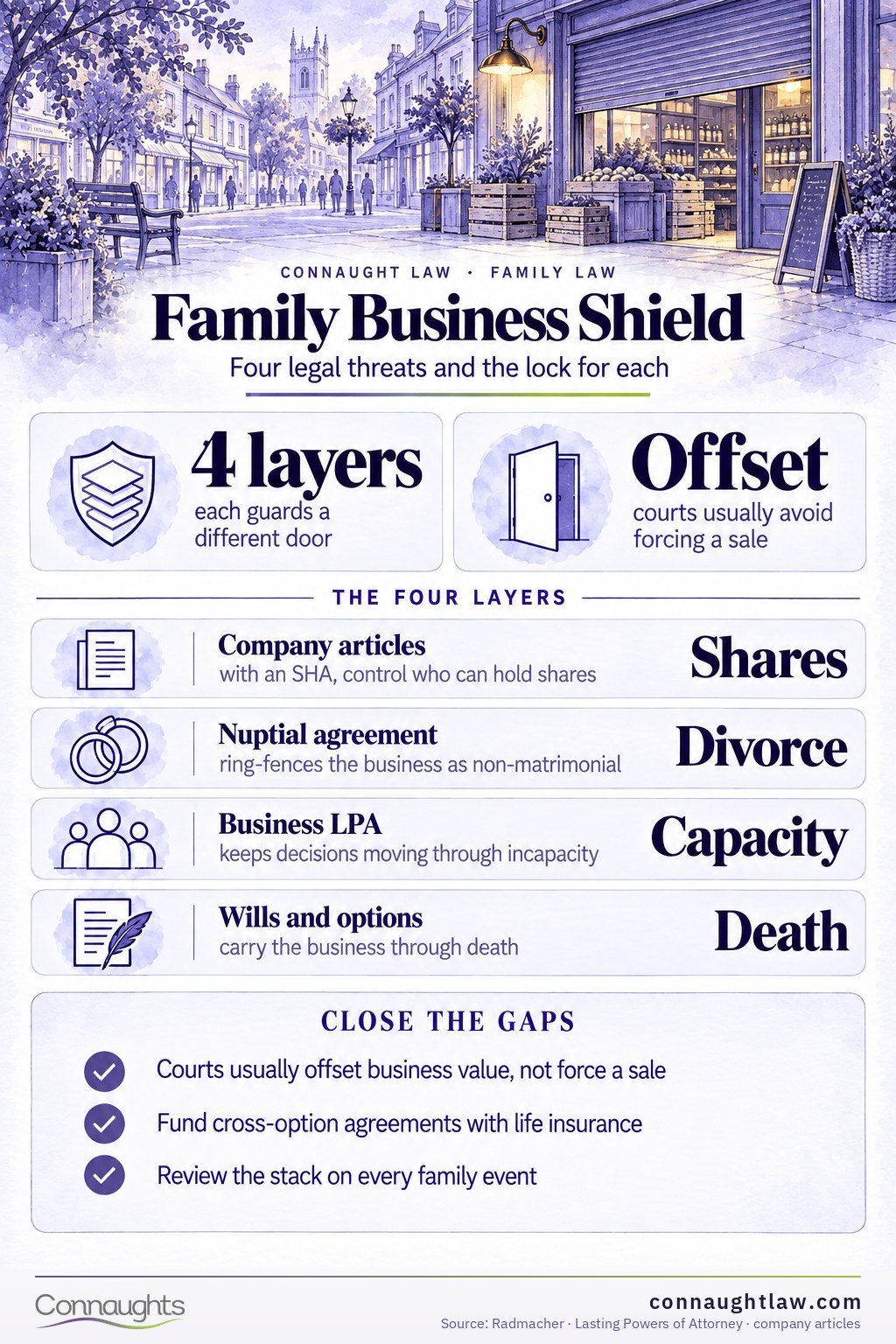
The Constitutional Layer: Articles and Shareholders' Agreements
Provisions That Do the Work
The company's articles and a shareholders' agreement decide who can ever become a shareholder — which is the whole game in a family dispute. Pre-emption rights force shares to be offered to the family first; permitted-transfer clauses define the approved circle; compulsory transfer provisions catch divorce, bankruptcy and death; and valuation clauses fix how a departing holder's shares are priced before anyone is angry. Drafted early, these clauses make the constitution the family's referee instead of the court.
The Divorce Layer
Nuptial Agreements Around the Business
A pre- or post-nuptial agreement can ring-fence business interests as non-matrimonial property, fix valuation methods, and meet the fairness requirements — disclosure, independent advice, no pressure, needs met — that make courts uphold them since Radmacher. For established businesses the agreement pairs with the constitution: the prenup manages the spouses' claims, the articles stop shares migrating outside the family regardless. Our prenuptial agreements guide covers the requirements.
If Divorce Comes Anyway
On divorce the business is an asset to value, not usually one to break: courts prefer offsetting — the non-owner spouse taking other assets against the business's value — over forced sales or shared ownership between ex-spouses. Valuation is where these cases are won and lost, as our business and asset valuation guide explains, and liquidity — how to fund the offset without bleeding the company — is the practical battleground. The wider framework sits in our financial orders guide.
The Incapacity Layer
Keeping the Business Run
If a controlling owner loses capacity without planning, the business can freeze while the family applies to the Court of Protection for a deputy — months of delay at the worst moment. A business lasting power of attorney, separate from the personal one and chosen for commercial competence, keeps decisions moving; articles should mirror it with provisions for an incapacitated director, and banking mandates should never depend on one signature.
The Succession Layer
Succession After the Relief Cap
For deaths from 6 April 2026, 100% business relief applies only to the first £2.5 million of qualifying property, with 50% relief above it — planning around the business relief rules is no longer optional for any business worth more. The toolkit: wills that route shares deliberately (never through intestacy), both spouses' caps used, cross-option agreements with life insurance so the family can buy out a deceased owner's estate without relief-destroying binding sale contracts, and trusts weighed against the capped landscape. Succession also means management: who runs the company is a different question from who owns it, and good plans answer both.
A Worked Example of the Stack
How the Layers Interlock
Take a second-generation manufacturer owned by two siblings, each married with children. The articles restrict shares to lineal descendants with pre-emption at fair value; each sibling's marriage carries a nuptial agreement ring-fencing the shareholding; each holds a business LPA naming the other plus the finance director; and mirrored wills route shares into the next generation using both £2.5m caps, with a cross-option agreement funded by life cover so either family can be bought out at a fixed valuation. Divorce, incapacity or death now each land on a prepared surface — and the business itself never becomes the battlefield.
Keeping the Stack Current
The Review Triggers
Protection decays: marriages, divorces, births, valuations and tax law all move. Review the stack on every family event and at least every few years — checking that valuations in the constitution still reflect reality, that insurance funding still matches buy-out obligations, that LPAs name the right people, and that wills still use the post-2026 relief landscape efficiently. The businesses that survive their families are the ones that treat this as governance, not paperwork.
Frequently askedQuestions about protecting a family business
How do I protect my family business from divorce?
Layer the protections: a nuptial agreement ring-fencing the business as non-matrimonial property, articles and a shareholders' agreement preventing shares leaving the family, and clean separation of business and personal finances. Courts then usually offset value rather than disturb the company.
Can my spouse claim half my business in a divorce?
The business's value enters the settlement, but courts rarely transfer shares or force sales — the usual outcome is offsetting against other assets, with the owner keeping the company. Growth during the marriage is more exposed than pre-marital value, which is what agreements protect.
What changed with business relief in April 2026?
For deaths from 6 April 2026, 100% inheritance tax business relief is capped at £2.5 million of qualifying property per person, with 50% relief above it. Estates built around uncapped relief need restructured wills, both spouses' caps used, and insurance-funded buy-out arrangements reviewed.
What happens to the business if an owner loses mental capacity?
Without planning, decisions freeze until the Court of Protection appoints a deputy. A business lasting power of attorney — separate from the personal LPA, naming commercially capable attorneys — keeps the company running, supported by articles that deal with an incapacitated director.
What is a cross-option agreement?
Reciprocal options between shareholders: on a death, the survivors can require the estate to sell and the estate can require the survivors to buy, funded by life insurance at an agreed valuation. Structured as options rather than a binding sale, it preserves business relief eligibility.
Tell us the ownership structure, the family picture and what documents already exist. We will audit the stack and close the gaps in order of risk.
Get Expert Advice