
"Buying a freehold" means two different purchases, and the right guide depends on which one you are making. Buying a freehold property is ordinary conveyancing — the house and its land, outright. Buying the freehold of your leasehold — a house individually, a block of flats collectively — is enfranchisement, with its own statutory rights, valuation and process. This guide covers both: who qualifies, how each purchase runs, what it costs, the stamp duty position, and the title quirks that catch freehold buyers out.
On This Page
Buying a Freehold: Two Different Purchases
If you are buying a freehold house on the open market, you need standard conveyancing — searches, contract, completion — covered in our buyer guides. If you already own a leasehold and want to buy its freehold, you are enfranchising: a statutory right with its own valuation and procedure. The rest of this guide deals mainly with the second purchase, because that is where the law does the heavy lifting.
The Market in Numbers
On the government's leasehold dwellings estimates for 2024–25, England holds about 19.7 million freehold homes against 4.9 million leasehold — freehold is the default, covering four dwellings in five, and 92% of houses are freehold. The leasehold house is the anomaly the market is slowly correcting: new leasehold houses have all but disappeared from new-build sales, and the 2024 Act's outright ban on them awaits only commencement. For the owners of the existing stock, enfranchisement is the correction available today.
What Freehold Ownership Means
Freehold is ownership of the land and everything on it, indefinitely — no term running down, no ground rent, no landlord's consent regime, no service charge machinery unless the estate imposes one. For a leaseholder, buying the freehold converts a depreciating term into permanent ownership and removes the extension problem forever; for flat owners it swaps an external freeholder for a company the owners control, with the flats still held on leases underneath — typically extended to 999 years at a peppercorn once the owners hold the freehold.
Commonhold and the Future of Flat Ownership
Commonhold — freehold flat ownership without any landlord — is the government's stated destination, and the draft Commonhold and Leasehold Reform Bill is now before Parliament for pre-legislative scrutiny. It changes nothing for today's transactions: no commonhold stock exists to buy and no conversion date is set. Enfranchisement remains the practical route to owner control.
Who Can Buy Their Freehold
Houses: The Individual Right
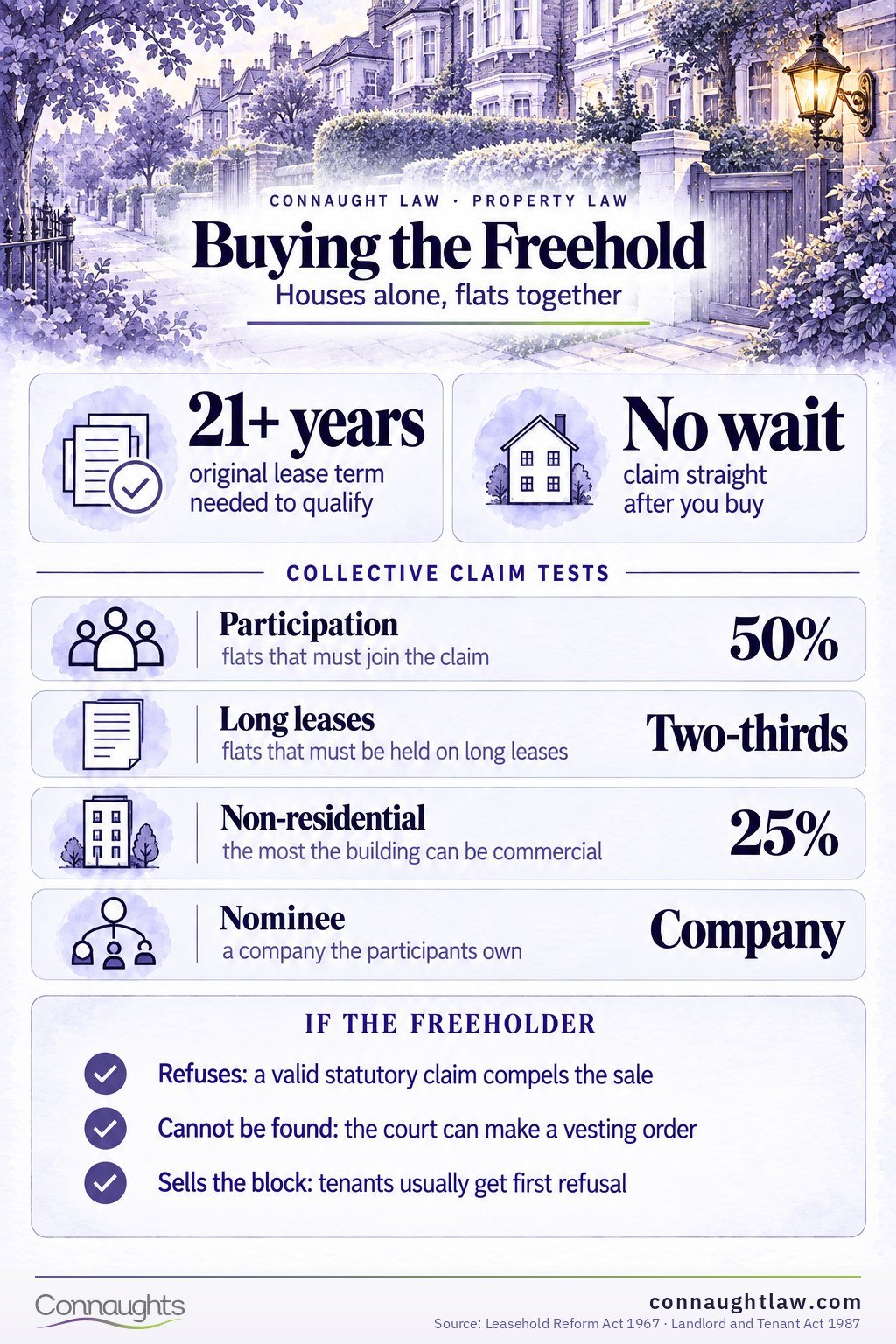
- The right to buy a leasehold house's freehold comes from the Leasehold Reform Act 1967.
- Core condition: a long lease — originally granted for more than 21 years.
- The old two-year ownership wait is gone — abolished on 31 January 2025, so a new owner can claim immediately.
- You act alone: no neighbours, no participation thresholds, no company to form.
- The full mechanics are in our leasehold house freehold guide.
Flats: The Collective Route
- At least 50% of the flats in the building must participate in the claim.
- Two-thirds of the flats must be held on long leases.
- No more than 25% of the building can be non-residential — the Leasehold and Freehold Reform Act 2024 raises this to 50%, but that change awaits commencement.
- No ownership waiting period — abolished January 2025.
- A nominee purchaser, usually a company the participants own, takes the freehold; our collective enfranchisement guide works through the thresholds, and our enfranchisement team runs the structure.
How the Purchase Runs
Both enfranchisement routes offer the same choice of gear. The informal route — simply agreeing a price with the freeholder — is quick when it works and worthless when it stalls, because nothing compels the freeholder to engage. The statutory route serves notice of claim, fixes a valuation date, and puts deadlines and the tribunal behind the negotiation. Serious claims usually open informally with the statutory notice drafted and ready: the freeholder negotiates differently when they know the compulsion exists. Expect six months to well over a year end to end, driven mostly by how hard the price is fought.
Separately from enfranchisement, a freeholder selling a building containing flats must usually offer it to the qualifying tenants first, under the Landlord and Tenant Act 1987 — criminal liability attaches to ignoring it. If your freeholder sells without offering, the new owner can be compelled to sell to the tenants on the same terms. Any letter about your freeholder selling deserves advice within days, because the response windows are short.
Searches and Title Checks
An enfranchisement purchase still needs the conveyancing layer: title investigation of the freehold, searches where mortgages require them, and — for collectives — apportionment of the price between participants and the terms of the new 999-year leases. Buying an ordinary freehold house needs the standard search bundle, plus attention to estate rentcharges and management schemes on newer developments, which quietly recreate service-charge economics on freehold titles.
What Buying a Freehold Costs
- The term: compensation for the ground rent the freeholder loses.
- The reversion: the value of getting the property back at the lease's end, discounted to today.
- Marriage value: half the uplift from combining the interests, payable where the lease is under 80 years — still in force, because the 2024 Act's abolition awaits commencement.
- Professional costs: your valuation and legal fees, and — until the 2024 Act's costs provisions commence — a contribution to the freeholder's.
- Long-lease houses at modest ground rents often enfranchise for comparatively little; short leases and collective claims run into five figures and beyond. A valuation before the notice is the best money in the process.
SDLT on Freehold and Enfranchisement Purchases
Stamp duty applies to the enfranchisement price like any land purchase, at residential rates — the nil band running to £125,000 since April 2025, so many house enfranchisements at modest premiums pay nothing. Collective purchases benefit from a specific relief that divides the price by the number of qualifying flats before applying the rate, which usually keeps each participant's share in the lower bands. An ordinary freehold house purchase pays SDLT on the full price in the normal way, with first-time buyer relief where it applies.
Common Problems and Their Fixes
A missing or unresponsive freeholder does not block the purchase. Where the freeholder cannot be found, the court can make a vesting order transferring the freehold with the price set by the tribunal and paid into court. Slower and more procedural than a negotiated deal — but the right exists precisely for the absent landlord, and dissolved-company freeholds have their own route through the Crown.
Rentcharges and Flying Freeholds
Two title quirks surface disproportionately on freehold purchases. Historic rentcharges — small annual sums with outsized enforcement remedies under the Rentcharges Act 1977 — should be redeemed or insured against at purchase, not ignored. Flying freeholds, where part of one freehold sits over another, trouble lenders because support and repair rights depend on old deeds; indemnity insurance or a deed of covenant usually solves what the title cannot. Neither is a reason to walk away; both are reasons the searches and title report earn their fee.
Frequently askedQuestions about buying a freehold
How do I buy the freehold of my leasehold house?
Under the Leasehold Reform Act 1967: confirm your lease was granted for over 21 years, get a valuation, then either agree a price informally or serve the statutory notice that compels the sale. There is no ownership waiting period since January 2025, and you act alone — no neighbours needed.
How much does it cost to buy a freehold?
The premium is built from the ground rent income lost, the discounted reversion, and — under 80 years — marriage value, which is still payable because the reform abolishing it has no commencement date. Long-lease houses can be modest; short leases and collective claims run to five figures. Value before you notice.
Can flat owners buy their freehold?
Yes, collectively: at least half the flats participating, two-thirds on long leases, and no more than a quarter of the building commercial under current law. The freehold passes to a company the participants own, and the flats are then typically re-geared to 999-year peppercorn leases.
Can the freeholder refuse to sell?
Not against a valid statutory claim — the right compels the sale, and disputes go to the tribunal on price, not principle. Refusal is only possible where you have no qualifying right or you rely purely on informal negotiation, which is why serious claims keep the statutory notice ready.
What if the freeholder cannot be found?
The claim proceeds without them: the court can vest the freehold in you, with the price fixed by the tribunal and paid into court. Absent and dissolved freeholders slow the process but do not stop it.
Is buying the freehold worth it?
For a leasehold house, almost always — it removes ground rent, the shrinking term and the landlord in one purchase. For flats, the case rests on control and 999-year leases versus the cost and coordination of a collective claim. In both cases the arithmetic beats the sentiment: value first, decide second.
Tell us whether it is a house or a block, the unexpired term and the ground rent. We will tell you what the premium should look like, which route fits, and what the freeholder can and cannot do about it.
Get Expert Advice