
Section 94B lets the Home Office refuse a human rights claim and certify it, so that any appeal has to be brought from outside the United Kingdom. It does not remove the appeal; it moves it. This guide sets out the power, the test the Secretary of State has to apply, who it is used against, and what the Supreme Court required before an out-of-country appeal can be treated as effective.
On This Page

Understanding Section 94B Certification
Section 94B of the Nationality, Immigration and Asylum Act 2002 is a certification power, and it is often confused with section 94. The two do different things. Section 94 certifies a claim as clearly unfounded and removes the appeal altogether. Section 94B certifies a refused human rights claim so that removal may go ahead pending an appeal, which then has to be brought or continued from outside the United Kingdom.
That distinction decides what you can do next. Under section 94 the question is whether the certificate itself can be challenged. Under section 94B there is still an appeal — the question is where you will be when you bring it, and whether it can be run fairly from there.
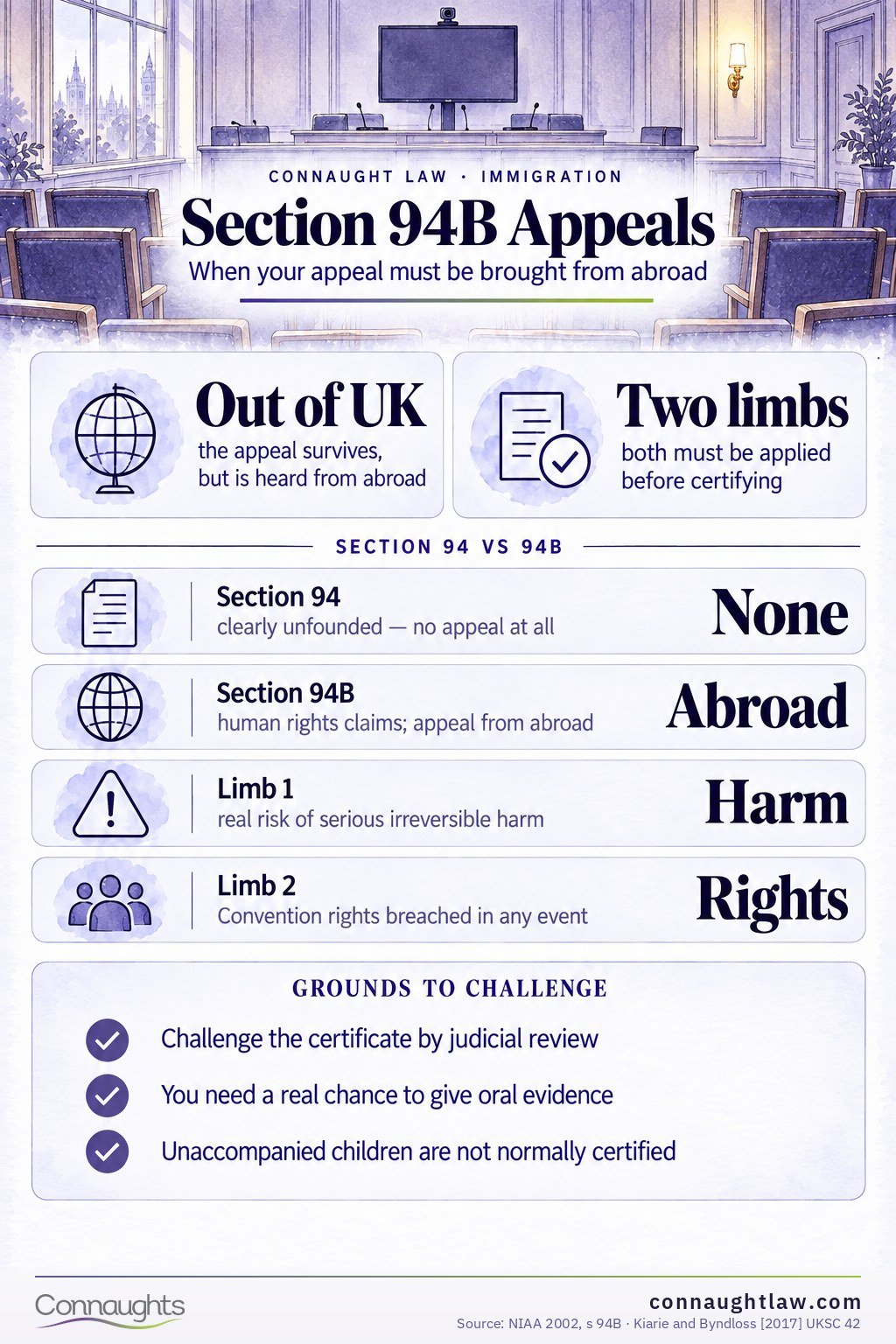
What Section 94B Does
The power allows the Secretary of State to certify a refused human rights claim where removing the person, or requiring them to leave, pending the outcome of an appeal would not be unlawful under section 6 of the Human Rights Act 1998. The effect is that the appeal becomes non-suspensive: removal is no longer held back by the fact that an appeal exists.
- The appeal survives: a section 94B certificate does not take the right of appeal away
- Where it is heard changes: the appeal can only be lodged or continued from outside the UK
- Removal is not blocked: the certificate is what allows removal to proceed while the appeal is outstanding
- The certificate is challengeable: it is a decision of the Secretary of State and open to judicial review
On its face the power reaches all human rights claims. In practice the published policy applies it to a narrower group, and the reason a certificate has been issued should be stated in the decision.
The Test the Secretary of State Applies
The statutory question is whether removal pending appeal would be unlawful under section 6 of the Human Rights Act 1998. The Home Office guidance on certification under section 94B, at version 10.0 and published for caseworker use on 8 May 2026, breaks that into two limbs.
The first asks whether removal would give rise to a real risk of serious irreversible harm, both phrases carrying their ordinary meaning. The second asks whether removal would breach Convention rights in any event — Articles 2, 3, 6 and 8 among them — weighed against the public interest in immigration control.
The limbs are not alternatives, and this is the point most often missed. The absence of serious irreversible harm does not by itself justify certification. A caseworker who addresses the first limb, finds no irreversible harm and certifies without going on to the second has not applied the test the guidance sets out.
Who Section 94B Is Applied To
Current policy directs the power at people liable to deportation, foreign national offenders in particular, and at cases the guidance describes in terms of abusive behaviour or specific nationality groups.
Two groups are treated as not normally suitable for certification: unaccompanied children, and people serving indeterminate sentences. Neither is excluded outright, so a certificate in either case is not unlawful on that ground alone — but it is a departure from the stated policy, and a departure from policy is something a decision has to explain.
Section 94 and Section 94B Compared
Section 94 and Section 94B represent distinct certification mechanisms with fundamentally different applications, legal standards, and consequences for claimants facing removal from the UK. While both provisions enable Home Office certification of claims, Section 94B applies exclusively to human rights claims and allows removal pending appeal rather than eliminating appeal rights entirely, creating crucial distinctions that determine which certification mechanism applies to particular claims and what procedural safeguards remain available to challenge certification decisions and removal directions under applicable immigration law frameworks.
Fundamental Distinctions Between Certification Types
Section 94 applies to both protection claims (asylum and humanitarian protection) and human rights claims, providing broader application across claim categories while triggering more severe consequences following the 2022 legislative changes. Since June 28, 2022, Section 94 certification completely removes all appeal rights, leaving judicial review as the exclusive challenge mechanism and permitting immediate removal without any tribunal oversight of substantive claim merits or certification appropriateness beyond the limited grounds available through judicial review proceedings.
Section 94B applies exclusively to human rights claims, not protection claims, and operates on a fundamentally different legal framework despite similar certification language. Unlike Section 94, Section 94B certification does not eliminate appeal rights but instead permits removal while appeals remain pending, allowing claimants to pursue tribunal challenges from outside the UK after removal has occurred. The Supreme Court’s decision in Kiarie and Byndloss [2017] UKSC 42 imposed significant video link requirements for Section 94B cases, recognizing fairness concerns with out-of-country appeals and mandating video evidence facilities in most circumstances where claims involve factual disputes requiring oral testimony from claimants and witnesses about their experiences and circumstances relevant to human rights and asylum claims.
Section 94 Against 94B
| Feature | Section 94 | Section 94B |
|---|---|---|
| Applicable Claim Types | Protection claims AND human rights claims | Human rights claims ONLY (not protection claims) |
| Appeal Rights Effect | Complete removal of ALL appeal rights since June 2022 | Allows removal PENDING appeal (appeal rights preserved) |
| Challenge Mechanism | Judicial review only (not an appeal) | Full appeal rights to tribunal from outside UK |
| Restrictions | No specific claim type restrictions | Cannot certify Article 2 or Article 3 ECHR claims |
| Current Operational Status | Fully operational with enhanced consequences post-2022 | Operational with Kiarie video link safeguards |
| Priority in Application | Home Office priority where clearly unfounded applies | Secondary option when Section 94 not applicable |
| Consequences Severity | More severe – complete loss of appeal access | Less severe – appeals preserved with practical challenges |
Strategic Implications for Certification Challenges
Understanding whether Home Office applies Section 94 or Section 94B certification significantly impacts challenge strategies and available remedies. Section 94 certification demands immediate judicial review action before removal occurs, as no subsequent appeal opportunity exists once claimants leave the UK, making pre-removal challenge through expedited judicial review proceedings the exclusive mechanism for contesting certification validity and preventing removal to countries where claimants face persecution risk or human rights violations.
Section 94B certification permits more measured challenge approaches through preserved appeal rights, although practical difficulties with out-of-country appeals remain substantial despite Kiarie video link requirements. Claimants facing Section 94B certification can choose between immediate judicial review of certification decisions or pursuing subsequent appeals from outside the UK after removal, providing strategic flexibility absent under Section 94’s complete elimination of appeal access and demanding immediate challenge before removal eliminates all tribunal-based remedies for addressing substantive claim merits and certification appropriateness.
Kiarie and Byndloss and What Followed
The certificate is lawful in principle. Whether the appeal it produces is worth anything is a separate question, and that is what the courts have concentrated on.
In Kiarie and Byndloss v Secretary of State for the Home Department [2017] UKSC 42 the Supreme Court held that an out-of-country appeal must be effective in practice, not only available on paper. An appellant needs a real opportunity to give oral evidence, if necessary by video link, because in a human rights appeal turning on private and family life the tribunal has to be able to assess the person giving it.
In AJ (s 94B: Kiarie and Byndloss questions) [2018] UKUT 115 the Upper Tribunal set out a structured way of asking whether a particular out-of-country appeal would be effective. The practical consequence is that a challenge to a section 94B certificate is usually built on the arrangements for the appeal — whether evidence can actually be given, and whether representation and instructions can be maintained from abroad — rather than on the merits of the human rights claim alone.
Frequently asked
Questions about section 94B certification
Does a section 94B certificate mean I have lost my appeal?
No. The appeal right remains. What the certificate changes is where the appeal is brought: it can only be lodged or continued from outside the United Kingdom, and removal is no longer prevented by the appeal being outstanding.
What is the difference between section 94 and section 94B?
Section 94 certifies a claim as clearly unfounded and there is no appeal at all. Section 94B certifies a refused human rights claim and the appeal survives, but it has to be exercised from abroad. The tests are different and so are the remedies.
Can a section 94B certificate be challenged?
Yes. It is a decision of the Secretary of State and is challenged by judicial review. Challenges commonly turn on whether the two limbs of the test were both applied, and on whether the appeal could in fact be conducted effectively from outside the UK.
What did Kiarie and Byndloss decide?
That an out-of-country appeal has to be effective in practice. The Supreme Court held in 2017 that an appellant must have a real opportunity to give oral evidence, by video link if necessary, for the appeal to satisfy procedural fairness.
Tell us the date on the decision, what it says about certification, and whether removal directions have been set. We will tell you whether the certificate can be challenged and what has to be shown about running the appeal from abroad.