
Portugal's Golden Visa remains open in 2026, despite persistent reports that the programme has ended. What actually closed, in October 2023, was the real estate investment route — not the residence-by-investment scheme itself. This guide explains what the programme now offers: the qualifying investment routes and amounts, who is eligible, how the application works, the minimal stay involved, and the path to citizenship under the nationality-law reform now in force.
On This Page

The Portugal Golden Visa in 2026: What Changed and What Remains
The Portugal Golden Visa — officially the Residence Permit for Investment Activity, or ARI — has been one of Europe's most popular residence-by-investment routes since 2012. In October 2023, the "Mais Habitação" (More Housing) law removed the property and property-fund options to ease pressure on the housing market. The programme continued for every other qualifying investment, and it remains active in 2026.
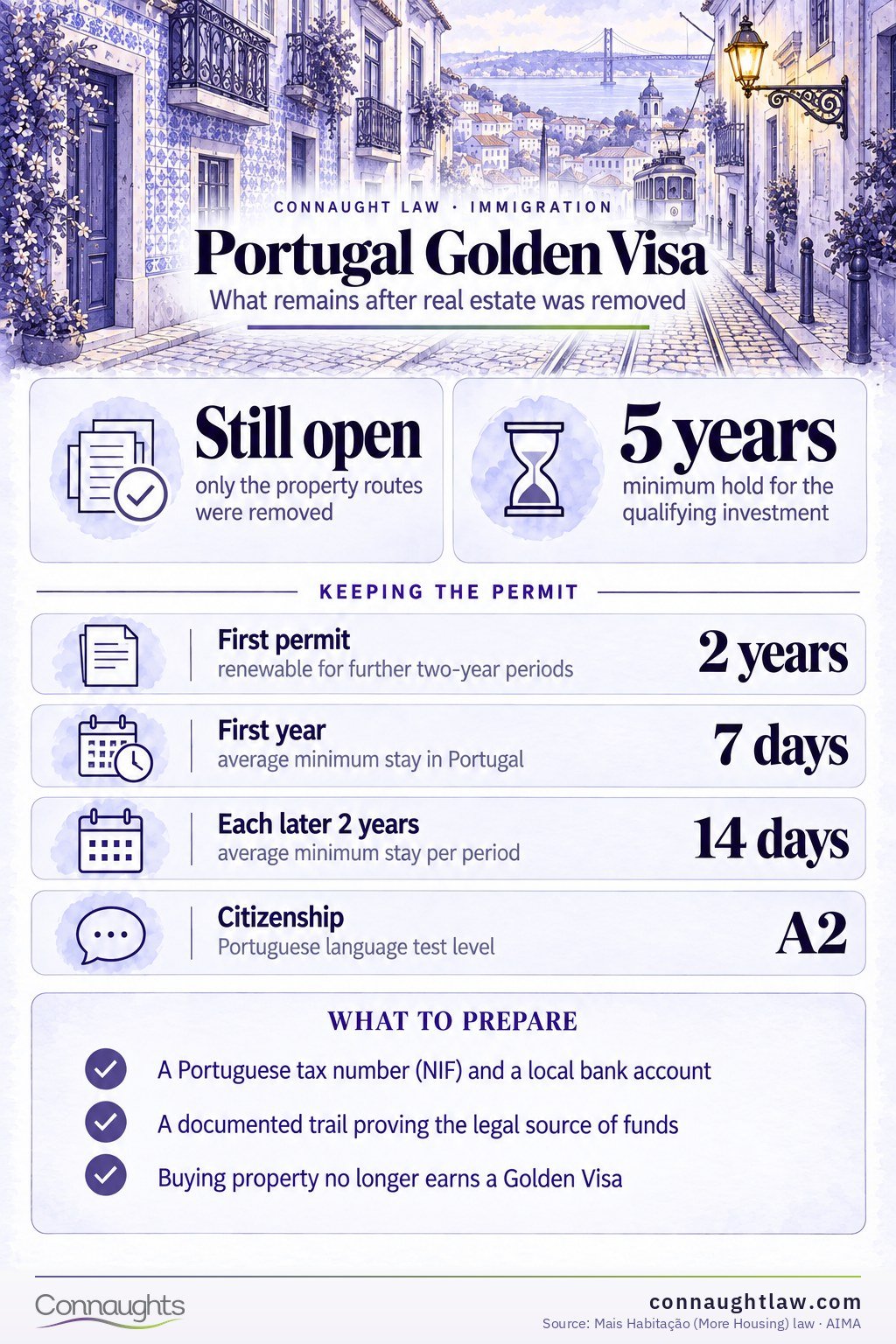
Yes. The Portugal Golden Visa is open in 2026. Only the real estate and property-fund routes were removed, in October 2023. You can still qualify through investment funds, scientific research, cultural donations, or company and job-creation routes — each held for at least five years.
For internationally mobile investors — including UK-based families weighing an EU foothold after Brexit — the core appeal is unchanged: a low minimum-stay residence permit that can, in time, lead to permanent residence and an EU passport. What has changed is where you are allowed to invest, how long the road to citizenship now runs, and the administration behind the application.
Is the Portugal Golden Visa Still Available in 2026?
Search interest around "Portugal Golden Visa suspended" or "ended" reflects genuine confusion, but the programme was never suspended. The 2023 reform was targeted: it closed the routes that channelled foreign money into residential property, which the government blamed for rising housing costs. Applications through the remaining routes have continued without interruption, and the scheme still issues thousands of permits each year.
Two routes are gone. Buying real estate — and investing through funds with real estate exposure — was removed in October 2023, and the €1.5 million capital-transfer option closed at the same time. Almost every reference you will find online to a property-based Portugal Golden Visa now describes a closed route.
The scheme has also weathered a legal and political test. Its rules — on investment, and separately on the timeline to citizenship — have been revisited during 2025 and 2026, and a constitutional challenge brought by investors remains a live factor. The core residence-by-investment offer, however, is intact for new applicants in 2026, and the remaining routes are arguably better aligned with the productive economy than property ever was.
It helps to separate three things that are often muddled together. The Golden Visa is a residence route, granted in exchange for a qualifying investment. Permanent residence is a status you can apply for after five years of legal residence. Citizenship is a separate step again, achieved by naturalisation. A change to any one of these — such as the 2026 shift in the naturalisation timeline — does not close the others, and much of the "the Golden Visa has ended" commentary online conflates a change to one stage with the end of the whole scheme.
Qualifying Investment Routes and Amounts
Every current route is designed to direct capital into the wider economy rather than housing. Five main options qualify in 2026. In each case the investment must be made and then maintained for at least five years — the minimum period you must hold residence before you can apply for permanent residence or citizenship.
Routes and Minimums Compared
| Qualifying route | Minimum investment | Key conditions |
|---|---|---|
| Investment funds | €500,000 | CMVM-regulated fund, at least five-year maturity, 60%+ invested in companies based in Portugal, no real estate exposure |
| Scientific research | €500,000 | Contribution to accredited research within the national science and technology system |
| Cultural or heritage support | €250,000 (€200,000 low-density) | Non-refundable donation to a pre-approved arts or heritage project |
| Company incorporation | €500,000 | Create or reinforce a Portuguese company and create or maintain at least five jobs |
| Job creation | No minimum sum | Create at least ten full-time jobs (eight in low-density areas) |
The Investment-Fund Route in Practice
The €500,000 fund route has become the most-used option since 2023. Eligible funds are regulated by the CMVM, Portugal's securities regulator, must have a maturity of at least five years, and must allocate a majority of their capital to Portuguese companies — typically in energy, technology, industry or agriculture. Because fund quality and liquidity vary widely, independent due diligence on the manager, strategy and exit terms matters as much as the headline figure — a fund's visa eligibility says nothing about its merits as an investment.
Two practical points are easy to miss. First, the €500,000 is committed capital at risk, not a fee — its value can rise or fall, and the exit at maturity is not guaranteed to return the full sum. Second, the fund must stay compliant for the whole five years, so a change in a fund's strategy or its real estate exposure mid-term can, in principle, affect the underlying residence. Reviewing the fund's regulatory standing and its subscription terms before committing is therefore part of the immigration decision, not a separate financial one.
Why Real Estate No Longer Qualifies
Property was the programme's most popular route for a decade, which is precisely why it was removed. Buying a home, a commercial unit, or a real estate fund no longer earns a Golden Visa, and any fund with real estate exposure is excluded from the €500,000 route. Investors who simply want Portuguese property can still buy it freely — it just no longer confers residence, a distinction that catches many applicants out.
Eligibility and the Application Process
The Portugal Golden Visa is open to non-EU, non-EEA and non-Swiss nationals aged 18 or over. You must have no serious criminal record, hold a qualifying investment made with legally sourced funds, and keep that investment in place throughout. The programme is family-friendly: a spouse or partner, dependent children, and dependent parents can be included in the same application. The applicant profile has shifted west since Brexit and the 2023 reform — American demand has grown into a leading share of the programme, by AIMA's own reporting — and most applications are family projects building a European option rather than a relocation.
- A valid passport and a Portuguese tax number (NIF)
- A Portuguese bank account holding the investment funds
- Evidence of the qualifying investment and the legal source of funds
- A criminal-record certificate from your country of residence
- Valid health insurance covering Portugal
- Proof of the family relationship for any dependants
How the Application Works
Applications are handled by AIMA, the immigration agency that replaced the former SEF. In practice you first obtain a NIF and open a bank account, then make the qualifying investment, submit the online application with supporting documents, and attend a biometrics appointment. A successful applicant receives a two-year residence permit, renewable for further two-year periods, as long as the investment and the minimum stay are maintained.
The most common cause of delay or refusal is not the investment itself but the source-of-funds evidence. AIMA expects a clear, documented trail showing that the capital was lawfully earned and lawfully transferred — pay records, sale proceeds, dividends, inheritance or gift documentation, and the banking history that connects them. Weak or inconsistent documentation is a frequent stumbling block, and it is far easier to assemble a clean file before applying than to answer follow-up requests during a backlog. Dependants add their own paperwork, including proof of relationship and, for adult dependent children, evidence of genuine financial dependency.
Minimum Stay and Realistic Timelines
The Golden Visa carries one of Europe's lightest presence requirements: an average of seven days in the first year and fourteen days across each subsequent two-year period. Processing, however, has been slow. A significant backlog at AIMA has left many applicants waiting well beyond a year for decisions and biometrics, and that delay has downstream effects on renewals and on the residency clock. Any plan should build in generous timelines rather than assume the headline processing times.
The backlog matters for more than patience. Because the residency clock for citizenship runs from when the permit is issued, delays at the front of the process can push the naturalisation date years further out than the raw figures suggest. Portuguese courts have at times ordered AIMA to schedule overdue appointments, and applicants have used legal channels to compel decisions where waits have become unreasonable. This is one reason a well-documented, promptly filed application is worth real money.
From Residence to Citizenship — and the 2026 Reform
Golden Visa holders follow the same long-term path as other legal residents. After the qualifying period of residence, you can apply either for permanent residence or for Portuguese citizenship, subject to an A2-level Portuguese language test, a clean criminal record, and genuine ties to the country. Citizenship is the prize for most investors, because a Portuguese passport brings EU citizenship and full free movement across the bloc.
The reform is now law. Lei Orgânica n.º 1/2026, published in the Diário da República on 18 May 2026 and in force from 19 May 2026, raises the naturalisation residence requirement from five years to ten — seven for nationals of EU and Portuguese-speaking (CPLP) countries — with the clock running from the date the residence permit is issued, not from the application. Citizenship applications submitted on or before 18 May 2026 continue under the former five-year regime. Detailed implementing regulations were still awaited at the time of writing, so confirm the position before relying on any citizenship timeline.
For an investor, the practical takeaway is timing. With the ten-year rule in force, the residence permit remains valuable in its own right — the right to live, work and study in Portugal and to travel the Schengen area — but the citizenship horizon has lengthened materially. That makes early, well-documented residence more important, not less, and it raises the value of advice that treats residence and citizenship as separate goals.
Tax: The End of NHR and Its Successor
Tax often shapes these decisions. Portugal's original Non-Habitual Resident (NHR) regime closed to new entrants at the end of 2023. It has been replaced by a narrower incentive, sometimes called NHR 2.0, aimed at qualifying roles in scientific research and innovation rather than at retirees or passive investors. Anyone relocating for tax reasons should take current, personalised advice rather than rely on the older NHR headlines that still circulate.
UK Alternatives and How Portugal Connects
The UK no longer offers a direct investor visa — the Tier 1 (Investor) route closed in February 2022 — so British-based investors and inbound families increasingly hold options in more than one country. For many, Portugal's programme is considered alongside UK plans rather than instead of them, and choosing well means understanding how residence in one jurisdiction interacts with settlement in the other. Building a coherent global citizenship strategy usually means mapping both at once.
For those building a life in Britain, the relevant UK routes are now skills- and talent-based. The Innovator Founder visa and Global Talent route can both lead to settlement and, in time, British citizenship, and they sit within the wider framework of UK settlement and citizenship options. Families weighing where to anchor want a clear read on both the Portuguese and the British sides before committing.
Comparisons with other programmes are common too. Some investors weigh Portugal against Caribbean options such as St Kitts and Nevis citizenship by investment, while others are moving the opposite way — for instance, Americans relocating to the UK. Mapping how an EU residence or passport sits beside a UK settlement or naturalisation plan is exactly where careful cross-border advice earns its place — our business immigration team runs the UK side, with Portuguese counsel instructed for Portuguese law.
Frequently askedQuestions about the Portugal Golden Visa
Is the Portugal Golden Visa still available in 2026?
Yes. The programme is open in 2026. It was never suspended; only the real estate and property-fund routes were removed in October 2023. Applicants can still qualify through investment funds, scientific research, cultural donations, company incorporation, or job creation.
When did the Portugal Golden Visa real estate route end?
The real estate route ended in October 2023 under the "Mais Habitação" (More Housing) law, which also closed property-linked investment funds and the €1.5 million capital-transfer option. The change was made to ease pressure on Portugal's housing market.
What is the minimum investment for the Portugal Golden Visa now?
The lowest entry point is a €250,000 cultural or heritage donation (€200,000 in low-density areas). Most routes — investment funds, scientific research, and company incorporation — require €500,000. The job-creation route has no minimum sum but requires ten full-time jobs.
Is the €1.5 million capital-transfer route still open?
No. The €1.5 million capital-transfer route closed alongside the real estate options in the 2023 reform. It no longer qualifies for a Portugal Golden Visa, and any guidance suggesting otherwise is out of date.
How many days a year must I spend in Portugal?
The stay requirement is light: an average of seven days in the first year and fourteen days across each subsequent two-year period. This makes the Golden Visa attractive to investors who cannot relocate full time but want to keep a residence permit alive.
Does the Portugal Golden Visa lead to citizenship?
It can, through naturalisation with an A2 language test. Since 19 May 2026 the qualifying period is ten years — seven for EU and CPLP nationals — counted from when the residence permit is issued. Applications filed on or before 18 May 2026 remain under the former five-year rule.
Can I include my family in the application?
Yes. A spouse or partner, dependent children, and dependent parents can be included in the same application, and they share the applicant's residence rights and eventual path to permanent residence and citizenship, subject to the same requirements.
Can I still buy property in Portugal?
Yes. There is no restriction on foreigners buying Portuguese property. Since October 2023, however, a property purchase no longer earns a Golden Visa — the two are now entirely separate, which is a common point of confusion for investors.
Why would a UK law firm handle a Portuguese visa?
Because most of our golden-visa clients are structuring a cross-border position — UK status, Portuguese residence, family and tax planning across both — and the UK side is where we act, with Portuguese counsel instructed for Portuguese law. The value is the joined-up plan, not a single form.
Tell us which programme you are considering, the investment you have in mind and where you expect to spend your time. We'll tell you what each route requires and how it sits alongside UK plans.
Get Expert Advice