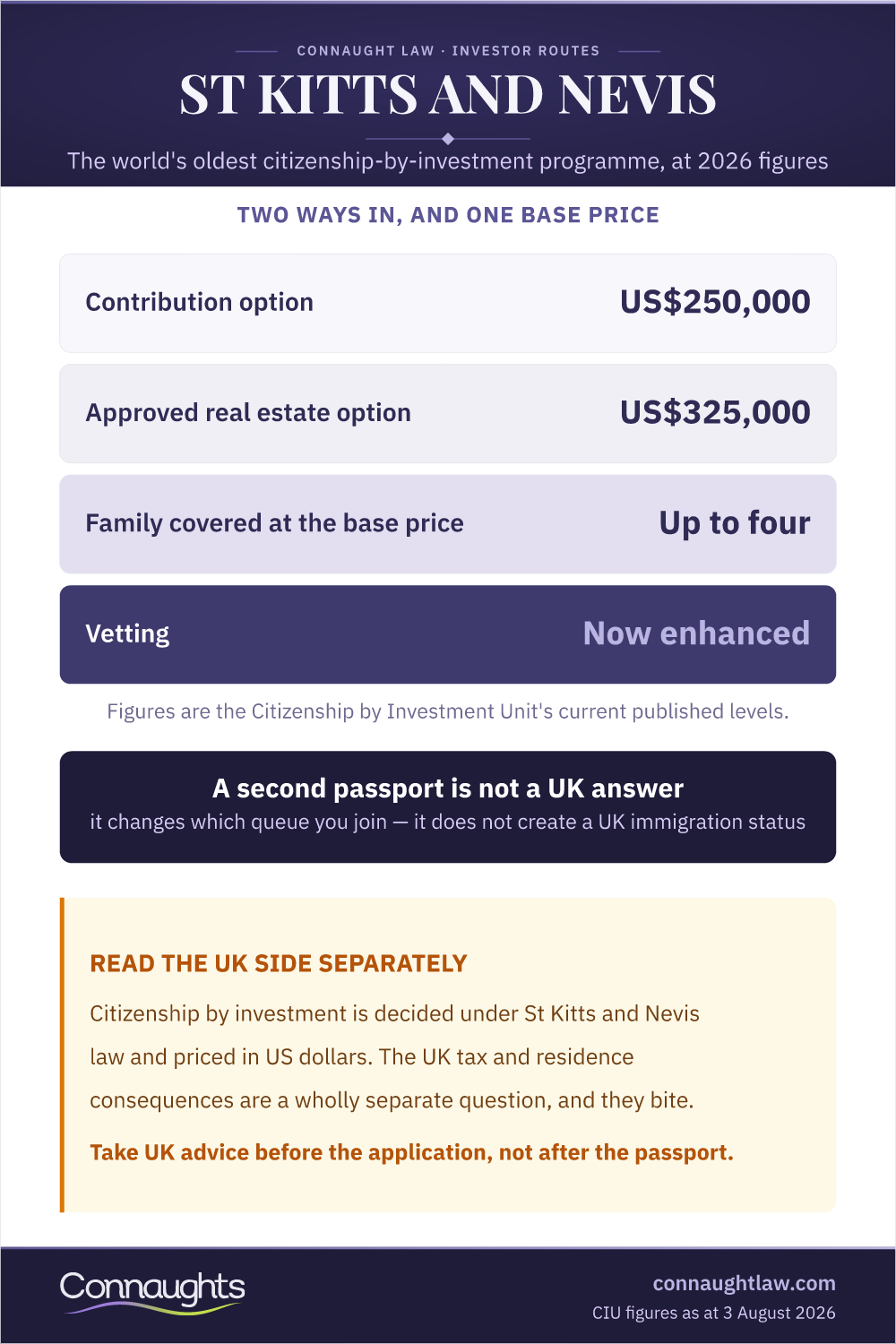
St Kitts and Nevis runs the world's oldest citizenship-by-investment programme, and in 2026 the entry point is a US$250,000 contribution or a US$325,000 approved real estate investment, with citizenship for a family of up to four at the base price. This guide sets out the options at the Citizenship by Investment Unit's current figures, the vetting that now applies, and the tax and UK-side realities a second passport does and does not change.
On This Page

The Oldest Programme in the Business
Operating since 1984, the St Kitts and Nevis programme is the one every other citizenship-by-investment scheme is measured against. It grants full citizenship — passport, lifelong status, transmission to future generations — without any residence requirement, in exchange for a qualifying investment vetted by the Citizenship by Investment Unit. For UK-based applicants, the legal work sits alongside a second question our global citizenship practice deals with daily: what the new passport changes at home, and what it does not.
How the 2024 Reforms Changed the Programme
In October 2024 the Citizenship by Investment Unit became an independent statutory corporation with its own board, and the programme repriced: real estate thresholds came down while vetting went up, with interviews and continuing due diligence built into the process rather than bolted on. The direction of travel matters more than any single figure — the programme is competing on credibility, not on being the cheapest ticket in the Caribbean.
What Happened to Applications
The government reported a sharp rise in applications after the repricing, and demand from American and Middle Eastern applicants remains the industry's consistent theme. We deliberately quote no percentage: application volumes are announced in press statements rather than a regular statistical series, and last year's surge figure is this year's stale number. What endures is the pattern — lower entry price plus harder vetting has kept the programme busy.
Choosing an Investment Route
Investment Options Compared
| Option | Minimum | Character |
|---|---|---|
| Sustainable Island State Contribution | US$250,000 | Non-refundable contribution; covers a family of up to four |
| Public Benefit Option | US$250,000 | Contribution to an approved public benefit project |
| Developer's real estate | US$325,000 | Investment in an approved development; resale conditions apply |
| Private real estate | US$600,000 | Purchase of an approved private property |
Sustainable Island State Contribution
The SISC is the programme's flagship: US$250,000 for a main applicant or a family of up to four, with US$25,000 for each additional dependant under 18 and US$50,000 for each additional adult dependant. It is a contribution, not an investment — the money is gone, which is precisely why it is the simplest route to administer and the hardest to get wrong.
Public Benefit Option
The same US$250,000 minimum, directed into approved projects — housing, infrastructure, public works — rather than the general fund. A time-limited fee waiver once made this the cheapest family route; that promotion has expired, and anyone still being quoted it should treat the quote as a red flag about the adviser. Current terms come from the CIU's published pages, not from marketing sites.
What the Passport Delivers
Broad visa-free travel — including the Schengen area and short visits to the UK, where St Kitts and Nevis nationals travel without a visa but now need the £20 electronic travel authorisation before boarding. We quote no visa-free country count deliberately: the totals move with diplomatic weather and every marketing site counts differently. The durable benefits are the mobility itself, the absence of any residence requirement, and citizenship that passes to children born after the grant.
United States Access
The passport does not join the US Visa Waiver Program — American travel still runs on a B-1/B-2 visitor visa, which St Kitts and Nevis citizens routinely hold in its ten-year multiple-entry form. Applicants whose real goal is US residence are looking at the wrong programme entirely: that is a US immigration question, and no Caribbean passport answers it by itself.
How the Caribbean Programmes Differ
Reading the Comparisons Properly
Five eastern Caribbean states — St Kitts and Nevis, Dominica, Grenada, Antigua and Barbuda, and St Lucia — run competing programmes, and they reprice often enough that any table of figures dates within months. The structural differences are what last: St Kitts has the longest track record; Grenada is the one whose citizens can access the US E-2 treaty investor visa; the others compete chiefly on family pricing. Verify current minimums with each programme's official unit on the day of decision, never from an agent's comparison chart.
Rankings and Their Limits
The industry's annual indices and rankings are produced by publications whose advertisers are the programmes and agents being ranked. They are a starting map, not evidence. The measures that should actually drive the choice are official pricing, due diligence reputation with Western governments, and the programme's regulatory trajectory — all checkable from primary sources.
Applying Through an Authorised Agent
Applications go through authorised agents to the CIU: agent selection, document preparation, submission, vetting and interview, then the investment on approval in principle. The Unit's published service standard is notification within 120 to 180 days of a complete application being acknowledged. Legal advice on the UK side belongs in parallel, not afterwards — the sequencing of the investment, the source-of-funds file and the tax analysis is where cases are won or quietly damaged.
Due Diligence and the Interview
- Due diligence fees run US$10,000 for the main applicant and US$7,500 for each dependant aged 16 or over, on top of the investment.
- The main applicant attends a mandatory interview — virtual or in person — conducted by an independent firm or the CIU; dependants 16 or over can be called if the Unit requires it.
- Background checks are continuing, not one-off: post-grant monitoring is part of the modern programme.
- Source-of-funds evidence carries the file — assemble it to bank-compliance standard before applying.
Restricted Nationalities
The programme maintains a published exclusion order barring applicants from a number of listed countries, with narrow exceptions for those long resident elsewhere and free of economic ties to the excluded state — and in practice those exceptions are sparingly granted. The list is amended as sanctions and security postures shift, so check the current position with the CIU before any fees are paid rather than relying on a summary, ours included.
Tax: The Honest Position
St Kitts and Nevis levies no personal income tax, capital gains tax or inheritance tax. What the marketing omits is that citizenship changes none of your existing obligations: a UK resident with a St Kitts passport remains fully taxable in the UK on the same basis as before, and tax residence turns on where you live, not what passports you hold. The passport is a mobility and planning instrument; treating it as a tax exit is the error that ends in an HMRC enquiry. Take coordinated immigration and tax advice before committing funds.
Family Members in One Application
A single application can cover a spouse and qualifying dependent children, with additional dependants priced as above, and dependants beyond the core family assessed under the programme's current criteria. Two practical rules from the casework: include every eligible family member at the outset, because later additions cost more and re-open vetting; and check each family member's own position — a dependant's nationality, residence or source-of-funds issue can complicate an otherwise clean file.
Frequently askedQuestions about St Kitts and Nevis citizenship
What is the minimum investment in 2026?
US$250,000 through the Sustainable Island State Contribution or Public Benefit Option — covering a family of up to four — or US$325,000 in approved developer real estate, or US$600,000 for an approved private property. Due diligence and processing fees apply on top.
How long does the process take?
The Citizenship by Investment Unit's published standard is a decision notification within 120 to 180 days of acknowledging a complete application, with the investment made after approval in principle. Incomplete source-of-funds evidence is the most common cause of delay.
Do I have to live in St Kitts and Nevis?
No. The programme has no residence requirement before or after the grant — no visits, no physical presence, no renewals beyond an ordinary passport. That absence of a residence footprint is a defining feature of the programme.
Can UK citizens apply, and is dual citizenship allowed?
Yes on both counts. The UK and St Kitts and Nevis both permit dual citizenship, and acquiring the second passport has no effect on British nationality. It equally has no effect on UK tax residence — a point worth absorbing before, not after, investing.
Does the passport give visa-free access to the UK and US?
UK: yes for short visits, with a £20 electronic travel authorisation required before travel. US: no — St Kitts and Nevis is not in the Visa Waiver Program, so American travel needs a B-1/B-2 visitor visa, commonly issued with ten-year validity.
Which family members can be included?
A spouse and qualifying dependent children within the base price for a family of four, with additional dependants at US$25,000 under 18 and US$50,000 as adults, each vetted and interviewed where the Unit requires. Adding family later costs more than including them at the start.
Tell us who is applying, where your funds sit and what the passport needs to achieve. We'll give you the current official figures, the realistic timeline and the UK-side analysis before you commit a dollar.
Get Expert Advice