A no recourse to public funds condition is imposed under section 3(1)(c)(ii) of the Immigration Act 1971 and it bars a defined list of benefits, not everything the state provides. The list is at paragraph 6 of the Immigration Rules, and what is missing from it matters as much as what is on it. Where the condition causes destitution or harms a child, it can be lifted by application.
On This Page

The Condition and What It Restricts
Section 3(1)(c)(ii) of the Immigration Act 1971 allows limited leave to be given subject to “a condition requiring him to maintain and accommodate himself, and any dependants of his, without recourse to public funds”. It is a power, not a duty — the Home Office chooses whether to impose it, and on most routes it does. Our guide to visa conditions covers the rest of that list.
The condition has a statutory partner. Section 115 of the Immigration and Asylum Act 1999 excludes a “person subject to immigration control” from universal credit, income-based jobseeker’s allowance, state pension credit, income-related employment and support allowance, personal independence payment, attendance allowance, severe disablement allowance, carer’s allowance, disability living allowance, income support, social fund payments, child benefit and housing benefit.
Section 115(9) defines who that catches: a person who requires leave and does not have it; a person whose leave carries a no recourse condition; a person granted leave as a result of a maintenance undertaking; and a person with leave only under paragraph 17 of Schedule 4. The condition and the statutory exclusion overlap, but they are not the same instrument, and an argument that works against one may not touch the other.
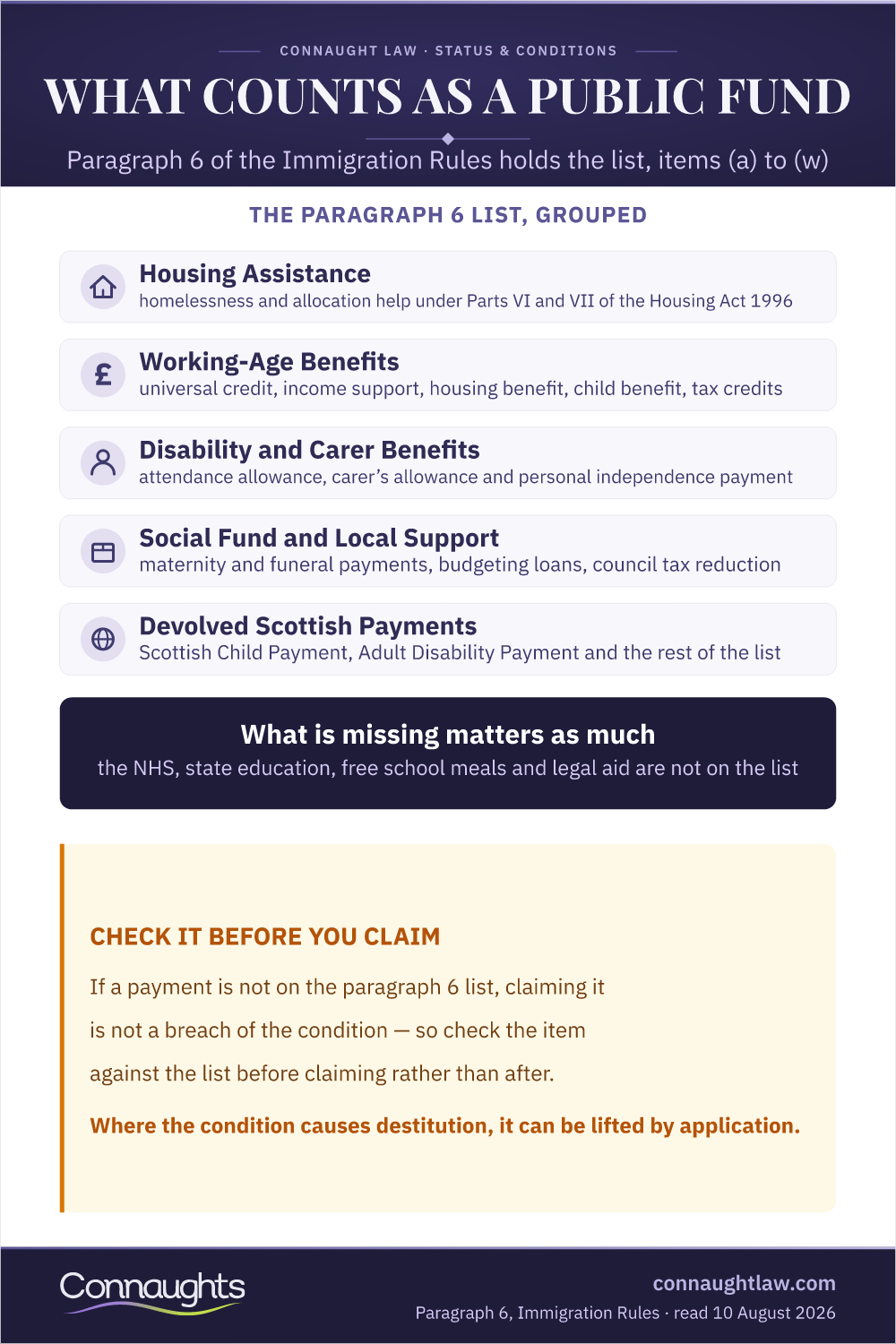
What Counts as a Public Fund
Paragraph 6 of the Immigration Rules holds the definitive list, running from (a) to (w). It is longer than most people expect because it takes in housing assistance, council tax reduction and the devolved Scottish payments as well as the familiar working-age benefits. If something is not on the paragraph 6 list, claiming it is not a breach of the condition.
Public Funds Under Paragraph 6
| Group | What the Rules name |
|---|---|
| Housing | Housing assistance under Parts VI and VII of the Housing Act 1996, Part II of the Housing Act 1985, Parts I and II of the Housing (Scotland) Act 1987, and the Northern Ireland Housing Orders |
| Working-age benefits | Universal credit, income support, income-based jobseeker’s allowance, income-related employment and support allowance, state pension credit, housing benefit, child benefit, child tax credit, working tax credit |
| Disability and carer benefits | Attendance allowance, severe disablement allowance, carer’s allowance, disability living allowance, personal independence payment |
| Social Fund | Maternity, funeral, cold weather and winter fuel payments, and budgeting loans |
| Local support | Council tax reduction, discretionary local authority payments under section 1 of the Localism Act 2011, Welfare Funds (Scotland) payments, Northern Ireland discretionary support |
| Scottish payments | Child Disability Payment, Adult Disability Payment, Carer’s Allowance Supplement, Scottish Child Payment, Funeral Support Payment, Job Start Payment, Child Winter Heating Assistance, Winter Heating Payment, Carer Support Payment, Pension Age Disability Payment, Pension Age Winter Heating Payment, Scottish Adult Disability Living Allowance |
One qualification in paragraph 6 is worth knowing. Relying on a family member or sponsor who is themselves in receipt of public funds does not put you in breach, provided the sponsor does not receive increased or additional funds because of you. An applicant outside the UK who relies on a future entitlement, however, is treated as having recourse.
Benefits and Services That Are Not Public Funds
This is where most of the anxiety sits, and most of it is misplaced. NHS treatment is not a public fund — the immigration health surcharge and the overseas visitor charging regime deal with healthcare separately. State education is not a public fund, and nor are free school meals. Legal aid is not a public fund.
Contributory benefits are outside the list as well: contribution-based jobseeker’s allowance and employment and support allowance, statutory maternity pay, statutory sick pay and the State Pension are earned through National Insurance contributions rather than granted as assistance, and claiming them does not breach the condition. Neither does using a food bank, a charity, or support from family. If you are unsure whether a particular payment is caught, check it against paragraph 6 before claiming rather than after, and take immigration advice where a family member’s claim is involved.
Getting the Condition Lifted
The condition is the default, not an inevitability. On the private life route, PL 10.5(c) provides that an applicant will not be subject to a no access to public funds condition where the decision maker is satisfied that they are destitute as defined in section 95 of the Immigration and Asylum Act 1999, or at risk of imminent destitution, or that there are reasons relating to the welfare of a relevant child which outweigh the considerations for imposing it, or that they face exceptional circumstances affecting income or expenditure.
Appendix FM does the same job through GEN.1.10 and GEN.1.11A, on the same limbs. It is worth being precise about where the trigger sits: the condition is imposed by GEN.1.10, and GEN.1.11A is the exit, so an argument aimed at the grant paragraph alone misses the provision that decides the point. A relevant child is a child under 18 at the date of application. Our guide to Article 8 family and private life covers the routes these grants sit on.
If the condition has already been imposed, the route is a change of conditions application, made online and on the same three grounds. The Home Office publishes no fee for it and no service standard, so any figure you are given for how long it takes is not coming from gov.uk.
Prioritisation Since February 2026
Version 7.0 of the Permitting access to public funds guidance, published for Home Office staff on 10 February 2026, added something earlier versions did not have: a triage. Tier 1 is reserved for applicants who are street homeless. Tier 2 covers other serious vulnerabilities — imminent street homelessness, a child in a precarious situation, a significant health condition, and domestic abuse.
That matters practically rather than legally. The grounds have not changed, but how an application is framed and evidenced now affects when it is looked at, and one that does not make a Tier 1 or Tier 2 vulnerability visible on its face will sit behind those that do.
The law behind all of this is R (W, a child) v Secretary of State for the Home Department [2020] EWHC 1299 (Admin), decided on 21 May 2020. The Divisional Court held that GEN.1.11A and the guidance were unlawful for failing to give effect to the duty under Article 3 of the Convention and section 6 of the Human Rights Act not to impose or maintain the condition where a person is not yet destitute but will imminently suffer inhuman or degrading treatment without it. It did not strike down the condition itself, and no reported decision since has moved it.
Where Your Conditions Now Appear
Physical biometric residence permits expired on or before 31 December 2024 and status is now held digitally. The eVisa in a UKVI account shows whether the permission carries a no recourse condition, and it is what a landlord, an employer or a local authority will be shown. The written decision granting the permission remains the legally operative notice of the conditions.
The practical problem is that a condition lifted after a change of conditions application has to be reflected somewhere before a benefits office will act on it. Keep the decision letter, and check that the UKVI account has been updated — a stale record is a common reason for a valid claim being refused at the counter.
Councils and the Duties That Remain
A no recourse condition does not switch off local authority duties, and this is the most under-used part of the position. Support for children in need under section 17 of the Children Act 1989, accommodation for a child under section 20, and adult social care under the Care Act 2014 are assessed on need. None of them appears in paragraph 6, and a council cannot decline to assess someone simply because a no recourse condition is in place.
Where a family is destitute and a child is affected, the two routes run in parallel: an approach to the local authority for support now, and a change of conditions application to remove the restriction. Neither replaces the other, and the local authority assessment often produces the evidence the Home Office application needs. Where the leave itself is the problem rather than the condition, discretionary leave carries recourse to public funds and no work prohibition.
Frequently askedQuestions about no recourse to public funds
What are public funds in the UK?
The list is at paragraph 6 of the Immigration Rules, items (a) to (w). It covers housing assistance, universal credit and the legacy working-age benefits, disability and carer benefits, Social Fund payments, council tax reduction, and the devolved Scottish payments. Anything not on that list is not a public fund.
Is NHS treatment a public fund?
No. Healthcare is dealt with separately through the immigration health surcharge and the overseas visitor charging regulations. Using the NHS does not breach a no recourse condition, though you may be charged for treatment depending on your status.
Can my children go to school?
Yes. State education is not a public fund, and neither are free school meals. A no recourse condition does not affect a child’s right to a school place.
Can I claim contributory benefits?
Yes. Contribution-based jobseeker’s allowance and employment and support allowance, statutory maternity pay, statutory sick pay and the State Pension are earned through National Insurance contributions and sit outside the paragraph 6 list.
How do I get the condition removed?
By an online change of conditions application, on the grounds of destitution, imminent risk of destitution, the welfare of a child, or exceptional circumstances affecting income or expenditure. The Home Office publishes no fee and no processing time for it.
How long does a change of conditions application take?
There is no published service standard. Since February 2026 the Home Office has prioritised applicants who are street homeless, and then those with other serious vulnerabilities including imminent homelessness, a child in a precarious situation, a significant health condition and domestic abuse.
Can a council help if I have no recourse to public funds?
Often, yes. Support for children in need under section 17 of the Children Act 1989 and adult social care under the Care Act 2014 are assessed on need and are not public funds. A council cannot decline to assess you because of the condition.
Tell us what your leave says, who depends on you and what has changed in your circumstances. We will tell you whether a change of conditions application is open to you and what support a council must consider.
Get Expert Advice