
The UK has no standalone "medical visa" — private patients come as visitors, either on the standard £135 six-month visa or the dedicated £234 eleven-month medical treatment option, with unlimited £1,172 extensions while treatment continues. What the route demands is proof: a diagnosed condition, arranged private treatment, and money that covers it. This guide covers the requirements, the insurance question, treatment evidence, and planning stays around long treatment.
On This Page
Private Treatment on a Visitor Visa
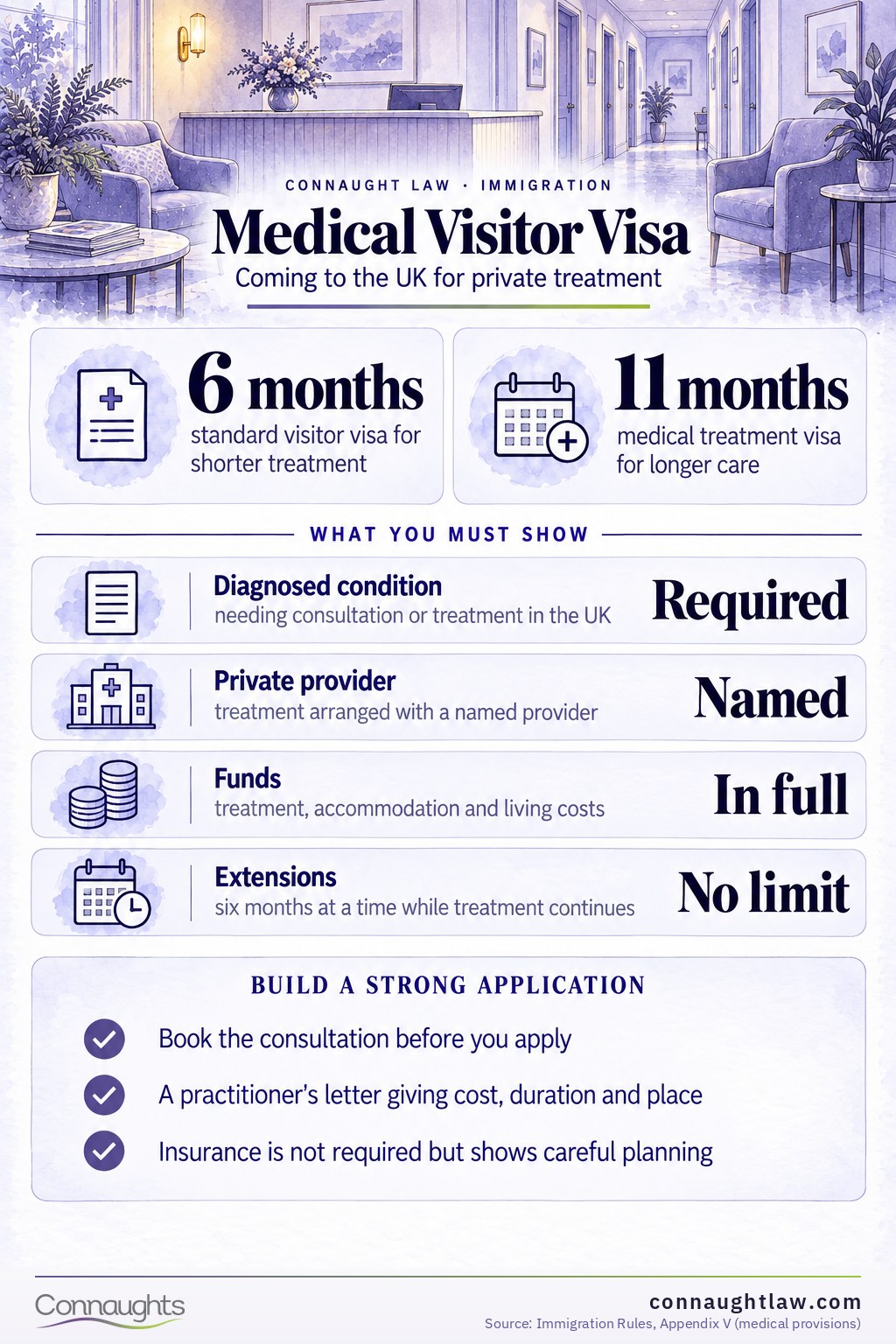
Medical visits run under the visitor rules' medical provisions: you must show a condition needing consultation or treatment in the UK, arrangements already made with a named private provider, and funds covering both the treatment and the stay. The National Health Service is not part of the plan — overseas visitors are chargeable patients, and an application that looks like NHS access by another name fails on suitability as well as credibility.
The UK Medical Tourism Landscape
Market and Regulatory Response
London's private hospitals and specialist clinics draw international patients for oncology, cardiac care, orthopaedics and fertility treatment, and the visitor rules have evolved to serve that market while protecting the NHS from unfunded use. The regulatory posture is simple: private treatment honestly arranged and paid for is welcome; the paperwork exists to prove that is what is happening.
Who Comes and for What
The caseload spans Gulf families funding complex surgery, patients from health systems without particular specialisms, and diaspora patients combining treatment with family. The common thread in successful applications is specificity — a named consultant, a treatment plan and a costed quote, rather than an intention to "see doctors in London".
Visa Options for Medical Visitors
The Two Routes In
Treatment finishing inside six months runs on the standard £135 visitor visa. Treatment with a longer arc — chemotherapy cycles, staged surgery, rehabilitation — uses the 11-month medical treatment visa at £234, which requires a TB certificate from listed countries. Both prohibit work, and both can be extended from inside the UK at £1,172 per application while treatment genuinely continues.
Alternative Entry Options
Non-visa nationals attending short consultations can enter on a £20 ETA under ordinary visitor conditions, keeping the medical evidence for the border. Organ donors, patients travelling with carers, and children accompanied by parents each add their own evidence layer — the general framework is in our Standard Visitor guide, the underlying provisions in our Appendix V analysis.
Evidence and Funds
Medical Documentation
The core exhibit is a letter from a registered practitioner confirming the condition, the need for UK consultation or treatment, its estimated cost and duration, and where it will happen. Add the UK provider's confirmation of the booking and quote. Vagueness is the enemy: "further investigations" satisfies no caseworker, while a named procedure at a named hospital with a price attached answers the question before it is asked.
Financial Evidence
Funds must cover treatment, accommodation and living costs without work or public funds — evidenced through bank statements, sponsor support or advance payment receipts. Insurance deserves its own line: no rule requires travel or medical insurance for a visitor visa, but caseworkers read comprehensive cover as evidence of planning, and uninsured complications are the fastest route to unpayable NHS emergency bills at the overseas visitor tariff.
Treatment Types and Visa Implications
Specialised Categories
Fertility treatment, cosmetic surgery, oncology and mental health care all qualify as private treatment; each shapes the evidence differently — cycle timing for IVF, staged procedures for reconstructive work, treatment protocols for cancer care. What matters is that the visa length sought matches the clinical plan on paper.
Matching Visa to Treatment Duration
Choose the route from the treatment plan, not the price list: a six-month visa for an eleven-month protocol forces an avoidable in-country extension at £1,172, while the 11-month visa bought for a short procedure invites questions about the real plan. The practitioner's duration estimate is the anchoring document for either choice.
Extensions and Long Treatment
Extending from Inside the UK
Medical visitors are the exception to the visitor extension ceiling: while treatment continues, extensions of six months at a time are available at £1,172 each, with no limit on their number. Each application rebuilds the evidence — updated clinical letters, proof of payment for treatment to date, and funds for the next phase.
Long-Term Treatment Planning
Serial extensions keep a patient lawful but never build toward settlement, and family members accompany as ordinary visitors with their own six-month limits. Where treatment will clearly run for years, the honest conversation is about whether the visitor framework fits at all — repeated extensions with no endpoint eventually strain the genuine visitor test.
Refusal Risks and Success Factors
Frequent Refusal Reasons
Medical visit refusals cluster on three findings: treatment arrangements too vague to verify, funds short of the quoted costs, and suspicion that the treatment story masks settlement or NHS use — particularly where the condition is chronic and the home country offers treatment. Each is answered by specificity, reconciliation of figures, and evidence of the return plan.
Building a Strong Application
Book the consultation before applying, quote the costs in the application, evidence the funds against them, insure the trip, and document what waits at home — work, family, follow-up care with the local physician. Applications assembled in that order rarely fail; applications that start with the visa and improvise the medicine usually do.
Frequently askedQuestions about medical visits
Is there a dedicated medical visa for the UK?
Not as a separate category — private patients use the visitor route: the standard £135 visa for treatment within six months, or the 11-month medical treatment visa at £234 for longer care, both under the medical provisions of Appendix V.
Do I need medical or travel insurance for a UK visitor visa?
No rule requires it — but it is strongly advisable. Visitors are chargeable NHS patients if complications force emergency care, at premium tariffs, and caseworkers read comprehensive cover as evidence of a well-planned genuine visit.
Can I use the NHS on a visitor visa?
Emergency departments treat anyone, but visitors are charged for hospital care at the overseas visitor tariff. The medical visitor route exists for arranged private treatment — applications suggesting NHS reliance are refused on funding grounds.
How long can I stay for medical treatment?
Six months on the standard visa, eleven on the medical treatment visa, then six-month extensions at £1,172 each with no cap while treatment genuinely continues — evidenced afresh with clinical letters and funds at every application.
What documents prove my treatment arrangements?
A registered practitioner's letter confirming the condition, the treatment's estimated cost and duration, and where it takes place — plus the UK provider's booking confirmation and quote, and payment evidence matching your financial documents.
Can family members come with me during treatment?
Yes, as ordinary visitors on their own applications — six-month stays, no work, each showing their own or shared funds. For a child patient, accompanying parents should evidence the family's arrangements and the child's care plan.
Send us the clinical letter and the quote. We'll match the visa route to the treatment plan and build the funds evidence to the figure.
Get Expert Advice