The Standard Visitor visa admits tourists, family visitors, business travellers and short-course students for up to six months: £135 for a single visa, long-term options to ten years, and a three-week processing standard that stretches in busy seasons. This guide covers the 2026 requirements, fees, current processing times, what a visitor may and may not do, and how the ETA system changes who needs a visa at all.
On This Page

Six Months, One Set of Rules
Every short-term visit to the UK — tourism, family, business meetings, private medical treatment, a short course — now runs through a single route governed by Appendix V of the Immigration Rules. Visa nationals apply for the Standard Visitor visa before travelling; non-visa nationals travel on an Electronic Travel Authorisation instead. Which side of that line you fall on decides everything about your preparation, cost and timing.
Requirements and Eligibility
Core Eligibility
The application succeeds or fails on the genuine visitor test in paragraph V4.2: you will leave at the end of the visit, you will not live in the UK through frequent or successive visits, your planned activities are permitted, and you can support yourself — and pay for the return journey — without working or accessing public funds. Decision-makers read the whole file against those four limbs, so the evidence of ties, income and itinerary matters more than any single document.
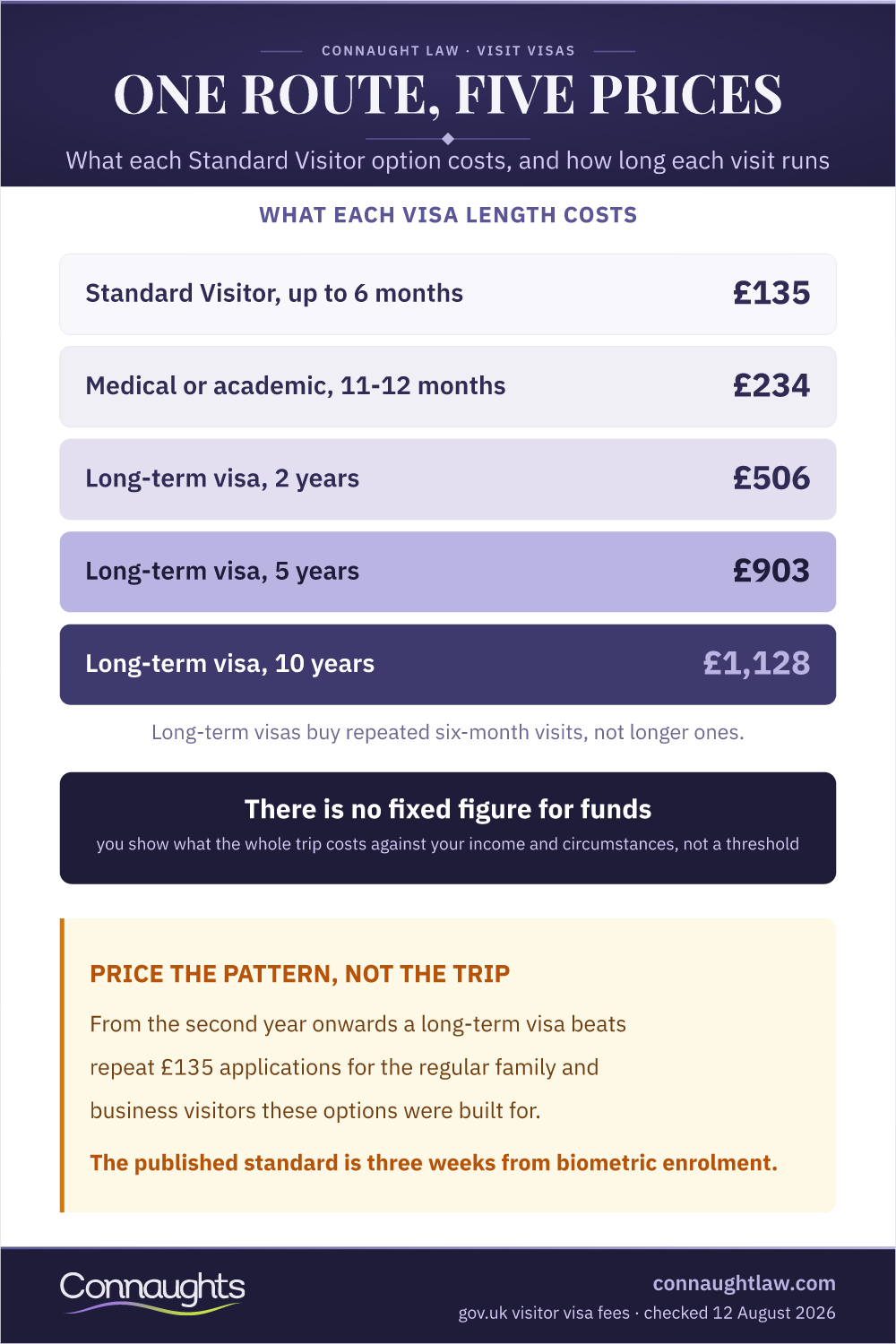
Fees and Visa Lengths
Current Standard Visitor Fees
| Visa | Fee | Stay per visit |
|---|---|---|
| Standard Visitor (up to 6 months) | £135 | Up to 6 months |
| Long-term — 2 years | £506 | 6 months per visit |
| Long-term — 5 years | £903 | 6 months per visit |
| Long-term — 10 years | £1,128 | 6 months per visit |
| Medical treatment visitor (11 months) | £234 | Up to 11 months |
| Academic visitor (12 months) | £234 | Up to 12 months |
Long-term visas suit regular family visitors and business travellers: one application covers repeated six-month visits across the validity period, and the per-trip economics beat repeat £135 applications from the second year onwards. The risk sits in the genuine visitor test — a long-term visa used to spend most of each year in the UK invites cancellation at the border, however valid the sticker.
Processing Times in 2026
The published service standard for visitor visas is three weeks from biometric enrolment, and most applications resolve inside it. Peak travel seasons, verification checks and incomplete files push cases beyond the standard, so the working rule is to apply as early as the three-month window allows and never book non-refundable travel against an undecided application. Where the timetable is tight, the priority service adds £500 for a five-working-day decision at participating application centres — covered in our priority services guide.
Permitted Activities
Business Activities
Visitors may attend meetings, conferences and interviews, negotiate and sign contracts, carry out site visits, and receive briefings — the full list sits in Appendix Visitor: Permitted Activities. The boundary is employment: doing the job itself in the UK, filling a role, or being paid by a UK entity for UK work all sit on the wrong side, and remote working for an overseas employer is permitted only as an incident of the visit rather than its purpose.
Study and Professional Development
Up to six months of study at an accredited provider is permitted within a visit — the basis of English-language stays covered in our short-term study guide — along with research-related activities for visiting academics and sitting professional exams such as the PLAB test for overseas doctors.
Family Visits
Visiting children at school, attending graduations and weddings, and ordinary family stays are all permitted; parents of children at independent schools have the dedicated Parent of a Child Student route where the stay needs to run with the school year, and anyone marrying in the UK needs the Marriage Visitor visa rather than a standard visit.
Success Rates and Statistics
How Outcomes Differ by Nationality
The Home Office granted 2.2 million visitor visas in the year ending March 2026, per the immigration system statistics — most applications succeed. Outcomes vary sharply by nationality, and the pattern is structural: applicants from countries with strong verification infrastructure and low overstay history see near-routine approval, while some nationalities face refusal on a scale that makes evidence quality decisive. The rate data, and what actually drives refusals, sit in our visit visa refusal analysis.
ETA or Visitor Visa?
Which One You Need
Non-visa nationals — Europeans, Americans, Australians and most other visa-free travellers — need a £20 ETA, applied for online and usually approved within days, permitting visits of up to six months. Visa nationals need the Standard Visitor visa itself. An ETA is a travel authorisation, not leave to enter: the decision at the border remains the officer's.
Refusal Risks and How to Avoid Them
Document Quality
Most visitor refusals are evidence failures rather than substance failures: unexplained bank deposits, employment letters that cannot be verified, itineraries inconsistent with stated income, and gaps where proof of ties should be. The application is decided on papers with no interview, so the file must anticipate every question — what you do at home, why you will return, who pays, and how the trip fits your circumstances. A refusal creates a record that every later application must address.
Applying Step by Step
The Application Sequence
- Complete the online application on gov.uk up to 3 months before travel and pay the fee.
- Book and attend a visa application centre appointment to enrol biometrics.
- Upload or scan supporting documents — funds, employment, ties, itinerary, sponsor documents where relevant.
- Wait out the three-week standard; add the priority service only where the centre offers it.
- Check the vignette on return of your passport and report any error immediately.
Recent Policy Changes
Remote Work and Rule Updates
The 2024–25 rule changes settled two modern questions: remote working for an overseas employer is tolerated within a genuine visit, and the ETA scheme now covers all non-visa nationalities, completing its phased rollout. Appendix V itself continues to move by statement of changes — the current consolidated text, and what each amendment did, is tracked in our Appendix V technical guide.
Frequently askedQuestions about the Standard Visitor visa
How long does a Standard Visitor visa take in 2026?
The published standard is three weeks from biometric enrolment for applications made outside the UK. Straightforward files often resolve faster; peak season and verification checks push others longer. The £500 priority service targets five working days where available.
How much money must I show?
There is no fixed figure. You must show funds covering the whole trip — travel, accommodation and living costs — that make sense against your income and circumstances. Third-party sponsorship is permitted where the sponsor's own funds and relationship to you are evidenced.
Can I work remotely for my employer at home while visiting?
Yes, within limits: answering emails and keeping up your overseas job alongside a genuine visit is permitted. Coming to the UK in order to work remotely — where the work is the point of the stay — fails the genuine visitor test.
Can I extend a visitor stay beyond 6 months?
Only in narrow cases — medical treatment visitors and some academics — at £1,172 per in-country extension. Ordinary visitors cannot extend past the six-month ceiling, and repeat back-to-back visits invite refusal at the border as de facto residence.
Is a long-term visitor visa worth it?
For regular visitors, usually: the 2-year visa at £506 beats four single applications, and the 5-year (£903) and 10-year (£1,128) options compound the saving. Each visit stays capped at six months, and the usage pattern must remain visiting rather than living.
Do children need their own visitor visa?
Yes — every traveller needs their own visa or ETA regardless of age. Child applications add consent and care evidence: who accompanies them, where they stay, and written permission from any parent not travelling.
Tell us your nationality, travel dates and past refusals. We'll build the evidence file around the genuine visitor test and match the service level to your timetable.
Get Expert Advice