
The marriage visitor visa lets you come to the UK for up to six months to marry or register a civil partnership — and then leave. It costs £135, decisions usually arrive within three weeks, and the ceremony needs 28 days' notice at a registry office. What it never does is turn into permission to stay: no extension, no switching, no work. This guide covers the requirements, the timing and the alternative most couples should at least consider.
On This Page
Marry Here, Then Leave
Two facts define this route. First, almost everyone who wants to marry in the UK as a visitor needs it — a standard visitor cannot give notice of marriage, and that includes nationals who normally visit without any visa at all. Second, it leads nowhere: the visa exists for the ceremony, not for the life afterwards. Get those two facts right and everything else on this page is logistics.
What the Marriage Visitor Visa Is
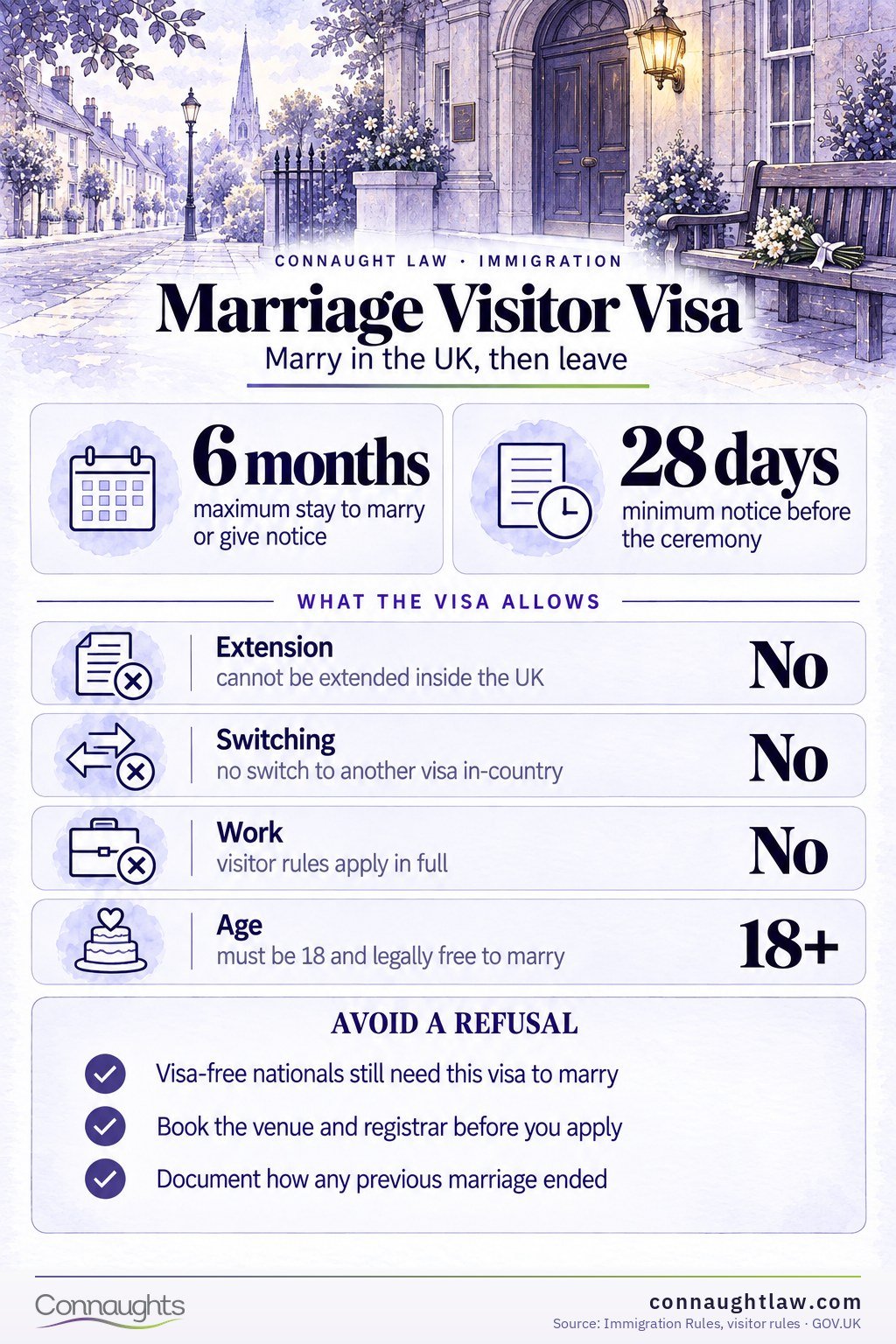
A visitor visa for people coming to the UK to marry, register a civil partnership, or give notice of one, within a stay of up to six months. It costs £135 under the fees in force from 8 April 2026 and is governed by the visitor rules — the official guide is at gov.uk. It cannot be extended and cannot be switched to any other visa from inside the UK.
Who Needs One
Anyone marrying in the UK during a visit — including non-visa nationals who would ordinarily enter visa-free. The exceptions are people who already hold UK status that permits marriage: settled and pre-settled residents, Irish citizens, and those on substantive visas. The classic error is a couple assuming a tourist entry covers a wedding; registrars check status when notice is given, and that is precisely where the plan collapses.
How It Differs from Other Routes
Visitor rules apply in full: no work, no study beyond incidental permitted activities, no public funds, no dependants, and no route to remaining. A couple intending to live in the UK after the wedding is on the wrong page — that plan belongs to the fiancé visa, which costs more precisely because it leads somewhere.
Eligibility and Evidence
Age and Freedom to Marry
Applicants must be 18 or over and legally free to marry — with divorce or death certificates where a previous marriage ended. The gov.uk eligibility rules also require that the marriage or notice actually happen during the visit, so the intention has to be concrete: a real ceremony, planned, within the stay. The UK's marriage-age rules themselves are covered in our marriage age guide.
Genuine Relationship Evidence
Decision-makers test whether the relationship and the wedding are genuine, and they do it on paper. There is no prescribed list and no magic number of months — what convinces is coherence: evidence of the relationship's history, of time spent together, and of a wedding that is actually organised rather than merely asserted.
Proving the Relationship
| Evidence | What it shows |
|---|---|
| Communication history | A relationship that exists between visits, told consistently by both partners |
| Time spent together | Travel records and photographs across the relationship, not a single trip |
| Wedding arrangements | Venue and registrar bookings, invitations — a ceremony with a date, not an idea |
| Family awareness | Involvement of family and friends on both sides where cultural context makes that natural |
Planning the Ceremony
Notice and the 28-Day Rule
Marriages and civil partnerships in the UK require notice to be given in person, and the ceremony cannot take place until the notice period — at least 28 days — has run. For a six-month visa that maths is generous, but only if the couple lands with documents ready: registrars need originals, and a missing divorce certificate can burn weeks the itinerary did not price in.
Venues and Bookings
The ceremony must happen at a register office or venue licensed for marriage, and the visa application is stronger when the booking already exists. Confirmations do double duty: they satisfy the registrar's process and they evidence, for the visa, that this wedding is real, funded and scheduled inside the permitted stay.
Money and Maintenance
Supporting Yourself Without Public Funds
There is no fixed income threshold — this is the visitor test, not the £29,000 partner rule. You must show you can cover travel, accommodation and living costs for the stay without working or claiming public funds: recent bank statements, employment or income evidence, and where a partner or family is contributing, evidence that their support is real and affordable to them.
Evidencing the Wedding Itself
Show that the wedding you describe is the wedding you can pay for: deposits paid, bookings in writing, a budget that matches the bank statements. No rule prescribes what a ceremony should cost, and inflated claims help nobody — a modest, documented wedding reads as far more genuine than a lavish one held together by assertion.
Applying and Timing
The Online Application
Applications are made online from outside the UK, up to three months before travel, with identity confirmed at a biometric appointment and documents uploaded. Non-English documents need certified translations. The application should tell one consistent story across the form, the evidence and both partners' accounts — inconsistency, not weakness, is what draws refusals.
Decision Times and Paid Options
Per gov.uk on the day of writing: decisions usually arrive within three weeks of the biometric appointment, with paid services available at some application centres for faster decisions. Build the notice period into the plan — the visa decision and the registrar's 28 days run one after another, not in parallel, unless notice is being given by a partner already in the UK.
Service Levels and Times
| Service | Cost | Usual timescale |
|---|---|---|
| Standard | £135 | Around 3 weeks from the biometric appointment |
| Priority (where available) | £500 on top | 5 working days |
| Super priority (limited locations) | £1,000 on top | By the end of the next working day |
Refusals and How They Happen
Timing and Paperwork Errors
- Ceremonies booked so close to travel that any processing delay makes the plan impossible — decision-makers notice impossible plans.
- Applying on, or after entering as, a standard visitor and hoping the registrar will not check. They check.
- Evidence that contradicts itself — dates, addresses or relationship history told differently across the form and documents.
- Previous marriages left undocumented, leaving freedom to marry unproven.
Thin Relationship Evidence
Genuine couples get refused for presenting real relationships badly: no shared history on paper, a wedding with no bookings, a sponsor whose support is asserted but not evidenced. The refusal letter then becomes part of the record for every later application — including any future spouse visa — which is why the first application deserves proper preparation even on this short route.
Marriage Visitor or Fiancé Visa?
The Two Routes Compared
| Feature | Marriage visitor | Fiancé visa |
|---|---|---|
| Fee | £135 | £2,064 |
| Stay | Up to 6 months | 6 months |
| Financial test | Visitor self-sufficiency, no fixed figure | £29,000 minimum income requirement |
| After the wedding | Leave the UK | Switch in-country to the partner route |
| Settlement path | None | Yes, via the spouse visa |
After the Wedding
A married couple who later decide on UK life apply for the spouse visa from abroad, meeting the full partner-route requirements — the marriage visitor stay contributes nothing towards it. Couples who suspect they will want to stay should run the numbers on the fiancé route before booking anything: paying £135 now and £2,064 later, with an international move in between, is usually the most expensive sequence of all.
Frequently askedQuestions about the marriage visitor visa
How much does the marriage visitor visa cost?
£135 under the fee table in force from 8 April 2026. Where available, a £500 priority service targets a decision in 5 working days and £1,000 super priority by the next working day. There is no health surcharge on a visit of six months or less.
Can I switch to a spouse visa after marrying?
No. The marriage visitor visa cannot be extended or switched from inside the UK. After the wedding you leave, and any spouse visa application is made from abroad against the full partner-route requirements, including the £29,000 financial test.
Do I need this visa if my country doesn't need a visit visa?
Yes. Marrying or giving notice in the UK requires the marriage visitor visa even for nationals who normally enter visa-free. Registrars verify immigration status when notice is given, so entering as an ordinary visitor and marrying anyway is not a workable plan.
How long does the application take?
Usually about three weeks from the biometric appointment, per current gov.uk guidance. Add the registrar's minimum 28-day notice period after arrival, and work backwards from the ceremony date — the two clocks run in sequence, and neither can be compressed by hoping.
What financial evidence is needed?
Enough to show the trip and wedding are affordable without working or claiming public funds: recent bank statements, income evidence, and documentation for any support from your partner or family. There is no fixed threshold — consistency between the plan and the money is what matters.
Can we give notice on one trip and marry on another?
The route covers coming to give notice as well as to marry, and some couples split the two across visits. The intended ceremony must still be genuine and planned, and each visit must respect the visitor rules — take advice before structuring it this way.
Tell us your ceremony date, where you'll apply from and whether you plan to stay after the wedding. We'll tell you which route fits and how the visa and notice clocks line up.
Get Expert Advice