
A UK spouse visa application stands or falls on five tests: an eligible sponsor, the £29,000 financial requirement, adequate accommodation, A1 English and a relationship the Home Office accepts as genuine. Every one is evidenced in a prescribed way, and most refusals are evidence failures rather than substance failures. This guide works through each test as it applies in 2026, with the current fees and the policy review that may yet move the threshold.
On This Page

Five Tests, One Application
The spouse visa lives in Appendix FM of the Immigration Rules, and Appendix FM thinks in tests. It does not ask whether your marriage is happy or your plans sensible; it asks whether five defined requirements are each met by the specified evidence. Applications succeed by treating each test as its own project — and fail by assuming that strength in one compensates for a gap in another.
A sponsor who is British, settled or in a qualifying category; income of £29,000 (or the savings alternative); accommodation that is adequate without overcrowding; A1 English from an approved test or exemption; and a genuine, subsisting relationship. Fees are £2,064 outside the UK or £1,407 inside, plus the health surcharge, at the rates in force from 8 April 2026.
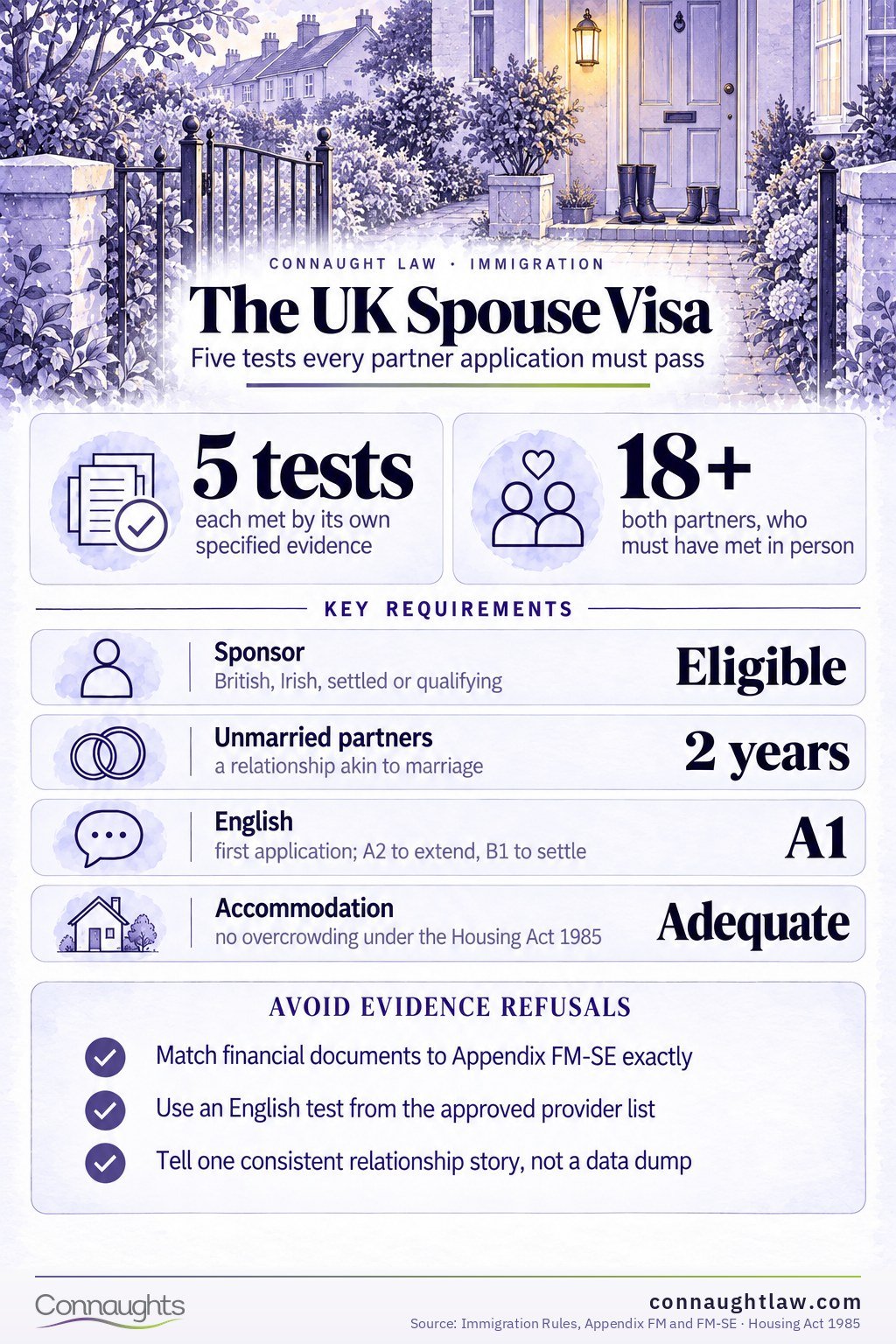
Who Can Apply and Who Can Sponsor
Age and the Relationship
Both partners must be 18 or over, have met in person, and be in a legally recognised marriage or civil partnership — or, on the unmarried partner route, a relationship akin to marriage for at least two years. Foreign marriages count where they were valid in the country of celebration; previous marriages must be properly dissolved and documented.
Who Can Sponsor
The UK partner must be a British or Irish citizen, hold indefinite leave to remain or EU settled status, or fall within a qualifying category such as refugee status. A pre-settled status partner generally sponsors through the EU Settlement Scheme's own family rules rather than Appendix FM. The sponsor also anchors the financial requirement, so their status and their income evidence usually come from the same file.
The £29,000 Financial Requirement
The minimum income requirement is £29,000, per the gov.uk financial requirement guidance checked on 1 August 2026, with no separate child supplements for applications made under the current rules. Cash savings can substitute — £88,500 with no income at all, from the formula £16,000 + 2.5 × £29,000 — or top up a shortfall on the same arithmetic. The full permutations, including self-employment and the six-month evidence windows, are in our financial requirements guide.
- Salaried employment, evidenced by six months of payslips and matching bank statements (twelve months where the job is newer).
- Self-employment, assessed on the last full tax year with the FM-SE document set.
- Pension, property and certain non-employment income, each with its own evidence rules.
- The applicant's own earnings — but only where they are lawfully working in the UK, which is why entry clearance budgets usually rest on the sponsor alone.
Transitional Protection for Earlier Applicants
Couples who entered the route before 11 April 2024 stay on the old framework for extensions and settlement: £18,600, plus the historic child additions. The protection follows the application chain — leave it (for instance by switching category) and the current threshold applies. Anyone planning a break in the route should price that decision before making it.
Adequate Maintenance and Exemptions
Where the sponsor receives specified disability or carer's benefits — Disability Living Allowance, Personal Independence Payment, Carer's Allowance and their equivalents — the £29,000 test is replaced by adequate maintenance: enough to support the household without public funds. It is a different calculation with its own traps, covered in our adequate maintenance guide.
Accommodation Without Overcrowding
The couple must show somewhere adequate to live — owned, rented or provided by family — without recourse to public funds. Evidence is practical: title deeds or a tenancy agreement, and a permission letter with proof of ownership where relatives are hosting.
The Room Standard
Adequacy borrows the Housing Act 1985 overcrowding standards: rooms available for sleeping are counted against the people who will occupy them, with children counted by age. A one-bedroom flat housing the couple alone passes comfortably; a family home already at capacity does not, however sincere the welcome. Where hosting is tight, a short surveyor's or council tax-style occupancy statement can settle the point before a caseworker raises it.
English at A1, Then A2 and B1
The first application needs CEFR level A1 in speaking and listening from a Home Office-approved test, the extension needs A2, and settlement needs B1 — so the requirement climbs with the route. A B1 pass taken early can be reused at every later stage, which is the quiet money-saver most applicants discover too late.
Exemptions and Accepted Qualifications
Exempt: applicants aged 65 or over, those with a long-term condition preventing testing, and nationals of the listed majority-English-speaking countries. A degree taught in English can substitute where confirmed by Ecctis. Everyone else needs a test from the approved provider list — the right level from an unapproved provider fails, and it is among the most common self-inflicted refusals on the route.
Proving the Relationship Is Genuine
Evidence That Reads True
Caseworkers read for coherence: a relationship history both partners tell the same way, communication that spans the relationship rather than the month before applying, cohabitation or visit evidence, family awareness, and financial lives that touch where the couple's circumstances make that natural. Volume is not the metric — a curated bundle that tells one consistent story outperforms a memory stick of everything.
Arranged Marriages and Cultural Context
An arranged marriage is not a sham marriage, and the rules do not require a Western courtship template. What they require is that the marriage is genuine and subsisting now — evidence of the families' involvement, the ceremony, and the couple's life since usually answers the question well. Where a relationship's paper trail is culturally thin, the application should explain the context rather than leave a caseworker to guess.
Applying, Inside or Outside the UK
Forms, Biometrics and FM-SE Evidence
Applications are made online, with biometrics enrolled and documents uploaded. The financial evidence must match Appendix FM-SE to the letter — the rules specify not just what to prove but which documents prove it, covering what dates, in what form. Most financial refusals are FM-SE form failures by couples who genuinely earn enough.
Fees and Processing Times
| Application | Fee | Health surcharge | Usual decision time |
|---|---|---|---|
| Entry clearance (outside the UK) | £2,064 | £3,105 (33 months) | Within 12 weeks; £500 priority targets 30 working days |
| Extension (inside the UK) | £1,407 | £2,587.50 (30 months) | Within 8 weeks; £500 priority 5 working days, £1,000 super priority next working day |
The full cost picture across the five-year route — settlement, citizenship and where money is genuinely saveable — is in our spouse visa fees guide.
Policy Watch — What Might Change
The MAC Review
The Migration Advisory Committee's family visa financial requirements review, published in June 2025, recommended against raising the threshold to £38,700 and set out lower options for ministers. The government has implemented no change since: £29,000 is the rule today, the shelved rises have not returned, and any future move will arrive through the Immigration Rules with notice.
Planning Amid Uncertainty
The May 2025 White Paper's family measures, and the earned-settlement proposals consulted on in early 2026, remain proposals — not law — and applications are decided under the rules in force on the day. The practical strategy is to apply when ready under today's requirements rather than time an application around reforms that may never arrive in their trailed form; our family visa team tracks the position case by case.
Frequently askedQuestions about spouse visa requirements
What are the main requirements in 2026?
An eligible sponsor (British, Irish, settled or qualifying status), £29,000 income or the savings alternative, adequate accommodation, A1 English from an approved test, and evidence of a genuine, subsisting relationship. Each is tested against specified evidence rules, and each can independently sink the application.
Is the £29,000 threshold going up?
Not currently. The previously announced rises to £34,500 and £38,700 were shelved, and the MAC's June 2025 review recommended against the higher figure. No change has been implemented — applications today are decided at £29,000, and any future move would come with notice.
We applied before April 2024 — which rules apply to us?
The transitional framework: £18,600 with the old child additions continues to apply at extension and settlement for couples who entered the route before 11 April 2024, provided they stay on it. Switching categories or breaking the chain moves you onto the current threshold.
What counts as adequate accommodation?
Somewhere the couple can live without public funds and without statutory overcrowding, measured against the Housing Act 1985 room standards. Owned, rented or family-provided all work — family hosting needs a permission letter, proof the host owns or rents the property, and room for everyone counted.
Who is exempt from the English test?
Applicants aged 65 or over, people with a long-term physical or mental condition preventing testing, and nationals of listed majority-English-speaking countries. A degree taught in English, confirmed by Ecctis, also satisfies the requirement. Everyone else needs an approved SELT at the right level.
How long does the application take?
Usually within 12 weeks from outside the UK and 8 weeks inside, per current gov.uk guidance — but in-country applications that rely on human-rights grounds rather than meeting the rules currently take around 12 months. Priority services can compress the compliant cases, not the exceptional ones.
Tell us who is sponsoring, what income or savings you are relying on and where you both live now. We'll tell you which requirement is the weak point and what evidence would answer it.
Get Expert Advice