
The spouse visa financial requirement is £29,000 a year — or £88,500 in cash savings, or a combination under the 2.5 formula — and it is tested with evidence rules precise enough that couples who earn comfortably above the line are still refused on paperwork. This guide covers the threshold as it stands, the savings arithmetic with worked figures, the self-employment categories and every exemption that replaces the income test.
On This Page

The £29,000 Question
Appendix FM's financial requirement is a threshold plus an evidence code. The threshold says how much; Appendix FM-SE says exactly which documents prove it, covering which dates, in which form. Most financial refusals happen in the second half — which is why this guide spends as much time on categories and paperwork as on the headline number.
£29,000 gross per year for applications made under the current rules, per gov.uk checked on 1 August 2026, with no separate additions for children. Cash savings can replace income at £88,500 or reduce it using the formula (savings − £16,000) ÷ 2.5. Couples who entered the route before 11 April 2024 keep the £18,600 framework.
Which Threshold Applies to You
The staged rises announced in 2023 — £34,500 and ultimately £38,700 — were shelved, and the Migration Advisory Committee's June 2025 review recommended against the top figure. No change has been implemented since: £29,000 is the operative threshold, and any future movement will come through the Immigration Rules with notice, not overnight.
Marriage Visa, Spouse Visa — Same Money Rules
Spouse visa, marriage visa, partner visa and unmarried partner visa are the same Appendix FM financial test wearing different names; the fiancé route applies it too. The genuinely different regimes sit elsewhere — partners applying under the EU Settlement Scheme, covered in our guide to family routes for non-EU family members, and the armed forces rules with their own £23,496 threshold.
Threshold by Application Date
| Cohort | Income threshold | Savings-only equivalent |
|---|---|---|
| Entered the route before 11 April 2024 | £18,600, with the historic child additions | £62,500 (£16,000 + 2.5 × £18,600) |
| Applying under the current rules | £29,000, no child additions | £88,500 (£16,000 + 2.5 × £29,000) |
| Armed forces sponsors (Appendix Armed Forces) | £23,496 | Formula applied to that threshold |
How Appendix FM Counts Income
Category A and Category B
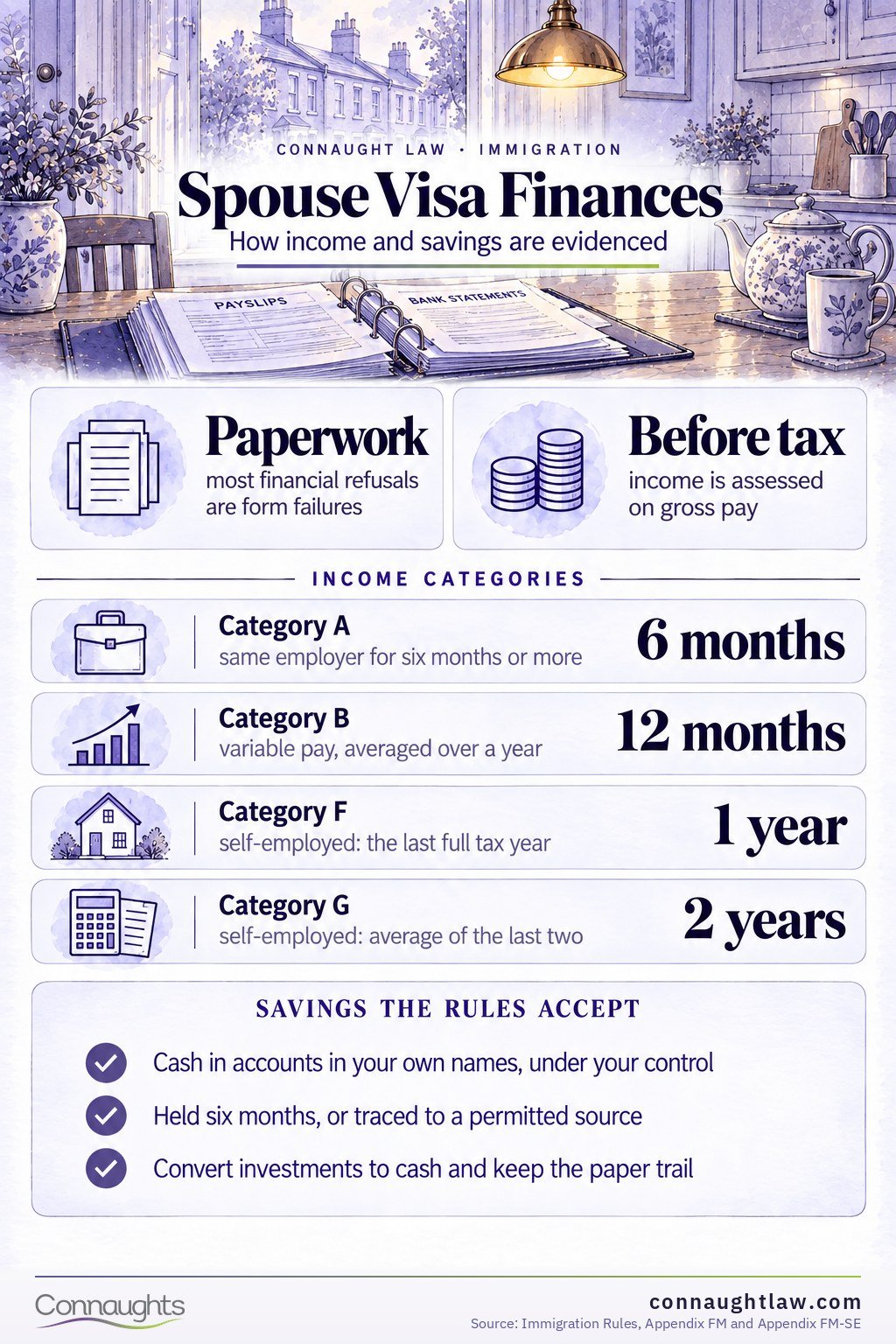
Salaried employment with the same employer for six months or more is Category A: the lowest payslip in the six months sets the annualised figure. Anything less settled is Category B: the last twelve months of income are averaged, and the current job must also pay at the threshold rate. Choosing the wrong category — or evidencing the right one with the wrong months — is the classic refusal that has nothing to do with how much anyone earns.
What Counts as Non-Salaried
Non-salaried covers pay that moves: hourly and shift work, commission-heavy roles, zero-hours contracts and employment shorter than six months. The rules average it rather than trusting a single month, so applicants with variable pay should assemble the full twelve-month picture and check the average clears the line before relying on a strong recent quarter.
Self-Employment and Company Directors
Category F vs Category G
Self-employed sponsors use Category F — the last full tax year — or Category G, averaging the last two, evidenced with SA302s, tax year overviews, business bank statements and accounts. Directors of specified limited companies face the most demanding set of all: company accounts, CT600, dividend vouchers and payslips, because the rules treat a family company's figures with organised suspicion. Timing matters — the "last full tax year" is fixed at the date of application, so applying weeks earlier or later can change which year must do the work.
The Savings Formula
Cash savings above £16,000 convert to income at the 2.5 rate: (savings − £16,000) ÷ 2.5 = income equivalent. Full substitution needs £88,500 under the current threshold. At settlement stage the arithmetic improves — savings above £16,000 count pound for pound against the shortfall — but for entry and extension, the table below is the planning tool.
Money the Formula Will Count
- Held in cash, in accounts in the couple's own names, under their control.
- Held for at least six months — or traceable to a permitted source such as a property sale within that window.
- Investments generally need converting to cash to count, with the paper trail kept.
- Gifted money can qualify once genuinely the couple's own and seasoned in their account — provenance evidence matters.
Savings and Income Combined
| Savings held | Income equivalent | Income still needed (£29,000 cohort) | Income still needed (£18,600 cohort) |
|---|---|---|---|
| £25,000 | £3,600 | £25,400 | £15,000 |
| £45,000 | £11,600 | £17,400 | £7,000 |
| £65,000 | £19,600 | £9,400 | None — fully met |
| £88,500 | £29,000 | None — fully met | None — fully met |
Benefits and Adequate Maintenance
Where the sponsor receives a qualifying benefit — Disability Living Allowance, Personal Independence Payment, Carer's Allowance, Armed Forces Independence Payment or Constant Attendance Allowance among them — the £29,000 test is replaced by adequate maintenance: after housing costs, the household must have more than an equivalent family on income support would. It is a genuinely different calculation with its own evidence habits, worked through in our adequate maintenance guide.
The Requirement at Extension and Settlement
The financial test recurs at the extension and again at settlement, and two things change in the applicant's favour: their own UK earnings now count, since they are lawfully working, and at settlement the savings arithmetic softens. Grandfathered couples keep the £18,600 framework throughout, provided they stay on the route. Couples who cannot meet the test at a later stage do not simply fail — the ten-year route exists for exactly that position, compared in our five-year versus ten-year route guide.
Refusals, Appeals and What the Evidence Shows
The Home Office does not publish a clean refusal rate for financial-requirement failures, so distrust any article quoting one. What the published record does show is the pattern: the MAC's review found the threshold bears hardest on lower-earning regions and sectors, and in practice most financial refusals turn on Appendix FM-SE form failures — the wrong category, the wrong months, a missing document — rather than genuine shortfalls. A refusal carries a human-rights appeal, lodged within 14 days in-country or 28 days from abroad, and appeals built on complete evidence succeed regularly; our spouse visa requirements guide covers how the tests fit together.
Frequently askedQuestions about the financial requirement
Is the £29,000 requirement before or after tax?
Before tax — the threshold is assessed on gross income. For salaried Category A cases the lowest payslip in the six-month window is annualised, so one light month can drag the assessable figure below a salary that looks comfortable on paper.
How much savings do I need if there is no income?
£88,500 under the current threshold — £16,000 plus 2.5 times £29,000 — held in cash for six months in the couple's own names. Grandfathered couples on the £18,600 framework need £62,500. Smaller balances reduce the income needed using the same formula.
What is non-salaried employment?
Pay that varies: hourly rates, shifts, commission, zero-hours arrangements or a job held under six months. It is assessed under Category B by averaging twelve months of income, and the current role must also pay at threshold rate — both limbs have to work.
Do the old rules still apply to my extension?
If you first applied on the route before 11 April 2024, yes — £18,600 with the historic child additions continues through extension and settlement while you remain on the route. Leaving the route, or switching category, brings the current £29,000 threshold into play.
Can investment accounts count as savings?
Generally only once converted to cash — funds must be immediately accessible and under the couple's control, with the conversion documented. Stocks, bonds and pension pots are not counted in their invested form, so restructure well before the six-month evidence window opens.
What evidence do self-employed sponsors need?
For Category F or G: SA302s and tax year overviews, business and personal bank statements, and accounts — with the company set (CT600, dividend vouchers, payslips) for specified limited company directors. The documents must cover the exact tax years the category requires, not approximately.
Can sponsors on benefits avoid the income requirement?
Sponsors receiving qualifying disability and carer's benefits use adequate maintenance instead of the £29,000 test: the household must be supportable without public funds, measured against income support equivalence after housing costs. It is often more achievable, but it needs its own careful evidence.
Tell us how the money is earned — employment, self-employment, savings or benefits — and when you first applied on the route. We'll tell you which category fits and exactly which documents the rules will demand.
Get Expert Advice