There is no formal sponsorship certificate for UK visitors — "sponsoring" a visit means putting your own status, finances and accommodation into someone else's application. Done well it anchors the file; done carelessly it supplies the inconsistencies that refuse it. This guide covers who can sponsor, what a sponsor actually promises, the documents and letter that carry weight, and the sponsor-side errors that sink otherwise strong visits.
On This Page

What Sponsoring a Visitor Really Means
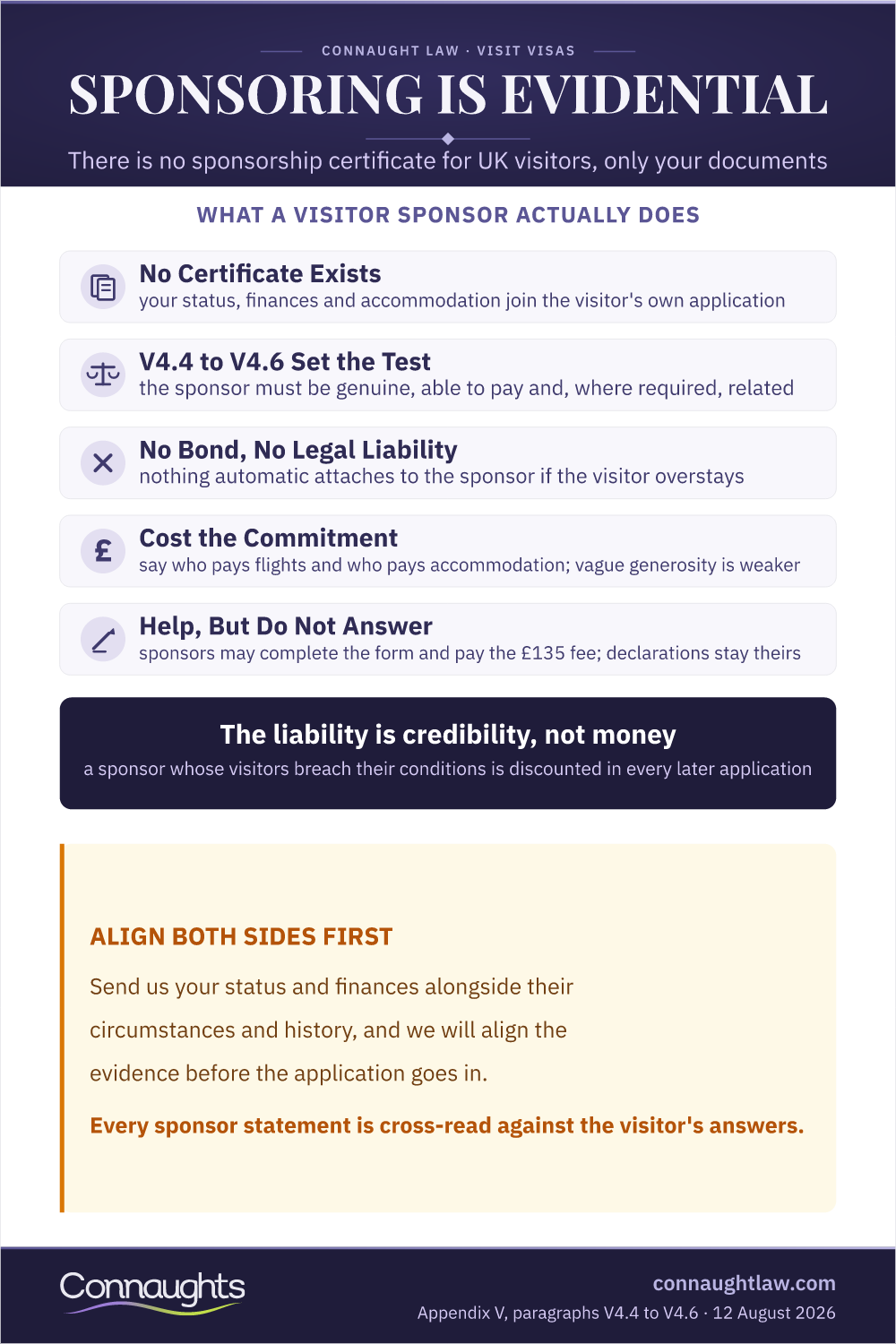
Visitor sponsorship is evidential, not legal: Appendix V permits a third party to fund and accommodate a visit under paragraphs V4.4 to V4.6, provided the sponsor is genuine, can actually pay, and — where required — has the right relationship to the applicant. The application remains the visitor's own; your role as sponsor is to make their story verifiable from the UK side.
Who Can Sponsor
Core Eligibility
Any UK resident with lawful status can support a visit application — British citizens, settled residents, and visa holders whose own permission is solid. What matters is credibility: a sponsor whose immigration status, income and address check out strengthens the file, while a sponsor with precarious status or undocumented income imports their problems into the applicant's case.
Proving Your Status
Sponsors evidence status with a British passport, an eVisa share code or settlement documents, plus proof of address — council tax, utilities or tenancy. The pack should be current, consistent with the address the visitor gives, and complete enough that the caseworker never needs to guess who the host is.
Obligations and Responsibilities
What You Are Promising
A sponsor's letter is a factual undertaking: that you will accommodate the visitor, fund what you say you will fund, and that the visit's purpose is as described. There is no financial bond and no automatic legal liability if the visitor overstays — but a sponsor whose visitors breach their conditions will find their support discounted in every later application, and knowingly false statements engage the false representation rules for both parties.
Documents That Carry Weight
Sponsor Document Checklist
- Status: passport, eVisa share code or settlement evidence.
- Address: council tax, utility bill or tenancy agreement, current within three months.
- Accommodation: proof there is room to host — tenancy terms or property ownership.
- Finances, where you fund the visit: 3–6 months of statements and employment evidence.
- Relationship: certificates or photographs establishing the family or friendship link.
- The invitation letter tying it together — dates, purpose, who pays for what.
The letter itself does the narrative work — structure and a worked example are in our invitation letter guide — while the documents make every sentence checkable against the standard in the supporting documents guidance.
Helping with the Application
Permitted and Prohibited Assistance
Sponsors may help complete the online form, pay the fee, and assemble documents — the application on gov.uk is frequently filed from the UK side. What a sponsor must not do is answer as the applicant: the declarations are the visitor's own, the credibility assessed is theirs, and a form whose answers only the sponsor could have written reads as exactly that.
Financial Support
How Much Support to Show
There is no set amount — the test is that the visit's full costs are covered between applicant and sponsor, from funds whose origin makes sense. The split should be explicit: if you cover accommodation and food while the visitor funds flights and insurance, the letter and both sets of statements should say precisely that. Vague generosity ("I will cover everything as needed") is weaker than a costed commitment your statements visibly support.
Relationship Evidence
Evidence by Connection Type
Family links prove with certificates — birth, marriage, adoption — building the chain from applicant to host. Friendships prove with history: photographs together, correspondence over time, records of previous visits in either direction. The thinner the paper trail, the more the visit's plausibility depends on the surrounding evidence, which is where long-distance friendships and online relationships need honest, careful presentation.
Common Sponsor Mistakes
The Errors That Refuse Applications
The refusal-generating errors are consistency failures: a letter promising accommodation at one address while the documents show another; sponsor funds that do not match the promised support; dates in the letter contradicting the form; and template letters recycled between relatives. Every sponsor statement is cross-read against the visitor's answers — reconcile both sides before submission, and if a previous visit went wrong, have our visitor visa team frame it rather than hoping it is forgotten. The applicant-side failure patterns are covered in our refusal prevention guide and the family-visit evidence rules in our family visitor guide.
Frequently askedQuestions about sponsoring visitors
Can I sponsor someone for a UK visitor visa?
Yes, if you live in the UK lawfully — citizens, settled residents and visa holders can all support a visit by evidencing accommodation, funds and the relationship. There is no formal sponsorship certificate; your documents simply join the visitor's application.
Am I legally liable if my visitor overstays?
No bond or automatic penalty attaches to visitor sponsorship. The real consequence is credibility: your support will carry little weight in future applications, and knowingly false statements in a sponsor letter engage the deception rules for both of you.
How much money do I need to sponsor a visitor?
No fixed figure — enough that the visit's full costs are credibly covered between you. Show 3 to 6 months of statements, state exactly which costs you cover, and make sure the numbers reconcile with what the visitor's own evidence shows.
Do I need to send original documents?
No — applications are digital, and clear scans uploaded with the visitor's application suffice. What matters is currency and consistency: documents within three months where possible, all showing the same names, addresses and figures as the form.
Can I pay the visa fee for my visitor?
Yes — sponsors routinely pay the £135 fee and complete the online form with the applicant. The answers and declarations must remain the visitor's own; assistance with mechanics is fine, substitution is not.
Why was my relative refused despite my sponsorship?
Usually because the refusal was about their side — ties, history or funds provenance — or because sponsor and applicant evidence contradicted each other. Read the notice: it identifies the failed limb, and the next application must fix that specific finding.
Send us both sides of the picture — your status and finances, their circumstances and history. We'll align the evidence before the application goes in.
Get Expert Advice