
Most UK visitor applications succeed — the Home Office granted 2.2 million visitor visas in the year ending March 2026 — but refusal is concentrated, predictable and almost always evidence-driven. Approval rates vary sharply by nationality, and the same ten failures account for the bulk of refusals. This guide sets out the current rate picture, the genuine visitor test, each refusal reason, and the realistic options once a refusal has landed.
On This Page

What the Grant Figures Really Show
The headline numbers are reassuring: 2.2 million visitor visas granted in the year ending March 2026, per the Home Office immigration system statistics. The reassurance is misleading for exactly the applicants who search for it. Refusal is not spread evenly — it concentrates by nationality, by profile and by evidence quality, which means your own approval odds are set by your file, not by the average.
Visitor Approval and Refusal Rates
The Home Office publishes entry clearance outcomes by nationality in its detailed data tables, and the spread is stark: nationals of wealthy visa-required countries are approved almost as a matter of routine, while applicants from some African and South Asian countries face refusal at rates several times the global average. The pattern is structural — verification difficulty, overstay history and document fraud rates in the country of application drive caseworker scepticism — and it means an applicant from a high-refusal country needs a materially stronger file to reach the same decision.
The Genuine Visitor Test
Four Core Requirements
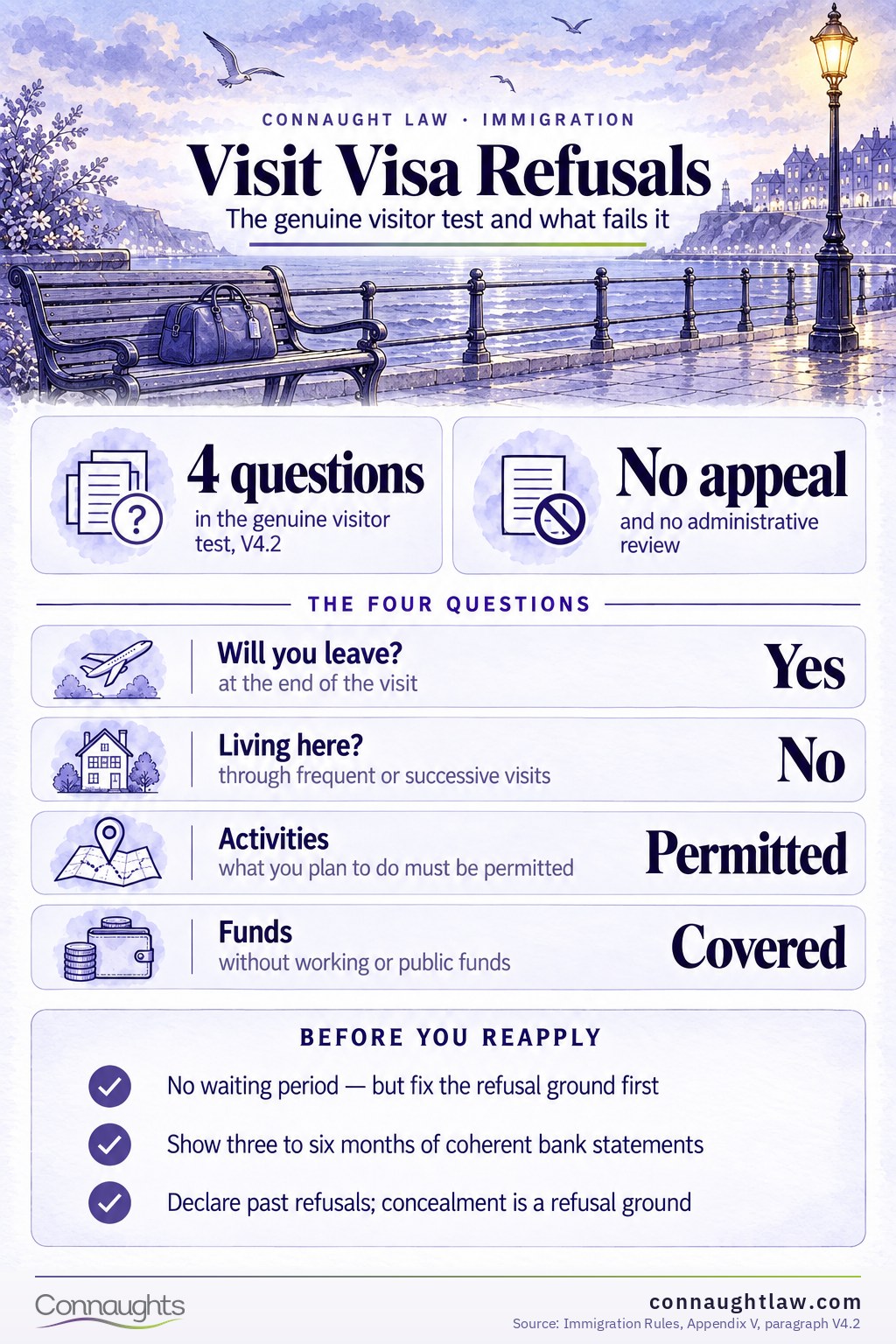
Paragraph V4.2 of Appendix V asks four questions: will you leave at the end of the visit; are you living in the UK through frequent visits; is what you plan to do permitted; and can you fund the trip without working or public funds. Every refusal reason below is one of these four limbs failing in a specific way — which is why prevention is about evidence architecture, not luck.
Common Refusal Reasons
Ten Reasons Applications Fail
- Funds that do not match the trip's cost, or balances that appeared just before applying.
- Weak evidence of employment, business or study commitments at home.
- Family circumstances suggesting the centre of life is moving to the UK.
- Inconsistencies between the form, the documents and the sponsor's account.
- Unexplained gaps or contradictions against previous applications.
- Overstays, breaches or refusals in the UK or comparable countries.
- Suspected intention to work, study long-term or settle.
- Documents that cannot be verified, or that prove false.
- Vague or implausible visit purpose with no supporting itinerary.
- A visit pattern already close to residence through successive stays.
Financial Evidence Failures
Money is the most common failure point because it is tested twice: sufficiency and provenance. A balance that covers the trip fails anyway if the account history cannot explain it — large recent deposits read as borrowed window-dressing. The working standard is three to six months of statements in which income, spending and the proposed trip cost form one coherent financial story.
Weak Home-Country Ties
Ties are the evidence that answers V4.2(a): employment with approved leave, business ownership, property, enrolled study, dependants who remain behind. Their absence is not fatal in itself — retirees and young adults can succeed — but where ties are thin, the rest of the file must work harder, and applicants who leave the ties section to inference are delegating the decision to scepticism.
Document Quality and Third-Party Issues
A distinct band of refusals is caused not by the applicant's circumstances but by the paperwork itself: employment letters the caseworker cannot verify by phone or email, bank statements in inconsistent formats, translations without certification, and sponsor documents that contradict the application form. Third-party involvement multiplies the risk — agents who recycle template letters across clients leave fingerprints caseworkers recognise, and a false document submitted by anyone, with or without your knowledge, engages the false representations rules with consequences reaching every future application. Every document should be independently verifiable, internally consistent and honestly obtained — and checked against the form line by line before submission.
Immigration History and Re-Entry Bans
Re-Entry Ban Durations
Deception and breach findings do not just refuse the current application — they trigger mandatory refusal periods: 12 months after a voluntary departure at your own expense, rising through 2, 5 and 10 years depending on how the departure happened and whether deception was used. The band system, and how to challenge a wrongly imposed ban, is set out in our re-entry ban guide.
Preventing a Refusal
Prevention is cheaper than challenge in every currency. Build the file around the four limbs before completing the form; reconcile every figure against the bank statements; brief any sponsor so their letter matches your account; and address known weaknesses — a past refusal, a thin employment record — head-on rather than hoping they pass unnoticed. The full prevention method, including country-specific evidence patterns, is in our refusal prevention guide; the requirements themselves are in our Standard Visitor guide.
After a Refusal
Visitor refusals carry no right of appeal and no administrative review. The realistic routes are two: a fresh application that squarely fixes the refusal ground — usually the better option — or judicial review where the decision is legally flawed rather than merely unwelcome, beginning with a pre-action letter as covered in our challenge guide and, for the court stage, our judicial review guide. Reapplying with the same file and hoping for a different caseworker is the one strategy with a documented failure rate.
Frequently askedQuestions about visit visa refusals
What is the UK tourist visa success rate in 2026?
Most applications succeed — 2.2 million visitor visas were granted in the year ending March 2026 — but rates differ sharply by nationality. The Home Office's detailed entry clearance tables break outcomes down by country; your own odds track your evidence, not the average.
Why are visitor visas most commonly refused?
Doubt that the applicant will leave, funds that do not add up, and documents that cannot be verified. Nearly every refusal notice cites paragraph V4.2 — the genuine visitor test — failing on one of its four limbs.
Can I appeal a UK visitor visa refusal?
No — visitor refusals carry no appeal right and no administrative review. Your options are a corrected fresh application or, where the decision is legally defective, judicial review starting with a pre-action protocol letter.
Does a refusal affect future applications?
Yes — every future UK application asks about it, and concealing it is itself a refusal ground. A refusal honestly declared and properly answered is survivable; a deception finding brings a mandatory re-entry ban of up to 10 years.
How soon can I reapply after a refusal?
Immediately — there is no waiting period. But reapply only once the refusal ground is actually fixed: new evidence, a corrected inconsistency, or changed circumstances. An unchanged file resubmitted quickly signals exactly the wrong thing.
Should I use an agent for my visitor application?
Be careful. Template letters and recycled itineraries are recognised refusal patterns, and you are responsible for everything submitted in your name. If you take help, use a regulated adviser and read every document before it goes in.
Send us the refusal notice or your draft evidence. We'll identify which limb of the genuine visitor test is failing and fix that — before the next application goes in.
Get Expert Advice