
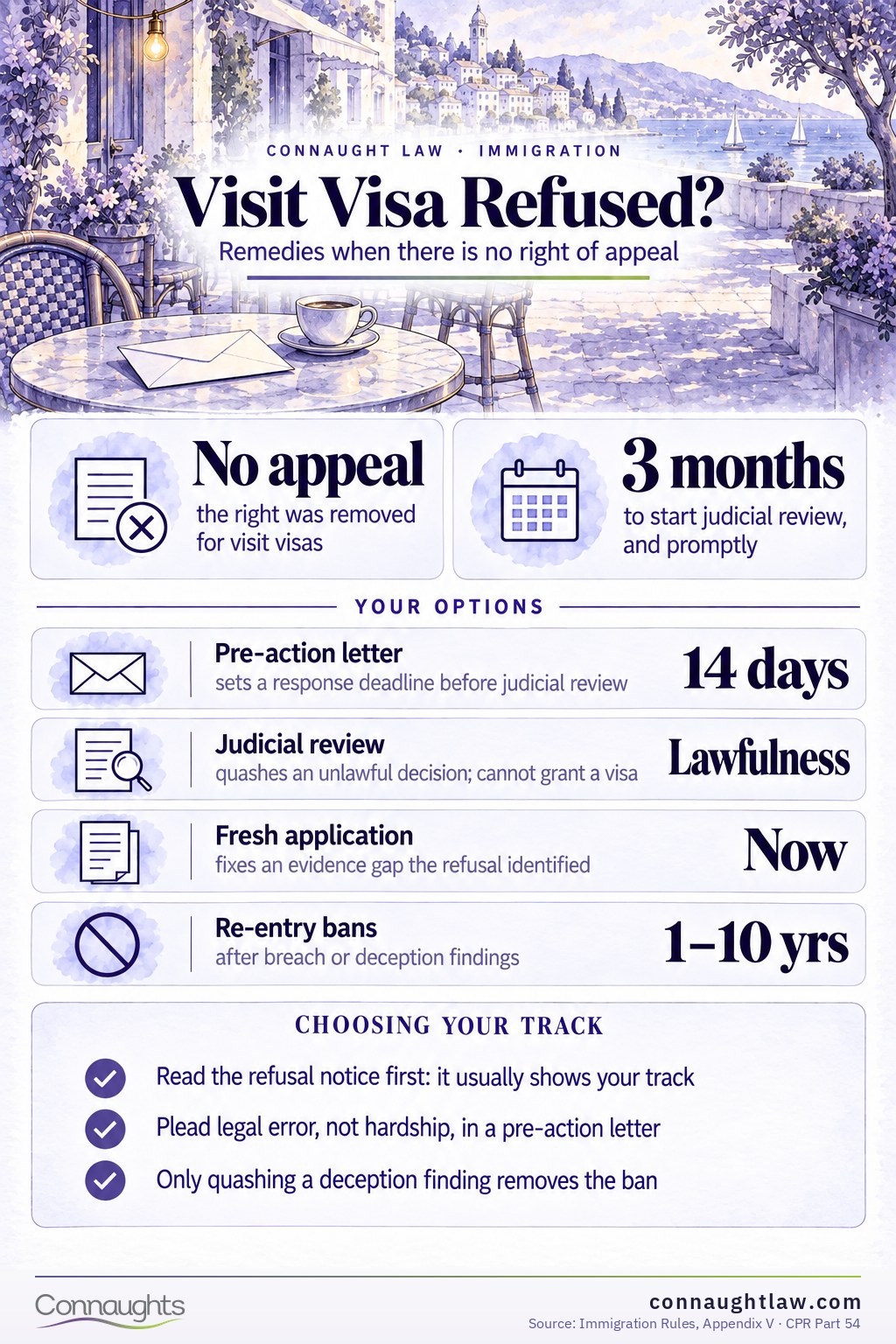
A UK visit visa refusal carries no appeal right — but it is not final. The working remedies are a pre-action protocol letter that forces the Home Office to defend the decision as law, judicial review where it cannot, and a corrected fresh application where the refusal was evidentially fair. This guide covers when each route wins, the deadlines that govern them, and how deception findings and re-entry bans are challenged.
On This Page

No Appeal Does Not Mean No Remedy
Parliament removed the visit visa appeal right in 2015, so the refusal notice's finality is procedural, not legal. What remains is a choice between attacking the decision — through the pre-action protocol and judicial review, where the caseworker misapplied the law or ignored evidence — and replacing it with a fresh application that fixes what the refusal actually found. Choosing the wrong track wastes months; the refusal notice itself usually tells you which one you are on.
Refusal Grounds
Common Refusal Categories
Most notices cite the genuine visitor test under Appendix V of the Immigration Rules — doubts about leaving, funds or purpose — which are evaluative findings a court will rarely disturb if the evidence supported them. The challengeable minority look different: findings that ignore documents actually submitted, reasoning that misstates the application, suitability refusals built on disputed deception, and decisions applying the wrong rule altogether. The taxonomy of what caseworkers find, and how often, is in our refusal reasons and rates guide.
Impact of Recent Guidance Changes
The visitor guidance has been progressively tightened through 2025's rule changes and the ETA rollout, pushing decision-making harder onto documentary consistency. For challenges that cuts both ways: caseworkers have clearer standards to apply, and applicants have clearer standards to hold them to — a refusal that departs from the published guidance without explanation is itself a public law error.
Judicial Review
Legal Grounds That Succeed
Judicial review tests lawfulness, not merits: illegality (wrong rule, ignored evidence, misapplied guidance), irrationality (a conclusion no reasonable decision-maker could reach on the file), and procedural unfairness (deception findings made without putting the allegation). The court cannot grant the visa — it quashes the decision and requires a lawful one, which is why JR is the right tool only where the decision, not the evidence, was the problem.
Procedure and Timeline
Immigration JR runs in the Upper Tribunal under the framework of CPR Part 54 principles: the claim must be filed promptly and in any event within three months of the decision, permission is the first filter, and most cases settle before or at that stage. The three-month clock makes early advice decisive — a strong claim can die of delay alone.
Pre-Action Protocol
What the Letter Must Contain
- The decision under challenge, with reference numbers and date.
- The precise legal errors — rule, guidance paragraph or evidence ignored — not a plea for sympathy.
- The remedy sought: withdrawal of the decision and reconsideration.
- A response deadline of 14 days and a statement that JR follows without one.
- The documents relied on, so the reviewer can concede without a file hunt.
How the Home Office Responds
Pre-action letters are reviewed by lawyers rather than the original caseworker, and decisions with identifiable legal defects are frequently withdrawn at this stage — it is the cheapest point for UKVI to fix an error. No official success rate is published, so treat any percentage you read as marketing; what is true is that the letter's quality determines its force, because a letter that pleads hardship rather than error tells the reviewer the decision is safe.
Other Routes
When Fresh Applications Work Best
Where the refusal correctly identified a gap — thin funds evidence, an unexplained deposit, missing ties documents — the remedy is a better application, not litigation. A fresh application can be filed immediately, costs the standard fee, and succeeds when it engages the refusal reasons point by point. Repeat visitors refused on business patterns sometimes discover the real answer is a sponsored route instead — our business immigration team advises on that boundary, as does our family visa team where repeated family visits point to a partner or family route.
Complaints and Service Standards
The UKVI complaints process addresses service failures — lost documents, delays beyond published standards, conduct — and can produce refunds and apologies, but it cannot overturn a refusal. Use it alongside, never instead of, the legal routes.
Bans and Deception
Re-Entry Ban Categories
Breach and deception findings trigger mandatory refusal periods running from 12 months to 10 years depending on how the applicant left and whether deception was found. Because the ban outlives the original refusal, an unchallenged deception finding quietly converts one bad decision into a decade of them.
Challenging Deception Allegations
Deception findings demand precise attack: the Home Office must show dishonesty, not just error, and findings based on discrepancies the applicant was never asked about are vulnerable on fairness grounds. These challenges justify JR even where a fresh application would be cheaper, because only quashing the finding removes the ban. Our refusal solicitors handle the allegation; the wider tribunal picture sits with our appeals team.
Costs and Timelines
Comparing the Routes
A fresh application costs the visa fee and weeks; a pre-action letter costs legal drafting time and a 14-day cycle; judicial review adds tribunal fees and counsel, with costs exposure if permission is refused. Legal costs vary with complexity — we scope them before starting, and the court-set benchmarks are published as guideline hourly rates. The discipline is proportionality: litigation for a holiday rarely makes sense; litigation to remove a 10-year deception ban almost always does.
Timeline Expectations
Fresh applications resolve on the standard three-week visitor timetable. Pre-action letters produce answers within 14 to 28 days. Judicial review, where it runs its course, is measured in months — permission decisions typically within two to three, substantive hearings well beyond — which is why concession at the letter stage, or early settlement, is the outcome good claims are built to produce. The full court-stage detail is in our judicial review guide.
Frequently askedQuestions about challenging a refusal
Can I appeal a UK visit visa refusal?
No — the appeal right was removed in 2015. The remedies are a pre-action protocol letter and judicial review where the decision is legally flawed, or a fresh application where the refusal fairly identified an evidence gap.
What is the pre-action protocol success rate?
No official rate is published. Letters that identify a genuine legal error are frequently conceded because withdrawal is the Home Office's cheapest option; letters that re-argue the merits rarely move anything. Quality of grounds, not volume, decides it.
How long do I have to start judicial review?
Promptly, and in any event within three months of the decision. The pre-action letter must fit inside that window too — start the process as soon as the refusal lands, not when travel next becomes urgent.
Is a fresh application better than a legal challenge?
Usually, where the refusal was evidentially fair: it is faster, cheaper and entirely in your control. A challenge is better where the decision ignored evidence, misapplied the rules, or made a deception finding — outcomes a new application cannot erase.
Can I reapply while challenging the refusal?
Yes — the routes are independent, and a granted fresh application often ends the dispute pragmatically. The exception is deception findings: reapplying without resolving one invites automatic refusal under the re-entry ban rules.
What does a refusal challenge cost?
A fresh application costs the standard visa fee; a pre-action letter is a fixed piece of legal drafting we scope in advance; judicial review adds tribunal fees and counsel with costs risk. Proportionality to what is at stake — a trip or a ten-year ban — drives the choice.
Send it to us unedited. We'll tell you within days whether it contains a challengeable error or needs a rebuilt application — and start whichever clock matters first.
Get Expert Advice