
Judicial review asks whether a decision was made lawfully, not whether it was right. That distinction governs everything about it: the grounds you can run, the evidence the court will look at, and why most refused applicants are better served by a fresh application or an administrative review first. It is the remedy of last resort, it carries a real costs risk, and the courts treat it as both.
On This Page

When Judicial Review Is the Remedy
Judicial review is available where there is no appeal and no administrative review, or where those routes have been used and exhausted. The court does not substitute its own view of your application. It asks whether the decision maker acted within their powers, followed a fair procedure, and reached a conclusion open to them on the material.
Quick answer — what judicial review is for
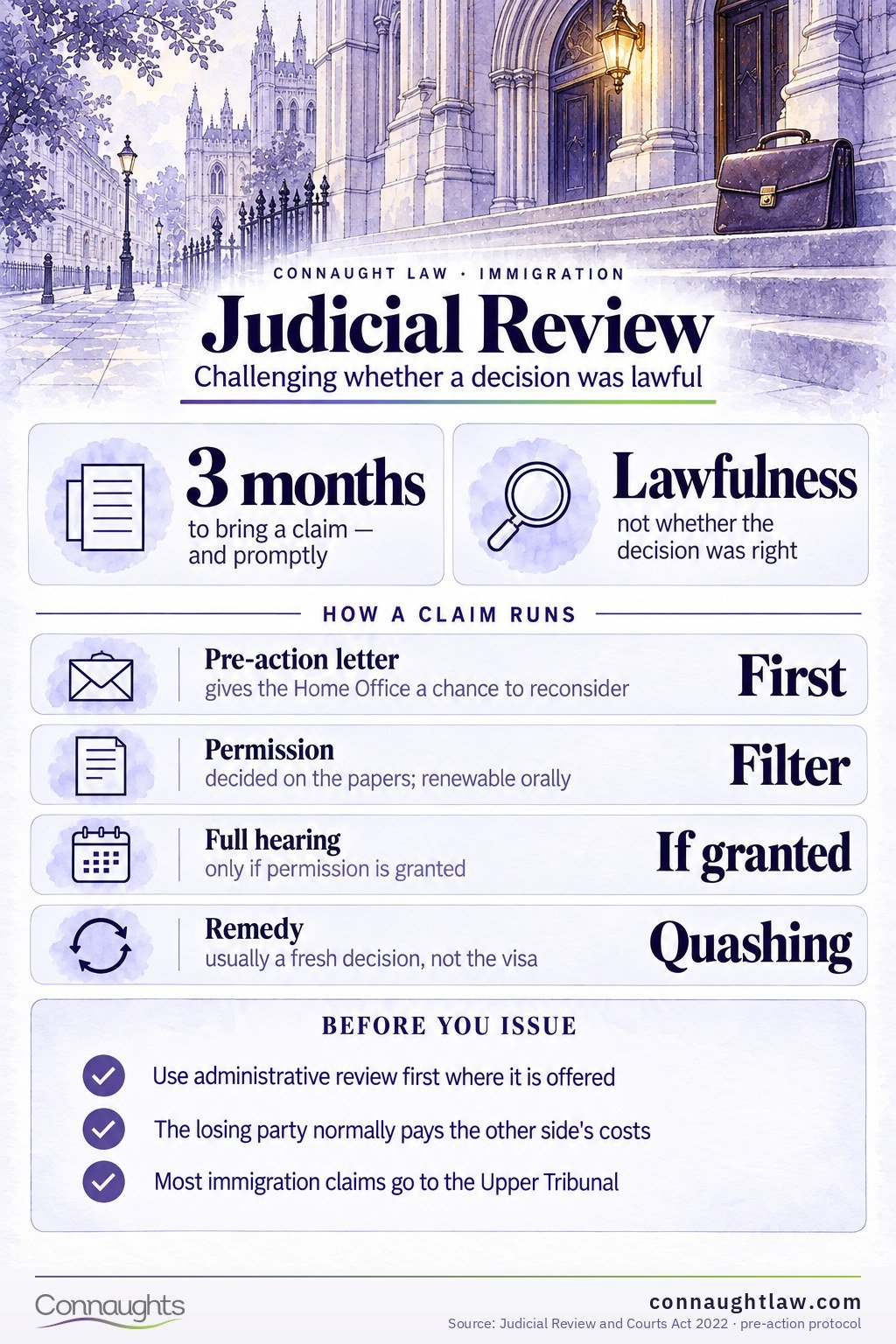
It challenges the lawfulness of a decision, not its merits. Most immigration claims go to the Upper Tribunal rather than the High Court. The deadline is three months, but you must also act promptly, and a claim filed at week eleven can still be refused as late. It carries a real costs risk, and permission is a genuine filter — many claims never get past it.
Because it is a remedy of last resort, the first question in practice is never "do I have grounds" but "have I used the cheaper route first". A claim brought while an administrative review was available will usually fail on that basis alone.
The Upper Tribunal Route
Most immigration and asylum judicial reviews are heard by the Upper Tribunal (Immigration and Asylum Chamber) rather than the Administrative Court. The procedure is governed by the Tribunal Procedure (Upper Tribunal) Rules 2008 and administered by the Upper Tribunal Immigration and Asylum Chamber, and the practical consequence is that the judges hearing your claim deal with immigration decisions daily. The claim is started on form UTIAC1, and gov.uk sets out the steps for applying for judicial review in an immigration or asylum case.
UTIAC or the Administrative Court
A small set of categories stays in the Administrative Court — challenges to the Immigration Rules themselves, to policy, to a declaration of incompatibility, and certain national security matters. Everything else is transferred to or begun in the Upper Tribunal. Filing in the wrong forum wastes time you may not have, so check the category before issuing.
The Upper Tribunal's judicial review decisions are published and searchable, which is worth knowing if you are trying to see how a particular kind of challenge has fared before.
Grounds That Actually Work
There are three classical heads — illegality, irrationality and procedural impropriety — and in human rights cases a proportionality assessment as well. In immigration practice the second is much harder than it sounds: irrationality means a decision no reasonable decision maker could have reached, not one you disagree with strongly.
Procedural Unfairness
This is where immigration claims most often succeed. Common examples: a decision that relies on material the applicant was never shown, a failure to put an allegation of deception to the applicant before relying on it, a departure from published policy without explanation, or a failure to consider a document that was plainly before the caseworker.
Grounds and Evidence Needed
| Ground | What must be shown | Usual evidence |
|---|---|---|
| Illegality | The decision maker had no power to do it, or misdirected themselves in law | The rule or policy, and the decision letter |
| Procedural unfairness | A fair procedure was not followed | Correspondence, the application file, published policy |
| Irrationality | No reasonable decision maker could have reached it | The evidence before the caseworker |
| Failure to consider policy | A relevant published policy was ignored or misapplied | The policy version current at the decision date |
Deadlines, Stages and Cost
The claim runs in stages, and permission is the one that matters most. A pre-action letter goes first under the pre-action protocol for judicial review, giving the Home Office an opportunity to reconsider — a step that resolves a useful proportion of claims without proceedings.
Three months — but promptly matters more
- Pre-action letter — sent first, setting out the decision, the grounds and the remedy sought.
- Issue within three months of the decision under rule 28, and promptly in any event.
- Permission — decided on the papers; if refused, renewable to an oral hearing.
- Substantive hearing — only if permission is granted.
- Remedy — usually a quashing order sending the decision back to be retaken, not the visa itself.
That last point is the one clients find hardest. Winning a judicial review generally means the Home Office must decide again, lawfully. It does not mean the court grants your application, and the fresh decision can lawfully be another refusal.
What It Costs and Who Pays
A fee of £179 is payable on the application for permission, and £449 to renew a refused permission decision to be reconsidered at a hearing. Where permission is granted at that hearing a further £448 falls due, and proceedings continuing after permission carry £897. All four took effect on 13 July 2026.
Legal aid is available for some immigration judicial review work, principally in protection and detention cases, subject to means and merits. How we cost this work is set out on our fees page.
Costs risk — the real deterrent
The losing party normally pays the other side's costs. An unsuccessful claimant can therefore face a Home Office costs bill on top of their own, and that exposure begins at the permission stage rather than at final hearing. This, far more than the court fee, is what makes judicial review unsuitable for a case that is merely disappointing rather than unlawful.
After Cart: What Changed
The most consequential change to immigration judicial review in recent years was not a case but a statute. Section 2 of the Judicial Review and Courts Act 2022, in force from 14 July 2022, inserted section 11A into the Tribunals, Courts and Enforcement Act 2007 and closed the route known as a Cart judicial review — the challenge to an Upper Tribunal refusal of permission to appeal.
Cart is closed — and the two exceptions
An Upper Tribunal decision refusing permission to appeal is now final and not liable to be questioned in any other court. Two narrow exceptions survive: where the Upper Tribunal was not properly constituted or had no valid application before it, and where it acted in bad faith or in a procedurally defective way amounting to a fundamental breach of natural justice. Neither is a route to re-argue the merits. See section 2 itself.
Fresh Claims and Paragraph 353
Where further submissions are rejected as not amounting to a fresh claim, judicial review is the route to challenge that rejection, because there is no appeal against it. The question for the court is whether the Home Office applied the paragraph 353 test properly — whether the material is significantly different and creates a realistic prospect of success before a judge. Our guide to fresh claims sets out that test.
EU Settlement Scheme Challenges
Settlement scheme refusals carry a right of appeal, so judicial review is rarely the first answer. It becomes relevant where the challenge is to the scheme's operation rather than to an individual eligibility decision — a policy applied unlawfully across a class of cases, or a refusal to accept a late application on grounds that depart from the published guidance.
Evidence in a Review
Judicial review is decided on the material that was before the decision maker, with limited exceptions. Expert evidence is admitted sparingly and usually only where it goes to a procedural question or to conditions in a receiving country. If your case depends on new evidence about your circumstances, that is a sign the right remedy is a fresh application, not a claim in the Upper Tribunal.
How the Route Changes the Case
Sponsored work and study cases turn on the sponsor's position as much as the applicant's, and often on published sponsor guidance. Visit visa refusals are rarely worth reviewing — the better answer is usually a stronger second application, as our note on visit visa refusal reasons explains. Deportation and human rights cases will normally have an appeal available first, covered in our analysis of deportation appeals.
Detention and Removal Are Different
A challenge to the lawfulness of detention is a different claim from a challenge to a removal decision, with different tests and different remedies — damages are available for unlawful detention, which they generally are not elsewhere. Where release rather than compensation is the object, immigration bail is usually the faster route: see our guide to immigration bail.
Cheaper Routes to Try First
The court expects alternative remedies to have been used. That is not merely a procedural hurdle — in most cases the alternative is genuinely better, faster and cheaper.
Review or Judicial Review
Where the refusal offers administrative review, that is the route, and a judicial review brought instead will normally be refused permission. The two ask different questions: a review asks whether the caseworker made an error applying the Rules, judicial review asks whether the decision was lawful. Our guide to administrative review covers the £80 fee, the deadlines and the twelve-month wait; where an appeal is offered instead, see UK visa appeal rights.
Timing the Decision
The three-month clock runs from the decision under challenge, and using an alternative remedy does not always stop it. Where an administrative review is pending, the reviewable decision for judicial review purposes is usually the review outcome rather than the original refusal — but the position needs checking case by case, and a claim issued against the wrong decision is out of time against the right one.
Urgent Applications and Injunctions
Where removal is imminent, the ordinary timetable is irrelevant and the application is made urgently, seeking interim relief to prevent removal until the claim is decided. These applications are made on short notice, are supported by a statement of the facts and the grounds, and are dealt with by a duty judge, including out of hours.
Out of hours — when an injunction is the only step
An urgent application is not a way of buying time for a weak case, and the courts deal firmly with claims issued only to disrupt removal directions. It is the right step where there is a genuinely arguable claim and removal would defeat it. The duty of candour is at its highest here: the judge is deciding without the other side present and must be told what is against you as well as what is for you.
If you are considering a challenge and are not sure which remedy fits, our immigration judicial review service sets out how we assess that.
Frequently askedQuestions about immigration judicial review
How long do I have to bring a claim?
Three months from the decision, and promptly in any event. Delay short of three months can still defeat a claim, and the time is not extended because you were taking advice or using another remedy. Check which decision the clock runs from.
Will judicial review get me my visa?
Usually not directly. The normal remedy is a quashing order requiring the Home Office to decide again lawfully. That fresh decision can lawfully be another refusal, though a decision retaken on the correct basis often goes the other way.
Where is my claim heard?
Most immigration and asylum claims go to the Upper Tribunal (Immigration and Asylum Chamber). Challenges to the Immigration Rules themselves, to policy, or raising incompatibility with human rights legislation stay in the Administrative Court.
Can I still bring a Cart judicial review?
No. Section 2 of the Judicial Review and Courts Act 2022 closed that route from 14 July 2022. Two narrow exceptions remain, for a tribunal that was not properly constituted and for a fundamental breach of natural justice.
What is the costs risk?
The losing party normally pays the other side's costs, and that exposure starts at the permission stage. It is the main reason judicial review is unsuitable for a case that is disappointing rather than unlawful.
Do I have to send a pre-action letter?
In all but genuinely urgent cases, yes. The pre-action protocol expects it, it gives the Home Office a chance to withdraw the decision, and failing to send one without good reason can affect both permission and costs.
Send us the decision and anything you have already tried. We'll tell you whether there is an arguable public law ground, what the deadline is, and what the costs exposure looks like.
Get Expert Advice