
Deportation is not the same as removal, and an appeal against it is not a general argument about fairness. It is a statutory test, and which test applies depends almost entirely on the sentence imposed. Two things changed in 2026: suspended sentences now count towards the automatic deportation threshold, and from 12 August the tribunal is under a duty to determine most non-detained deportation appeals within twenty-four weeks.
On This Page

Who Can Appeal Against Deportation
Automatic deportation is a statutory duty, not a discretion. Under section 32 of the UK Borders Act 2007 the Secretary of State must make a deportation order against a foreign criminal, and Condition 1 is met where the person is sentenced to a period of imprisonment of at least twelve months. British and Irish citizens are outside the definition. The exceptions in section 33 do not stop the order being made — section 33(7)(a) says so expressly.
The threshold moved this year. On 22 March 2026 the carve-out for suspended sentences was removed from both the automatic deportation provision and the definition of a foreign criminal in Part 5A, by section 45 of the Sentencing Act 2026. A suspended sentence of twelve months now counts where before it did not. Anyone advised on the old basis needs that advice revisited.
Quick answer — what the tribunal is actually deciding
There is no appeal against the deportation order itself. The appeal is against the refusal of a human rights or protection claim, and the tribunal decides whether removing you would breach the Convention. That is why the case turns on the statutory tests in Part 5A rather than on whether the deportation decision seems harsh.
How a Deportation Appeal Works
The right of appeal arises under section 82(1) of the Nationality, Immigration and Asylum Act 2002 when a protection or human rights claim is refused. Section 92(3) makes that appeal in-country by default: it must be brought from outside the United Kingdom only where the claim has been certified under section 94(7) or section 94B. Otherwise, in the words of the section, the appeal must be brought from within the United Kingdom.
Leaving the country matters. Under section 92(8) an appeal is treated as abandoned if the appellant leaves the United Kingdom, unless the claim was certified under one of those two provisions. That is a trap for anyone who travels while an appeal is pending, and it is not cured by returning.
Three deadlines — and what each one runs from
- Fourteen days in the United Kingdom — the notice of appeal must be received by the tribunal not later than fourteen days after you are sent the notice of decision. Time runs from sending, not from your reading it.
- Twenty-eight days from departure — where you were in the United Kingdom when the decision was made but may not appeal from here, time runs from the date you left.
- Twenty-eight days from receipt — in any other out-of-country case, from when you receive the notice of decision. There is no shorter deadline for detained appellants.
A late notice is not necessarily fatal. Rule 20 of the First-tier Tribunal procedure rules requires a late appeal to include an application to extend time and the reason it was not brought in time, and the tribunal decides that as a preliminary issue, which it may do without a hearing. The reason has to be a real one, and the delay has to be explained rather than acknowledged. Who can appeal and how sets out the wider appeal framework.
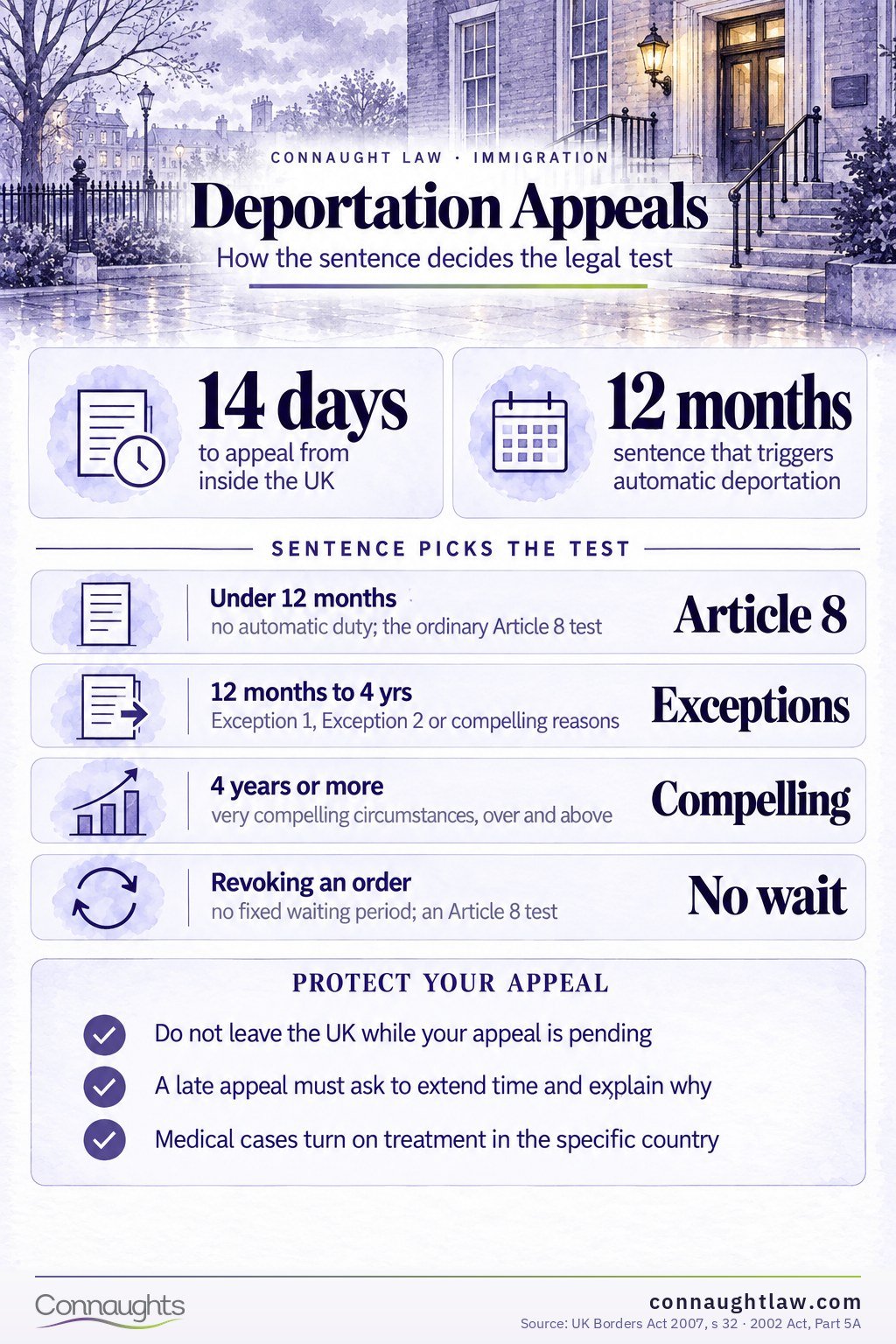
The Very Compelling Circumstances Test
Part 5A of the 2002 Act sets the weight the tribunal must give the public interest. Under section 117C, a person sentenced to less than four years must show Exception 1 or Exception 2. Exception 1 requires lawful residence for most of your life, social and cultural integration here, and very significant obstacles to integration in the country of return. Exception 2 requires a qualifying partner or child on whom the effect of deportation would be unduly harsh.
At four years or more, neither Exception is enough on its own. Section 117C(6) requires very compelling circumstances over and above those described in Exceptions 1 and 2. One point of arithmetic is easily missed: under section 117D(4)(b), consecutive sentences do not aggregate to reach a threshold.
Over and above — what the phrase demands
In Yalcin the Court of Appeal held that where the circumstances overlap with an Exception, there must be something substantially more than the minimum needed to qualify for it. That "something more" can be the same factor present to an elevated degree, or complementary factors, or both — but a tribunal is not required to spell out what it consists of.
The appellate law has settled rather than shifted. KO (Nigeria) fixed a high threshold for undue harshness, and HA (Iraq) rejected the notional comparator gloss that had grown around it, requiring instead a fact-specific assessment. Both remain good law. The Court of Appeal applied them again in Kapikanya in 2025, holding that the question is whether the statutory test in section 117C(6) is met and not whether deportation is disproportionate in some general sense.
In Lewis in July 2026 the Court of Appeal made a distinction worth understanding before an onward appeal. Findings of primary fact are findings of fact, but whether those facts amount to very compelling circumstances over and above the Exceptions is a question of law — which is what makes such a conclusion capable of being challenged. The same case confirms that a wish to build a relationship in future falls short of Exception 2 rather than going beyond it.
Sentence Length and the Test
| Sentence | Deportation duty | What the appeal must show |
|---|---|---|
| Under 12 months | No automatic deportation duty; deportation may still be pursued as conducive to the public good | The ordinary Article 8 assessment, with the Part 5A public interest factors |
| 12 months to under 4 years | Automatic deportation applies | Exception 1 or Exception 2, or very compelling circumstances |
| 4 years or more | Automatic deportation applies | Very compelling circumstances over and above Exceptions 1 and 2 |
Deport First, Appeal Later: Where It Stands Now
The common account of this area is wrong, and acting on it would be a mistake. The Supreme Court in Kiarie and Byndloss [2017] UKSC 42 did not abolish section 94B or hold out-of-country appeals unlawful. It quashed two certificates, on the footing that the Home Secretary had failed to establish that the interference with Article 8 was justified, in the absence of a system that would let an appellant give live evidence and otherwise participate from abroad.
The court recorded the scale of the problem it was addressing: of 1,175 certificates issued to foreign criminals between 28 July 2014 and 31 December 2016, only 72 notices of appeal were filed from abroad, and as at February 2017 none had succeeded.
Certification restarted — the position since May 2026
Home Office guidance now states that certification under section 94B "is being restarted after a period of non-use following the judgment in Kiarie and Byndloss", and that it will be applied to further cohorts. Anyone treating the power as spent is working from a position that ended in May 2026.
What the judgment produced is a precondition rather than a prohibition. The guidance now instructs caseworkers not to certify where the claimant cannot give evidence by video link, which means not only that a facility exists but that the receiving country has consented to evidence being given that way. Where a video link is not possible, certification is not appropriate. In Nixon, a single-judge permission decision of the Court of Appeal in 2018, it was held that an out-of-country appeal will not always be ineffective, and that there is no presumption in favour of ordering a person's return even where a certificate was unlawful.
Medical Grounds and the Article 3 Threshold
The governing authority is AM (Zimbabwe) [2020] UKSC 17, which adopted the test in Paposhvili: whether substantial grounds have been shown for believing that a seriously ill person, although not at imminent risk of dying, would face a real risk, because appropriate treatment is absent or inaccessible in the receiving country, of a serious, rapid and irreversible decline in health resulting in intense suffering or a significant reduction in life expectancy.
Two refinements in that judgment do real work. The Court of Appeal's gloss, which had turned a significant reduction in life expectancy into the imminence of death, was rejected as too much of a leap. And "significant" was held to mean substantial. The burden begins with the appellant, who must raise a case capable of proof; if that is done, it is for the returning state to dispel any serious doubts about it.
There is no category rule. No judgment establishes that people with a particular diagnosis succeed or fail as a class, and articles that group cases by illness are describing outcomes rather than law. What decides these appeals is the evidence about availability of and access to treatment in the specific country, measured against that threshold.
What Changes on 12 August 2026
Section 50 of the Border Security, Asylum and Immigration Act 2025 inserts a new section 86B into the 2002 Act, and it comes into force on 12 August 2026 under regulation 2 of S.I. 2026/766. From that date the tribunal must, except where it considers that it is not reasonably practicable to do so, determine the appeal and give notice of its determination within twenty-four weeks beginning with the day after the appeal is instituted.
From 12 August — the 24-week duty and its limits
- Who it covers — an appellant who, when the appeal is instituted, is not detained, has been convicted of an offence whether here or abroad, and is liable to deportation under section 3(5)(a) of the Immigration Act 1971.
- The escape — the duty does not apply where the tribunal considers it is not reasonably practicable to determine the appeal in time. It is a target with a statutory qualification, not a guarantee.
- It switches off abroad — the duty does not apply, or ceases to apply, where the appeal must be brought or continued from outside the United Kingdom. A section 94B certificate therefore removes it entirely.
Section 49 commences on the same day and inserts a parallel section 86A, but it does not concern deportation: it applies the same twenty-four week target to protection claim appeals brought by people being provided with accommodation under sections 95 or 98 of the Immigration and Asylum Act 1999. The two are often reported together and are frequently confused.
Two further developments belong in their proper category. The Home Office announced on 5 March 2026 that foreign offenders with a suspended sentence of at least twelve months would have entry clearance refused or revoked, with rules changes taking effect on 26 March 2026. Proposals to reform the application of Article 8, and the Immigration and Asylum Bill introduced in the Commons on 30 June 2026, are announcements and a Bill respectively. Neither is law, and neither should be planned around as though it were.
Revoking a Deportation Order
A deportation order remains in force until it is revoked or quashed, and revocation does not entitle anyone to re-enter: it means a person may apply for entry clearance or permission like anyone else. The power is in section 5(2) of the Immigration Act 1971, under which an order may at any time be revoked by a further order of the Secretary of State. An application should normally be made from outside the United Kingdom after deportation.
The rules here were rewritten and many sources have not caught up. Paragraphs 390 to 392 were deleted on 12 April 2023 and replaced by Part 13 of the Immigration Rules in its current numbered form. The fixed periods that used to appear there, including the ten years commonly quoted for a sentence of four years or more, were deleted with them and have no successor. Any guide still stating a qualifying period is more than three years out of date.
What Part 13 now provides is a test rather than a waiting time. For a sentence of under four years, the order will be revoked where the private or family life exception is met or there are very compelling circumstances making refusal a breach of Article 8. At four years or more, only very compelling circumstances will do. Where the person was not convicted of an offence carrying a custodial sentence, a material change in the circumstances that led to deportation may be enough.
There is no free-standing appeal against a refusal to revoke. An appeal arises only if the human rights or protection claim within the application is refused, and where further submissions are rejected without meeting the fresh claim test there is no right of appeal at all. That is why what goes into a revocation application matters more than when it is made. Where detention has been part of the history, our guide to immigration detention covers the related issues, and our deportation service explains how we act.
Frequently askedQuestions about deportation appeals and deportation orders
How long do I have to appeal against deportation?
Fourteen days from the date the decision was sent to you if you are in the United Kingdom, and the notice must reach the tribunal within that time. Out of country it is twenty-eight days, running from your departure or from receipt of the decision depending on the case.
Does a suspended sentence count towards deportation?
It does now. The carve-out for suspended sentences was removed on 22 March 2026, so a suspended sentence of twelve months or more engages automatic deportation and the foreign criminal definition. Advice given before that date may no longer hold.
Can I be removed before my appeal is heard?
Only if your claim has been certified, under section 94(7) or section 94B. Without a certificate the appeal is in-country. Certification under section 94B was restarted in 2026, and it requires a working video link and the receiving country's consent to evidence being given that way.
What does very compelling circumstances mean in practice?
Something substantially more than the minimum needed to meet Exception 1 or Exception 2. It can be one of those factors present to a much greater degree, or additional factors alongside it. It is a high threshold and it is where four-year cases are won or lost.
Will my appeal be decided within twenty-four weeks?
From 12 August 2026 the tribunal is under a duty to decide most non-detained deportation appeals in that period, unless it considers doing so is not reasonably practicable. The duty does not apply where the appeal has to be brought or continued from abroad.
How long must I wait before applying to revoke an order?
There is no longer a fixed waiting period. The paragraphs that set one were deleted in April 2023. What matters now is whether the Article 8 test in Part 13 is met, which depends on your circumstances rather than on elapsed time.
Send us the decision, the sentencing remarks and any refusal letter. We will tell you which statutory test your case has to meet and whether the evidence you have reaches it.
Get Expert Advice