
A driving conviction does not automatically end a settlement application — but the wrong one, at the wrong time, handled the wrong way, can. Custodial sentences engage mandatory refusal grounds, drink driving invites discretionary scrutiny, and even points matter when they form a pattern. This guide covers how the suitability rules actually treat motoring convictions, how caseworkers weigh them, what a refusal leaves open, and how to time and evidence an application around a record.
On This Page

Where Motoring Records Meet the Rules
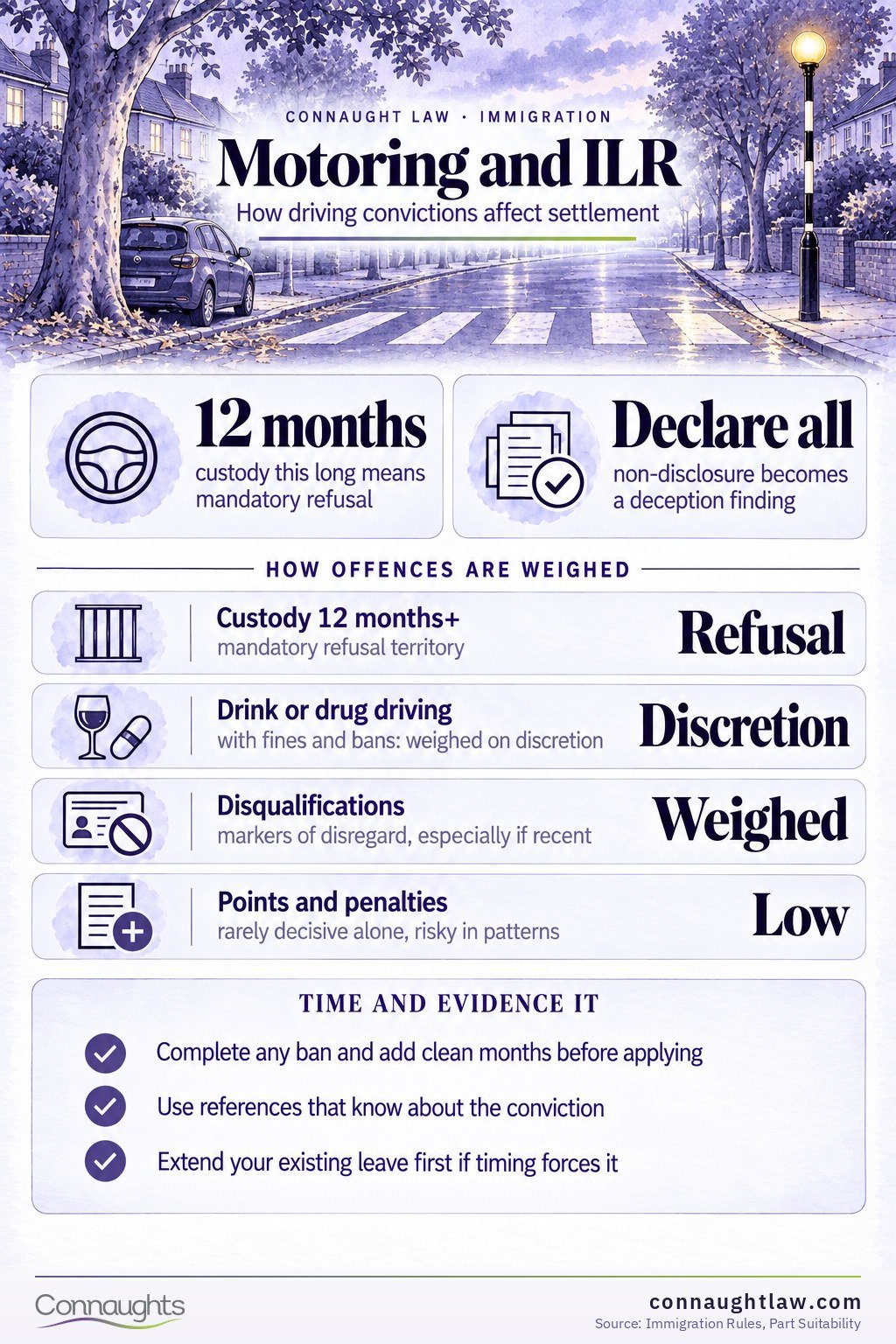
A motoring conviction does not by itself end a settlement application. The sentence sets the frame: 12 months or more grounds mandatory refusal, shorter custody and persistent offending refuse in defined circumstances, and fines, bans and points feed discretion. Recency, the applicant's response and the shape of the wider record then decide the outcome. Everything must be declared, because an undeclared offence becomes a deception finding far more damaging than the conviction.
Suitability Rules
The Legal Framework
Settlement applications are tested against the suitability grounds in Part Suitability of the Immigration Rules: a custodial sentence of 12 months or more grounds mandatory refusal, shorter custodial sentences and persistent offending ground refusal in defined circumstances, and non-custodial outcomes — fines, bans, penalty points — feed a discretionary assessment of conduct and character. Every driving conviction must be declared; the conviction that sinks most applications is the one left off the form, because non-disclosure converts a motoring matter into a deception finding.
Offence Impact
High-Risk Offences
The Offences That Do Damage
- Custodial sentences — dangerous driving, death by driving, repeat drink driving: 12 months or more is mandatory refusal territory; any custody is serious.
- Drink and drug driving with fines and bans: discretionary — outcome turns on recency, response and the rest of the record.
- Disqualifications, including totting-up: weighed as markers of disregard for law, especially when recent.
- Points and fixed penalties: rarely decisive alone, dangerous in patterns or when undeclared.
Patterns and Cumulative Impact
Caseworkers read records as narratives: three speeding offences across a decade reads as ordinary motoring; the same three inside eighteen months, alongside an insurance offence, reads as escalation. The pattern question is where applicants underestimate risk — each offence was minor, but the record as a whole answers the character question badly.
How Caseworkers Decide
Factors and Weighting
The discretionary assessment weighs offence seriousness, sentence, recency, the applicant's response — courses completed, bans served cleanly — and the countervailing years of residence and contribution. The rules set the framework; the weighting is human, which is why the application's presentation of the conviction matters nearly as much as the conviction.
Consistency Problems
Outcomes on similar records genuinely vary — a known feature of discretionary caseworking. The planning consequence: build the file for the sceptical caseworker, not the generous one, and where a refusal seems out of line with the guidance, that inconsistency is itself reviewable.
After a Refusal
Administrative Review
Administrative review corrects caseworking error — a conviction misrecorded, guidance misapplied, a mandatory ground cited for a non-custodial sentence. It cannot reweigh discretion, so its value is precision: identify the specific error, or choose a different remedy.
Judicial Review
Where no review right bites, judicial review polices rationality and fairness — refusals treating spent or trivial matters as decisive, or ignoring rehabilitation evidence, are the candidates. Many driving-related refusals, though, are better answered by time: a fresh application after the record improves often beats litigation on cost and odds; the deeper conduct-refusal jurisprudence sits in our paragraph 322(5) analysis.
Application Strategy
Timing and Evidence
Timing is the cheapest advocacy: applying with a ban still running invites refusal that applying six months after clean completion avoids. Where extension deadlines force an application at a bad moment, extend first and settle later — status protection beats settlement speed when the record is raw.
Alternative Routes
An applicant refused settlement usually keeps their underlying route: extend, let time and conduct rebuild the record, and reapply. Route arithmetic occasionally helps too — the long residence route may fall differently for a long-resident applicant than a work-route settlement application filed at the wrong moment.
Rehabilitation Evidence
Evidence Categories
The persuasive file shows response, not remorse alone: drink-drive rehabilitation course certificates, clean driving since, employment and community references that know about the conviction, and insurance and licence documentation in order. Character references that omit the conviction are worthless — the referee vouching despite knowing is the point.
Addressing the Circumstances
Deal with the conviction in the application's own narrative: what happened, the sentence, what changed. Declared and framed, a drink-driving conviction from years past is a survivable fact pattern our settlement team handles routinely; discovered by the caseworker instead, it is a deception issue with a decade's consequences. The motoring law itself — penalties, bans, totting-up — is covered in our driving offences guide.
Frequently askedQuestions about convictions and ILR
Will a drink driving conviction stop my ILR?
Not automatically. A non-custodial drink-driving conviction is assessed on discretion — recency, response and the wider record decide it. Custodial sentences are far more serious, with 12 months or more grounding mandatory refusal.
Do I have to declare penalty points and fixed penalties?
Declare everything the form asks about, including fixed penalties and points. Non-disclosure is the real danger — an undeclared minor matter becomes a deception finding that outweighs the offence itself many times over.
I have 6 points — can I still apply for ILR?
Usually, yes. Points alone rarely refuse a settlement application; patterns, recent disqualifications and accompanying offences are what change the assessment. Declare them and evidence the otherwise clean record.
Should I wait until my driving ban ends before applying?
Almost always — applying mid-ban presents an active sanction to the caseworker. Complete the ban, add clean months, and apply with the rehabilitation evidenced. Extend your existing leave if timing forces the issue.
Can I challenge an ILR refusal for a driving offence?
Administrative review for identifiable caseworking errors; judicial review where discretion was exercised irrationally. Often the better economics is a fresh application once time and conduct have moved the record.
Does a conviction also affect citizenship later?
Yes — naturalisation's good character requirement looks at convictions on its own timescales, and a conviction survivable at ILR can still delay citizenship. Plan both applications' timing together.
Send us the record and your dates. We'll tell you honestly whether to apply, wait, or extend — and build the rehabilitation file that carries the discretionary call.
Get Expert Advice