
Paragraph 322(5) was the character-and-conduct ground the Home Office used to refuse settlement to skilled migrants over tax discrepancies — until the Court of Appeal in Balajigari ruled its approach legally flawed. The ground lives on inside Part 9 of today's consolidated rules, and the fairness protections the courts built still govern every refusal on it. This guide covers the framework, the judgment, the numbers and the ways a refusal is challenged.
On This Page

The Character Ground With a History
Few provisions of the Immigration Rules have been litigated as hard as paragraph 322(5) — the discretionary ground for refusing leave where conduct or character made a person's presence "undesirable". Its infamous application was against highly skilled migrants whose tax returns and visa applications showed different earnings figures, treated as dishonest without being asked to explain. Understanding it still matters, because its substance survives in the current rules and its case law protects every applicant facing a character-based refusal today.
Understanding the Legal Framework
Historical Context and Scrutiny
By 2018 the provision had become a scandal: a Westminster Hall debate heard that more than a thousand highly skilled migrants had been refused indefinite leave on tax-discrepancy grounds, and the Home Office was forced into a formal review of 1,697 such refusals. The pattern was consistent — a discrepancy between HMRC records and visa applications read as dishonesty, with no opportunity to explain accountant error, amendment or innocent mistake.
Application Across Categories
Where 322(5) Is Applied
| Application type | Typical trigger | Position after Balajigari |
|---|---|---|
| Settlement / ILR | Tax and earnings discrepancies | Procedural safeguards mandatory before refusal |
| Skilled Worker extensions | Salary and employment inconsistencies | Explanation opportunity required |
| Family routes | Financial evidence discrepancies | Closer scrutiny, same fairness duties |
| Business routes | Source-of-funds and credibility concerns | Heavier evidence, same three-stage test |
Balajigari: The Judgment That Rewrote the Procedure
Key Legal Principles Established
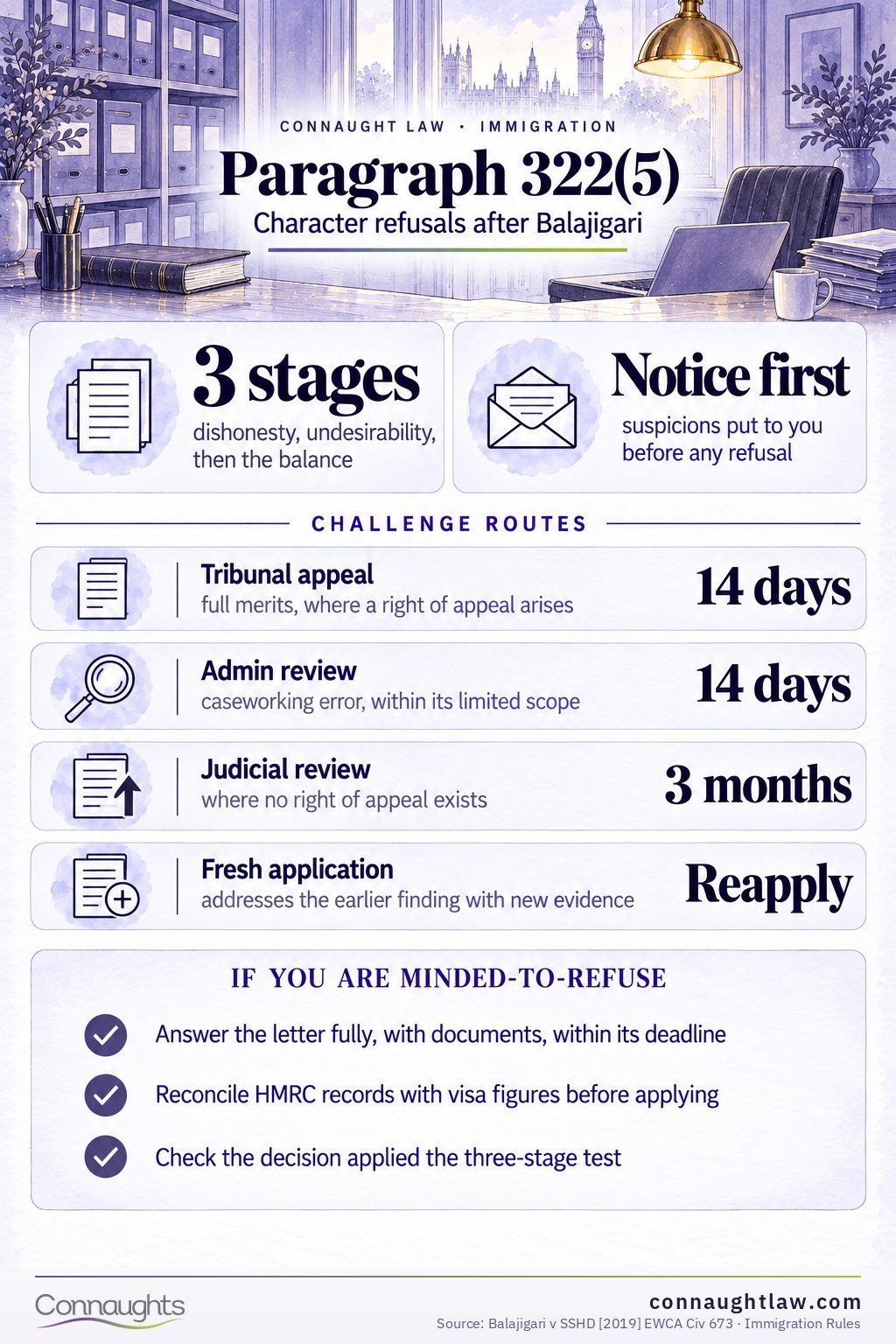
In Balajigari v Secretary of State for the Home Department [2019] EWCA Civ 673, the Court of Appeal held the Home Office's approach legally flawed: a decision-maker cannot leap from discrepancy to dishonesty without giving the applicant a chance to offer an innocent explanation. The court imposed a three-stage assessment — was there dishonesty; does it make the person's presence undesirable; do other factors nonetheless outweigh refusal — with each stage requiring actual reasoning, not recitation.
The Minded-to-Refuse Procedure
Balajigari's practical legacy is the minded-to-refuse letter: the Home Office must set out its suspicions, give a genuine opportunity to respond with evidence, and engage with the response before deciding. A refusal issued without that sequence is vulnerable on procedure alone — often the cleanest ground of challenge available, because it needs no relitigation of the underlying tax history.
What the Numbers Showed
Home Office Investigation Findings
The Home Office's published review of the 1,697-case cohort found that in 88% of them — 1,490 applications — the discrepancy exceeded £10,000, and that in 473 of those, 28.5%, the applicant had never amended their HMRC records — the fact pattern the department read as confirming dishonesty and the courts read as demanding explanation. The review conceded errors in dozens of cases and left hundreds more to the tribunals.
Outcomes of the Review
| Outcome | Cases | Meaning |
|---|---|---|
| Appeals allowed | 244 | Refusals overturned by the tribunal |
| Appeals then pending | 400+ | Still before the First-tier Tribunal at reporting |
| Errors acknowledged | 37 | Home Office accepted the refusal was wrong |
| Reinstated outside review | 25 | Leave granted after separate challenge |
Appeal Success by Ground
No official series publishes success rates for these challenges, and quoted percentages deserve suspicion. What the decided cases show qualitatively is a stable hierarchy: procedural-fairness grounds — no minded-to-refuse letter, no interview, no engagement with the explanation — succeed most readily; direct attacks on a properly-procedured dishonesty finding are the steepest climb.
Procedural Requirements Today
HMRC Evidence Standards
A modern character refusal built on tax history needs real HMRC evidence — formal records of the discrepancy, spanning enough tax years to show a pattern rather than an isolated error. Applicants can meet it in kind: amended returns, accountant correspondence and contemporaneous records are the raw material of an innocent explanation, and assembling them before applying beats assembling them after a minded-to-refuse letter. Our tax discrepancy guide covers that preparation in detail.
Interview and Response Procedures
Where concerns arise, the response opportunity is the case. Treat a minded-to-refuse letter as litigation with a deadline: every assertion answered, every explanation documented, nothing left to goodwill. Interviews deserve preparation to the same standard — inconsistency between the written explanation and the interview answer is the modern route to an adverse finding.
Common Refusal Scenarios
Settlement and ILR Applications
Settlement remains where character grounds bite hardest, because the application invites a whole-history review — the concerns travel under Part 9 of the consolidated rules today, with paragraph 322(5)'s conduct-and-character substance carried into the suitability provisions of the current Immigration Rules. Anyone whose tax, earnings or compliance history contains an awkward chapter should have it professionally reviewed before filing, as our settlement team does routinely.
Skilled Worker and Business Immigration
In sponsored work cases the discrepancy pattern is salary-shaped — certificates, payslips and RTI records that fail to agree — while business routes attract source-of-funds and credibility scrutiny. The prevention is identical: consistency across every document the Home Office can see, checked against the requirements in our Skilled Worker guide before submission rather than explained afterwards.
Challenging a Refusal
Available Challenge Routes
- First-tier Tribunal appeal, where a right of appeal arises — full merits review, strongest for fairness violations; our appeals team runs these.
- Judicial review, where no appeal right exists — targeting procedural failure and irrationality.
- Administrative review for caseworking error, within its limited scope.
- A fresh application that squarely addresses the earlier finding with new evidence.
Key Challenge Strategies
The winning pattern since Balajigari is procedural: show the decision skipped a required step — no notice of suspicion, no genuine response opportunity, no engagement with the explanation, no three-stage reasoning — and the decision falls without the tribunal ever ruling on the tax history. Substantive challenges remain possible with strong innocent-explanation evidence, but the procedure-first strategy wins faster and cheaper, which is why our refusal team reads every 322(5)-type decision letter against the checklist before anything else.
Frequently askedQuestions about paragraph 322(5) refusals
What is paragraph 322(5)?
The discretionary ground in the old general grounds for refusal allowing applications to be refused where conduct or character made a person's presence undesirable — notoriously applied to tax discrepancies in skilled migrants' settlement applications before the courts intervened.
Does paragraph 322(5) still exist?
Its substance does. The consolidated Immigration Rules moved the general grounds into Part 9, where conduct, character and associations remain suitability grounds for refusal. Decisions citing the modern provisions still carry Balajigari's procedural obligations.
What did Balajigari decide?
The Court of Appeal held in 2019 that refusing on assumed dishonesty without offering a chance to explain was legally flawed, and required a minded-to-refuse procedure plus a three-stage assessment — dishonesty, undesirability, and discretionary balance — before any refusal.
What should I do if I get a minded-to-refuse letter?
Treat it as the decisive stage and take advice immediately. Respond within the deadline with a complete, documented innocent explanation — accountant evidence, amendment history, contemporaneous records — because the tribunal will later judge the refusal against exactly this exchange.
Can a tax discrepancy still sink a settlement application?
Yes, where it evidences dishonesty — but not automatically. Discrepancies with innocent explanations, properly evidenced, are survivable; undisclosed ones discovered by the caseworker are far more dangerous. Reconcile HMRC records before applying, never after.
How long do I have to challenge a refusal?
Deadlines are short and route-specific — typically 14 days in-country for appeals and administrative review, and three months at the outside for judicial review, where delay itself can defeat the claim. The practical answer is to take advice within days of the decision.
Send us the decision letter and your tax and application history. We'll test the decision against the Balajigari checklist, tell you which challenge route fits, and run the deadline that matters.
Get Expert Advice