
A mismatch between the earnings you told the Home Office and the earnings you told HMRC once refused settlement applications almost automatically — until Balajigari forced dishonesty to be proved, not presumed. Tax discrepancy cases now run on procedure: a minded-to-refuse letter, a genuine chance to explain, and a decision that engages with the explanation. This guide covers the safeguards, the innocent explanations that succeed, and the evidence that carries them.
On This Page

When Two Government Records Disagree
The Home Office cross-checks settlement applicants' declared earnings against HMRC records, and discrepancies — amended returns, late filings, income claimed to one department and not the other — historically triggered refusal under the conduct grounds now sitting in Part Suitability of the Immigration Rules. The refusals fell hardest on self-employed applicants from the Tier 1 (General) era, and the litigation they produced rewrote the procedure every such case now follows.
Balajigari Safeguards
The Governing Principles
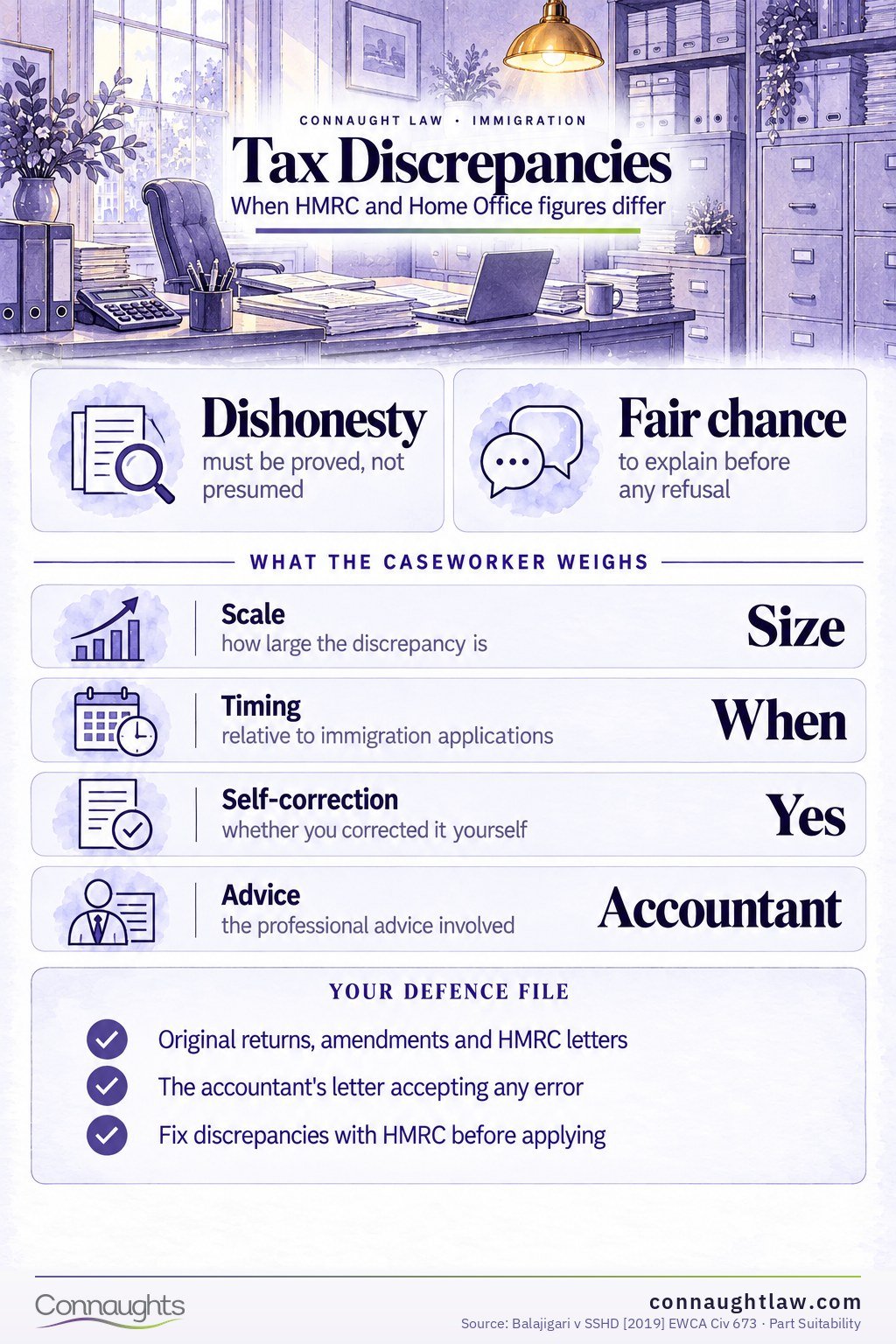
In Balajigari v SSHD [2019] EWCA Civ 673 the Court of Appeal held that conduct-based refusal requires dishonesty, not carelessness — and that procedural fairness demands the applicant be told of the suspicion and given a real opportunity to answer before refusal. A discrepancy is the beginning of an inquiry, never its conclusion: the caseworker must consider the explanation, weigh innocent causes, and reach a dishonesty finding that survives scrutiny.
Minded-to-Refuse Letters
Responding to the Letter
The minded-to-refuse letter is the case's decisive moment — usually with a short deadline and always with the full file at stake. Answer it comprehensively: the discrepancy's precise history, the accountant's role, the correction trail with HMRC, and the documents behind each assertion. Caseworkers must weigh the scale of the discrepancy, its timing relative to immigration applications, whether it was self-corrected, and the professional advice involved — give them each factor answered, in order.
Challenge Prospects
Remedies When Refusal Comes
Refusals that skip the Balajigari procedure — no letter, no engagement with the explanation, dishonesty inferred from the bare mismatch — are strong judicial review candidates, and administrative review catches the narrower caseworking errors. No reliable success statistics exist for these challenges; what is observable is that procedural failures concede early while properly-reasoned dishonesty findings are hard to dislodge. The wider conduct-refusal jurisprudence, including its 322(5) history, is analysed in our paragraph 322(5) guide.
Innocent Explanations
The explanations that succeed are ordinary life, documented: accountant error with the correspondence proving it, genuine amendments made when mistakes surfaced — HMRC's correction process exists precisely for them — timing differences between accounting periods, and income honestly declared under different heads. What fails is the explanation that arrives late, shifts between tellings, or asks the caseworker to accept coincidence stacked on coincidence.
Evidence That Carries It
- Full tax records: original returns, amendments, HMRC correspondence and payment history.
- The accountant's file — engagement letters, advice given, and their letter accepting any error.
- Business records reconciling the true earnings: invoices, bank statements, contracts.
- A chronology showing when the error arose, when discovered, when corrected — and that immigration deadlines did not drive it.
Applicants with historic discrepancies still unamended should resolve them with HMRC before any settlement application, not during one — the correction made years before an application reads as honesty; the correction made the month before reads as preparation. Our settlement team audits the tax position alongside the immigration file for exactly this reason.
Frequently askedQuestions about tax discrepancy cases
Can ILR be refused for a tax discrepancy?
Yes, where the Home Office finds the discrepancy dishonest — but after Balajigari it must put the concern to you first and genuinely weigh your explanation. Carelessness and corrected errors are not dishonesty.
What is a minded-to-refuse letter?
The Home Office's notice that it suspects dishonesty and intends refusal unless persuaded otherwise. It is your one structured chance to explain — answer it fully, with documents, inside the deadline, and take advice before responding.
I amended my tax return years ago — is that a problem?
An honest amendment, made when the error surfaced and documented through HMRC, is the classic innocent explanation. Bring the full correction trail to the application rather than waiting to be asked.
My accountant caused the error — does that help?
Yes, when evidenced: the engagement records, the erroneous advice, and ideally the accountant's letter accepting responsibility. Blaming an adviser without their file persuades no one.
Can I challenge a tax discrepancy refusal?
Refusals that skipped the fair procedure — no letter, no engagement with your explanation — are strong judicial review material. Well-reasoned dishonesty findings are harder; the honest assessment of which you face should precede the remedy choice.
Should I fix outstanding tax issues before applying for ILR?
Yes — resolve discrepancies with HMRC well before applying, keep every record, and disclose the history in the application. Corrections read very differently made before an application than during one.
The deadline is short and the response decides the case. Send us the letter, the returns and the accountant's file today — we'll build the explanation the procedure entitles you to have heard.
Get Expert Advice