
The Global Talent visa is the UK's freest work route: no sponsor, no salary threshold, no job offer — any work, for anyone, once an endorsing body or a prestigious prize confirms you are a leader or potential leader in technology, science, research or the arts. It costs £766 plus the health surcharge, and settlement arrives in three years for most endorsed talent. This guide covers the endorsement routes, the prize alternative, conditions, costs and the path to ILR.
On This Page

Work Freedom in Exchange for Proof of Excellence
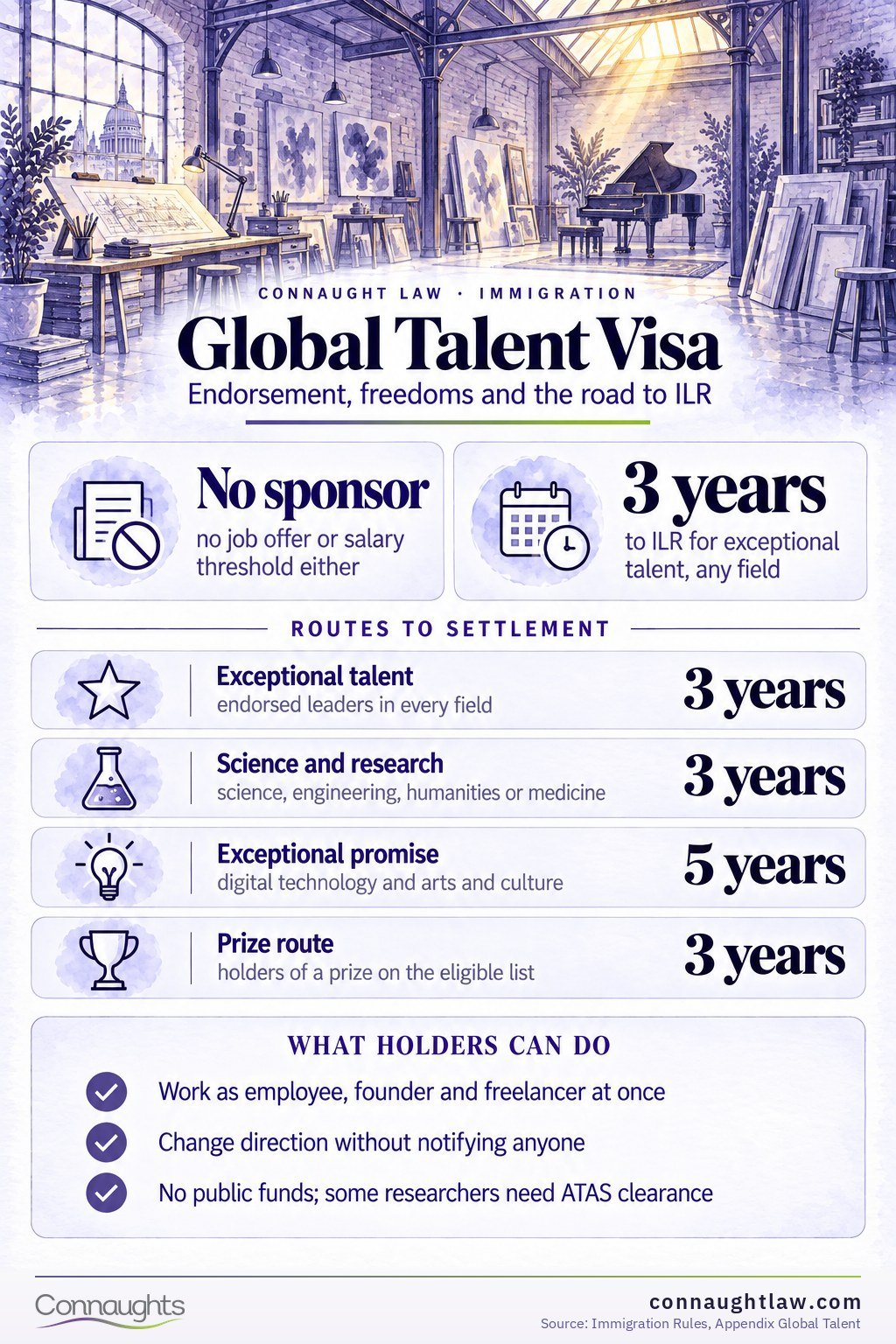
Every other work route trades permission for a sponsor's control; the Global Talent route trades it for evidence of excellence. Once through, holders work as employees, founders, freelancers or all three at once, change direction without telling anyone, and hold leave of up to five years at a time. The route's whole difficulty is concentrated at the front door: the endorsement, where a specialist body judges the career against its field's standards.
Eligibility
Qualification Categories
Endorsement as exceptional talent (an established leader), endorsement as exceptional promise (an emerging one), or a prestigious prize from the published list that skips endorsement entirely. The fields are fixed — digital technology, science and research, arts and culture — and applicants outside them need a different route, however talented.
Costs and Timing
Fee Structure
The total fee is £766 per person — split £561 at the endorsement stage and £205 at the visa stage for endorsed applicants, or paid as one £766 application on the prize route — with the health surcharge at £1,035 per year of leave on top, and partners and children each paying the same £766. The structural mercy is that the £561 buys the answer that matters: an applicant refused endorsement never pays the visa-stage fee.
Processing Timeframes
Endorsement decisions run to the endorsing bodies' own timetables — typically weeks, with fast-track arrangements for some categories — and the visa stage then decides on the standard three-week entry clearance timetable (eight weeks in-country). Plan the two stages in sequence; only the visa stage offers the usual paid priority services.
Endorsement
Approved Endorsing Bodies
Each field has its judge, listed with criteria in the endorsing bodies guidance: Tech Nation for digital technology; the Royal Society, British Academy and Royal Academy of Engineering for science, research and academia — with UKRI operating the endorsed funder route and fast tracks for holders of qualifying fellowships and academic posts; and Arts Council England for arts and culture, working with sub-panels for film, fashion and architecture. The endorsement application is a specialist dossier, not a form — evidence letters, achievements and impact assembled to the body's published rubric.
Prize Route
Awards That Skip Endorsement
Holders of a prize on the eligible prize list — Nobel prizes, the Turing Award, named Academy Award, BAFTA and Olivier categories, and the Grammy Lifetime Achievement Award among them — apply directly for the visa with no endorsement stage at all: one £766 application on the strength of the award itself. The list is precise; a career garlanded with awards just below it still goes through endorsement.
Outcomes
What the Published Data Shows
The Home Office publishes Global Talent grant volumes within its quarterly immigration statistics rather than route-level grant rates; the one official satisfaction survey is a 2022 evaluation of self-selected respondents, not a population measure — treat precise percentages quoted elsewhere with suspicion. What the published pattern does show: endorsement is the selective stage, visa refusals after endorsement are rare, and digital technology and research dominate the caseload.
Professional Outcomes
The route's conditions explain its appeal to careers that refuse to sit still: employment, self-employment, directorships and portfolio work are all permitted simultaneously, with no minimum earnings and no reporting duties when roles change. The only meaningful conditions are the standard ones — no public funds, and for some researchers ATAS clearance for sensitive subjects.
Settlement Outcomes
Most holders reach indefinite leave on the accelerated clocks below, and the route's absence rules are forgiving by design — research trips and touring count toward the usual limits, with specific tolerance for absences linked to the field. Career mobility rarely threatens the endgame, which is precisely the route's design.
Sector Criteria
Digital Technology
Tech Nation's rubric asks for proof of innovation, recognition and impact — product leadership, significant open-source contribution, growth roles at recognised companies, investment raised — under the criteria at gov.uk's digital technology pages. Founders and senior engineers dominate, but the criteria deliberately reach designers and commercial leaders in product businesses.
Science and Research
The academies endorse on peer recognition: publications, grants, fellowships and appointments — with the fast tracks turning a qualifying fellowship or UK academic appointment into near-automatic endorsement, and the endorsed funder route covering researchers on qualifying grants. For established academics this is often the simplest immigration route the UK offers.
Arts and Culture
Arts Council England asks for sustained international recognition — awards, significant appearances or exhibitions, critical coverage in more than one country — calibrated separately for talent and promise. The evidence is the portfolio and press file, and its curation matters as much as its contents.
Applying
Essential Documentation
Stage one is the endorsement dossier: the evidence set against the body's criteria, capped counts of documents and letters, and recommenders chosen for standing in the field. Stage two is the visa application under Appendix Global Talent: identity, the endorsement, and the ordinary suitability checks. The craft is stage one — our immigration team builds the dossier to the rubric rather than the CV.
Settlement
Indefinite leave arrives after three years for exceptional talent in every field and for anyone endorsed in science, engineering, humanities or medicine — five years for exceptional promise in digital technology and arts and culture — making this the fastest mainstream road to ILR alongside Innovator Founder. Time on other work routes can combine per the rules, prize-route holders take the three-year clock, and the full comparison across every route sits in our settlement routes guide.
Frequently askedQuestions about the Global Talent route
What are the Global Talent visa requirements?
Endorsement by the specialist body for your field — Tech Nation, the academies and UKRI routes, or Arts Council England — as exceptional talent or promise, or a prize from the eligible list. No sponsor, job offer or salary threshold applies.
How much does the Global Talent visa cost?
£766 per person — £561 at endorsement and £205 at the visa stage, or one payment on the prize route — plus £1,035 a year of health surcharge. Dependants pay the same fee each.
What work restrictions does the Global Talent visa have?
Almost none — employment, self-employment, founding companies and freelancing are all permitted, simultaneously and without notifying anyone. The standing conditions are no public funds and, for some research fields, ATAS clearance.
How long until ILR on the Global Talent visa?
Three years for exceptional talent in any field and for all science, engineering, humanities and medicine endorsements; five years for exceptional promise in digital technology and arts and culture. Prize-route holders settle in three.
What if my endorsement is refused?
An endorsement review corrects assessments that misapplied the criteria, and a rebuilt application often succeeds where the first dossier under-evidenced the career. The visa-stage fee is never at risk until endorsement is won.
Can my family join me on a Global Talent visa?
Yes — partners and children under 18 apply as dependants at £766 each plus surcharge, with full work and study rights. A partner settles on their own five-year clock; children settle alongside the parent.
Send us the CV, the recognition and the field. We'll match you to the right body — or the prize list — and build the dossier to its rubric.
Get Expert Advice