
The Proceeds of Crime Act 2002 gives the state powerful tools to strip the profits of crime — confiscation orders after conviction, restraint orders that freeze assets before trial, and the money laundering offences that reach anyone who deals with criminal property. This guide explains how confiscation actually works, the criminal lifestyle assumptions that inflate the figures, the reforms made by the Criminal Finances Act 2017 and later legislation, and where a defence can genuinely change the outcome.
On This Page

Understanding POCA 2002 and Proceeds of Crime
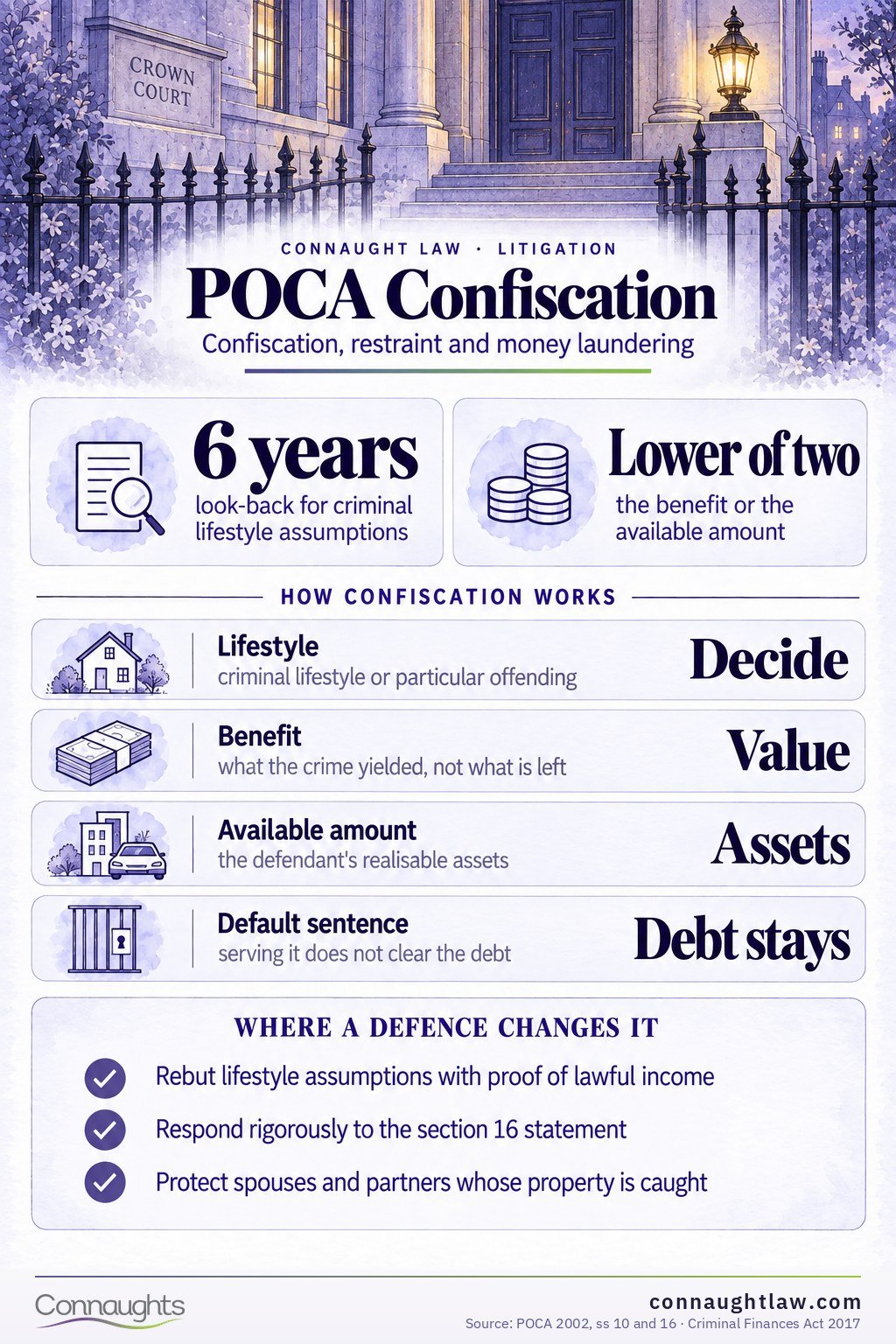
A confiscation order is made after conviction and requires the defendant to pay a sum representing the benefit they obtained from crime. The court sets the order at the lower of the "benefit" figure and the "available amount". Non-payment carries a default prison sentence — but serving it does not cancel the debt, which continues to accrue interest.
What POCA 2002 Does
The Proceeds of Crime Act 2002 is the backbone of asset recovery in the UK. It provides for confiscation of the proceeds of crime after conviction, restraint orders to freeze assets while a case is ongoing, civil recovery of property in the High Court without a conviction, and the principal money laundering offences. Its purpose is to ensure that crime does not pay — that a defendant does not keep the financial benefit of the offending even after serving a sentence.
For most defendants the sharpest edge of POCA is confiscation. It runs as a separate stage after conviction, with its own procedure and its own, often severe, financial consequences. Because the figures can dwarf the underlying offence, confiscation is frequently the part of a criminal case where the most is genuinely at stake.
How Confiscation Orders Work
Confiscation follows a defined structure. After conviction, the court decides whether the defendant has a "criminal lifestyle" or has simply benefited from the particular offending. It then calculates the benefit — the value obtained from the criminal conduct, which is what the crime yielded, not what is left. Separately it calculates the available amount — the defendant's realisable assets. The confiscation order is made in the lower of those two figures.
Where the court finds a criminal lifestyle, the statutory assumptions in section 10 bite: property held and expenditure made over the six years before proceedings can be presumed to be the proceeds of crime, unless the defendant proves otherwise. These assumptions can inflate the benefit figure dramatically, which is why rebutting them with clear evidence of legitimate income is central to a defence. The prosecutor's section 16 statement of information sets out the case, and the defendant's response to it is where outcomes are genuinely shaped.
Enforcement and Default Sentences
If a confiscation order is not paid, the court can impose a default prison sentence. Crucially, serving that sentence does not extinguish the order — the debt remains due, continues to attract interest, and can still be enforced against assets afterwards.
The Money Laundering Offences: Sections 327–329
POCA also creates the principal money laundering offences, which reach far beyond organised criminals. Section 327 covers concealing, disguising, converting, transferring or removing criminal property. Section 328 covers entering into or becoming concerned in an arrangement that facilitates another's acquisition or use of criminal property. Section 329 covers acquiring, using or possessing criminal property. Each turns on the property being "criminal property" and the defendant knowing or suspecting that it is.
Because these offences are so broadly drawn, ordinary businesses and professionals can be drawn in — through a transaction, an arrangement or a payment they did not realise was tainted. The regulated sector also faces failure-to-disclose offences under sections 330 to 332. A defence often turns on knowledge and suspicion, the adequacy of any authorised disclosure, and whether the property was in fact criminal property at all.
The Criminal Finances Act 2017 and Later Reforms
The Criminal Finances Act 2017 significantly strengthened the regime. It introduced unexplained wealth orders and account freezing orders, created the corporate offence of failing to prevent the facilitation of tax evasion, and extended disclosure and information-sharing powers. It marked a shift towards civil, asset-focused enforcement alongside traditional prosecution.
Reform has continued since. The Economic Crime (Transparency and Enforcement) Act 2022 expanded the unexplained wealth order regime, and the Economic Crime and Corporate Transparency Act 2023 added powers to confiscate cryptoassets and reformed corporate criminal liability, including a new failure-to-prevent-fraud offence and a broader basis for attributing the conduct of senior managers to a company. The direction of travel is consistently towards wider, faster asset recovery, which makes early, specialist defence advice more important, not less.
Unexplained Wealth Orders
An unexplained wealth order is an investigative order under section 362A of POCA, introduced by the Criminal Finances Act 2017. It can require a person to explain how they obtained property worth more than £50,000 where their known lawful income appears insufficient to have afforded it. It applies to two categories: certain politically exposed persons, and those reasonably suspected of involvement in serious crime. A UWO does not itself confiscate anything — it compels an explanation, and an inadequate response can support civil recovery.
The 2022 reforms made the orders easier for enforcement authorities to use, including cost protection and longer interim freezing periods, and their use is gradually widening beyond the National Crime Agency. Because a UWO reverses the usual burden by requiring the respondent to account for their assets, the response must be prepared with care. Our dedicated guide to defending unexplained wealth orders examines the thresholds and defences in detail.
Enforcement Trends
Enforcement has broadened in both tools and targets. Alongside the National Crime Agency, prosecutors and other agencies are making greater use of account freezing orders and asset-focused powers, and the reach of the regime now expressly extends to cryptoassets. The emphasis on recovering value, not just securing convictions, means that financial investigation now runs alongside many prosecutions from an early stage.
For anyone facing a POCA matter, the practical consequence is that the financial dimension cannot be treated as an afterthought to the criminal charge. Restraint can freeze assets long before trial, and confiscation can follow conviction with figures that far exceed any fine. Engaging with the financial case early — at the restraint and statement-of-information stages — is where a defence has the most influence.
How We Defend POCA Proceedings
Effective POCA defence is financial and forensic. It means challenging the benefit figure and the available amount, rebutting the criminal lifestyle assumptions with evidence of legitimate income, protecting third parties such as spouses and business partners whose property is caught, and responding rigorously to the prosecutor's section 16 statement. Our criminal defence and asset tracing team handles confiscation, restraint and money laundering matters, working within our wider litigation services.
Frequently askedQuestions about POCA confiscation and restraint
What is a POCA confiscation order and how does it work?
It is an order made after conviction requiring payment of a sum representing the benefit obtained from crime. The court sets it at the lower of the benefit figure and the available amount (realisable assets). Non-payment can lead to a default prison sentence, but the debt itself remains.
What are the criminal lifestyle assumptions?
Where the court finds a criminal lifestyle, section 10 of POCA allows it to presume that property and expenditure over the previous six years came from crime, unless the defendant proves otherwise. Rebutting these assumptions with evidence of lawful income is often the key to reducing the benefit figure.
Can I appeal a POCA confiscation order?
Yes. A confiscation order can be appealed to the Court of Appeal, and there are also mechanisms to vary an order — for example where the available amount is later found to be inadequate, or where assets change. Early advice is important because the grounds and time limits are strict.
What are the section 327 to 329 money laundering offences?
They are the principal money laundering offences: concealing or transferring criminal property (s327), being concerned in an arrangement facilitating its use (s328), and acquiring, using or possessing it (s329). Each requires the property to be criminal property and the defendant to know or suspect that.
What did the Criminal Finances Act 2017 change?
It introduced unexplained wealth orders and account freezing orders, created the corporate offence of failing to prevent the facilitation of tax evasion, and extended disclosure powers — shifting enforcement towards civil, asset-focused recovery alongside prosecution.
Can cryptoassets be confiscated under POCA?
Yes. The Economic Crime and Corporate Transparency Act 2023 introduced specific powers to seize, detain and confiscate cryptoassets under POCA, reflecting how asset recovery has expanded to cover digital as well as traditional property.
Can a restraint order freeze my assets before conviction?
Yes. A restraint order can be made at an early stage of an investigation or prosecution to prevent the dissipation of assets that might later satisfy a confiscation order. It can affect property held jointly or by third parties, so it should be responded to promptly with advice.
When should I get legal advice on a POCA matter?
As early as possible — ideally at the restraint or investigation stage, well before the confiscation hearing. By the time a confiscation timetable is set, the financial case is well advanced, and early representation at the statement-of-information stage is where outcomes genuinely move.
Tell us what the charge is, what the prosecution says you benefited by, and which assets are caught. We’ll tell you where the benefit and available-amount figures can realistically be challenged.
Get Expert Advice