
Foot injury compensation in the UK is assessed under the Judicial College Guidelines 18th edition, published in April 2026. Minor foot injuries are valued up to £18,150, moderate injuries at £18,150 to £33,020, serious injuries at £33,020 to £51,790, and severe injuries at £55,450 to £92,520, with loss of one foot at £110,930 to £144,860 and amputation of both feet reaching £266,200. Financial losses are claimed on top. This guide covers every bracket, broken foot and heel fractures, workplace and crush claims, toe injuries, evidence and time limits.
On This Page

Understanding Foot Injury Compensation UK 2026
Feet absorb every working day: twenty-six bones per side carrying loads, ladders, kerbs and warehouse floors, protected — or not — by whatever footwear the job provided. When they fail, everything above them fails too, which is why foot claims are valued on mobility rather than anatomy: standing tolerance, walking distance, stairs, uneven ground, and the trades and pastimes those capacities carry.
Every foot claim recovers two kinds of loss. General damages compensate the injury itself, valued against the Judicial College brackets set out below. Special damages repay what the injury has cost — earnings, treatment, orthotics, travel and care — and both are recovered through a single personal injury claim, whoever the defendant turns out to be.
The caseload is faithfully mundane: pallet trucks and forklift wheels, dropped stock and tools, ladder falls landing on heels, potholes, sports impacts, and vehicles rolling over feet in yards at walking pace. Each setting brings its own liability rules; the valuation ladder below is common to all of them.
One warning before the figures. Template compensation tables circulate online quoting six-figure "catastrophic foot" ranges borrowed from other chapters of the Guidelines, and AI search summaries repeat them confidently. The figures in this guide are the published 18th edition brackets, corroborated on the day of writing, which is the only anchor worth having.
Diabetic claimants carry special stakes: impaired healing and sensation turn ordinary foot injuries into ulceration and, mishandled, amputation risks. The eggshell principle protects them fully — the defendant compensates the outcome this foot suffered, not a textbook outcome. The same principle protects older claimants with bones thinned by age or medication: defendants take victims as they find them.
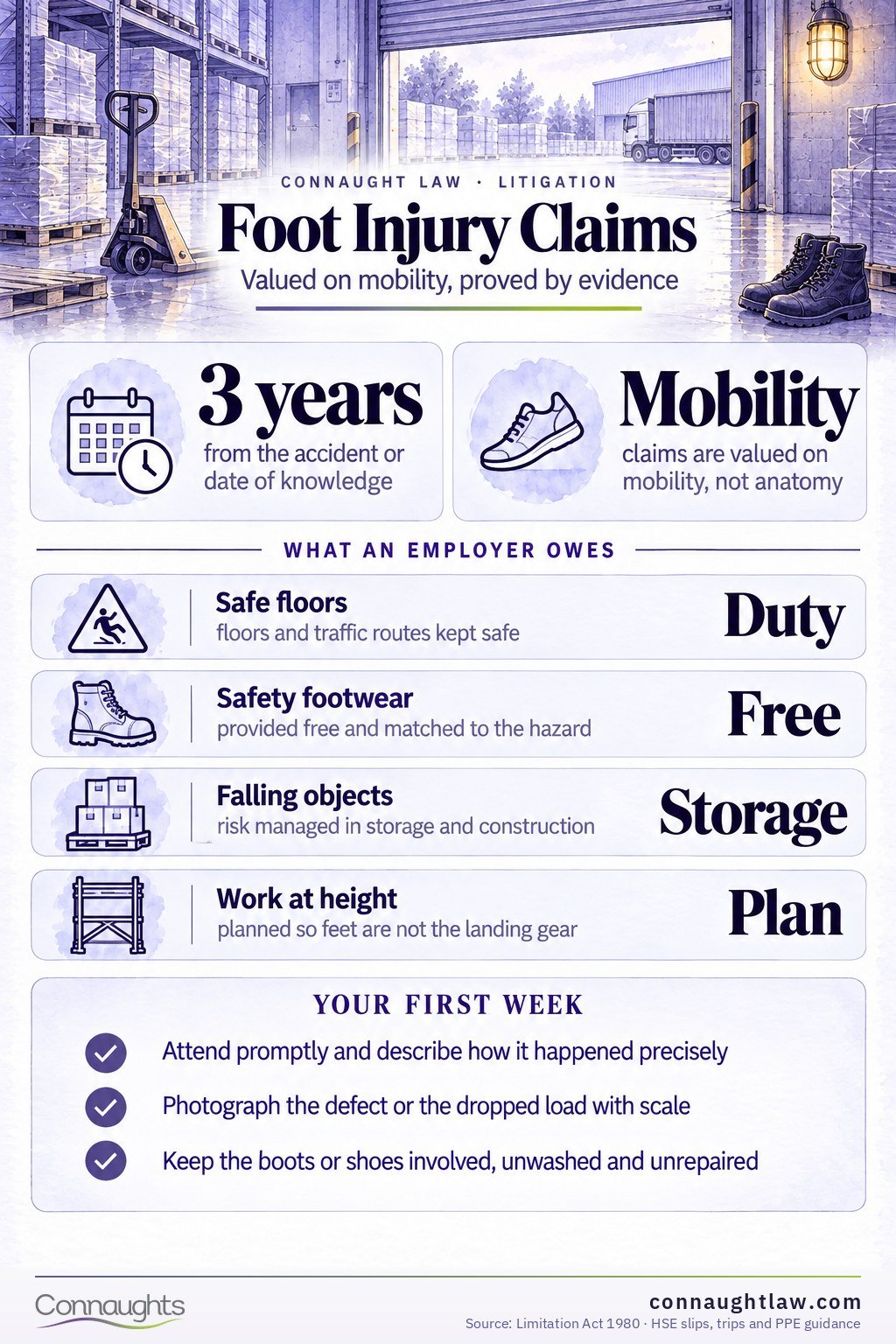
Evidence disciplines for the first month, condensed: attend promptly and describe the mechanism precisely; photograph the defect, the load or the vehicle position with scale; secure the accident book or RIDDOR reference; keep the boots or shoes involved, unwashed and unrepaired; and start a two-line daily note of standing time and pain.
Losses complete every foot claim and lead the serious ones: earnings across recovery and, where standing trades end, across retraining; private physiotherapy and surgery to shortcut waiting lists; orthotics and modified footwear on lifetime cycles; travel while driving is impossible; and care during the non-weight-bearing months. Our loss of earnings guide covers the evidence for that half of the claim.
Judicial College Guidelines for Foot Injuries
General damages follow the foot chapter of the Judicial College Guidelines, 18th edition, published 9 April 2026, which lifted the April 2024 figures by roughly eight per cent. The full ladder runs as follows.
Foot Injury Brackets
| Injury | JCG 18th Edition Bracket |
|---|---|
| Amputation of both feet | £223,800 – £266,200 |
| Amputation of one foot | £110,930 – £144,860 |
| Very severe — permanent severe pain or really serious disability | £110,930 – £144,860 |
| Severe — both feet or heels, substantial mobility restriction | £55,450 – £92,520 |
| Serious — continuing pain, arthritis risk, prolonged treatment | £33,020 – £51,790 |
| Moderate — displaced metatarsal fractures, lasting symptoms | £18,150 – £33,020 |
| Modest — fractures, sprains and soft tissue with good recovery | Up to £18,150 |
Amputation of both feet shares its territory with leg amputation because the useful ankle joint is gone on both sides, and one-foot amputation shares its bracket with the very severe category. Within every bracket, position turns on residual mobility, pain on weight-bearing, footwear restrictions, deformity and the documented risk of arthritis and fusion surgery, always read against the claimant's work and life.
Minor Foot Injury Compensation
Minor foot injury compensation is governed by the modest bracket: up to £18,150 under the 18th edition. This covers simple metatarsal fractures, ruptured ligaments, puncture wounds and soft tissue injuries where recovery is largely complete. Position inside the bracket follows recovery time and residue — a fracture healed in six weeks sits low; symptoms persisting a year or more, or a limp that lingers, climb toward the top.
Two points stop minor claims being undersold. First, permanent symptoms — pain on prolonged standing, restricted footwear, visible deformity — belong in the moderate bracket of £18,150 to £33,020, not the minor one, however small the original fracture looked. Second, special damages sit on top of the bracket, and for a self-employed roofer six weeks off work, they can exceed the injury award itself.
Where foot and ankle are injured together, as they commonly are, the injuries are valued as one changed mobility rather than two chapters, with the leading injury framing the assessment — the adjacent framework is in our ankle injury guide. Heel involvement drags valuation toward the foot chapter's severe territory; pure malleolar injury belongs to the ankle ladder.
- The top published foot brackets are £110,930 – £144,860 for loss of one foot and £223,800 – £266,200 for both feet.
- Six-figure "catastrophic foot" ranges quoted elsewhere online belong to other chapters of the Guidelines, not the foot chapter.
- Minor and modest injuries are capped at £18,150; permanent symptoms move a claim into the moderate bracket.
- A source still quoting £16,770 or £30,500 boundaries is using the superseded 2024 edition.
Broken Foot and Heel Fracture Claims
Fracture claims grade by joint involvement and permanence. Single metatarsal fractures that heal straight sit in the modest range; multiple and displaced fractures with lasting symptoms occupy the moderate bracket; and midfoot Lisfranc injuries, talar fractures and calcaneal — heel — fractures populate the serious and severe brackets, because they damage the joints that make a foot a mechanism rather than a platform.
What Is the Average Payout for a Broken Foot?
There is no official average. Most broken foot settlements sit between £18,150 and £51,790 under the 2026 Guidelines — the moderate and serious brackets — with clean, fully-healed fractures below £18,150 and financial losses added on top.
The honest answer behind that range: averages mislead because settlements pool wildly different injuries. A hairline metatarsal crack and a displaced Lisfranc fracture are both "a broken foot", four brackets apart. Losses distort the picture further — two identical fractures produce very different totals when one claimant is desk-based and the other climbs scaffolds. Value your claim from your prognosis and your losses, never from someone else's settlement figure.
Lisfranc Injuries: The Missed Diagnosis
Lisfranc injuries earn a specific warning because they hide: midfoot sprain-pattern pain, X-rays read as normal, weight-bearing resumed, and a joint quietly collapsing toward arthritis. Persistent midfoot pain after a crush or twist justifies weight-bearing views and CT, and the claim, like the foot, depends on someone insisting. Where diagnosis was delayed in hospital, the accident claim gains a clinical negligence companion.
Heel Fracture Claims
Heel fractures deserve their reputation: falls from ladders and scaffolds onto hard ground drive the calcaneus into itself, and the result — subtalar arthritis, altered gait, fusion surgery — ends ladder trades and long-standing careers out of proportion to the injury's public profile. Both-heel involvement is expressly severe-bracket territory at £55,450 to £92,520, and the earnings consequences usually exceed the bracket itself.
Broken Foot at Work: Employer Liability
A broken foot at work claim rests on concrete duties: floors and traffic routes kept safe under the workplace regulations, falling-object risk managed in storage and construction, safety footwear provided free and matched to the hazard under the PPE regime, and work at height planned so that feet are not the landing gear. HSE slips and trips guidance and PPE guidance frame these as management systems, and their documented absence is how liability is usually proved.
Workplace Foot Injury Scenarios
| Workplace Injury Scenario | Employer Duty Breached | Typical Injuries Caused |
|---|---|---|
| Slip Trip Fall Accidents | Inadequate surface maintenance, poor lighting, defective flooring | Ankle fractures, metatarsal breaks, heel trauma, ligament damage |
| Falling Objects Impact | Inadequate storage systems, poor load securing, unsafe stacking | Crush injuries, multiple metatarsal fractures, toe amputations |
| Machinery Accidents | Inadequate machine guarding, no safety training, equipment failure | Severe crushing trauma, partial foot amputation, nerve damage |
| Vehicle Struck Injuries | Inadequate pedestrian segregation, poor vehicle management, unsafe loading | Complex fractures, complete foot destruction requiring reconstruction |
The compensation column such tables normally carry has been removed deliberately: workplace foot awards come from the verified ladder above, positioned by outcome, with losses built on top. What the scenarios decide is breach, and the employer's own records — risk assessments, footwear issue logs, inspection rotas — decide the scenarios.
Safety Footwear and PPE Arguments
Safety footwear arguments repay precision: steel and composite toe protection is rated for defined impacts, midsole protection for punctures, and an employer who issued the wrong rating against a known hazard, or none at all, has documented its own breach. A worker's momentary lapse in enforced boots is a different case from a yard where trainers were tolerated for years.
Agency, casual and delivery workers are over-represented in foot files for structural reasons: inductions skipped, footwear budgets unclear between agency and host, and time pressure that walks loads across unswept floors. Duties follow control of the workplace and the work, not the payroll label, and gig-economy status arguments rarely survive contact with the accident book.
Public-place falls complete the map: supermarket spills, uneven steps, and the pavement defects highway law governs through the section 41 duty and section 58 inspection defence. Photographs with scale, prior-complaint histories and prompt written reporting decide these files in days, not year two.
Toe Injury Compensation and Crush Trauma
Toe injuries have their own chapter of the Guidelines, separate from the foot brackets, and it is worth quoting because toe claims are routinely undervalued against it. The 18th edition ladder runs as follows.
Toe Injury Brackets
| Toe Injury | JCG 18th Edition Bracket |
|---|---|
| Amputation of all toes | £48,250 – £74,090 |
| Amputation of the great toe | In the region of £41,370 |
| Severe — crush injuries, amputation of one or two lesser toes | £18,150 – £27,830 |
| Serious — great toe fractures or multiple lesser fractures with lasting symptoms | £12,690 – £18,150 |
| Moderate — straightforward fractures and soft tissue injury | Up to £12,690 |
The great toe stands apart because it is the push-off digit: its loss or stiffness changes walking mechanics permanently, which is why its amputation alone is valued in the region of £41,370. Pallet trucks, forklift wheels, dropped loads and stamping incidents supply the caseload, and safety-boot compliance — the employer's enforcement of it more than the worker's momentary lapse — supplies the liability argument.
Crushed foot injury compensation occupies the severe end's quiet territory: swelling that masks ligament destruction, compartment syndrome risks in the first hours, and long-term stiffness that no operation fully returns. Crush claims across the midfoot reward early specialist imaging and honest prognosis patience, because a crushed foot's final function is not knowable in month three.
Complications as Claimable Consequences
Complications are claimable consequences, not bad luck: compartment syndrome released late, infection around fixation, complex regional pain syndrome converting a crush into a pain condition, and deep vein thrombosis from immobilisation. Each moves brackets or adds heads of loss, provided the medical evidence names it and the claim is not settled before it declares itself.
Multi-injury accidents are the rule rather than the exception at the severe end: heels with lumbar compression from the same ladder fall, a crushed midfoot alongside the knee injury that struck the ground first. The claim values the whole changed person, led by the gravest element, and the losses schedule — mobility, work, care — is where the combination's real cost is captured.
Settlement timing respects bone and cartilage: midfoot and heel injuries declare their arthritis intentions slowly, fusion decisions sit months or years out, and early offers price that uncertainty for the insurer's benefit. Provisional damages hold defined deterioration risks open; neither works for a claim settled in the swelling stage.
Funding is the personal injury standard: conditional fee agreements, adverse-costs insurance, household legal expenses cover checked first. Defence themes — pre-existing degeneration, delayed first attendance, footwear choices — are answered by measured honesty, because a corroborated claimant settles well and an exaggerated claim, under fundamental dishonesty rules, can lose even its genuine core.
Medical Evidence in Foot Claims
The evidence set mirrors the joint's job: weight-bearing X-rays and CT for structure, MRI for ligament and soft tissue, gait analysis where mechanics changed, and a consultant foot-and-ankle surgeon addressing causation, arthritis risk and future fusion or corrective surgery with probabilities and dates. NHS guidance maps competent early management, which matters where hospital delay worsened the outcome.
Function evidence does the valuation work: standing tolerance against a shift's demands, walking distance measured honestly, stairs and ladders tested against the job description, footwear actually wearable, and a short diary of the days the foot decided. Defendants argue degeneration and pre-existing biomechanics; chronology and contrast answer them, as everywhere in orthopaedic litigation.
Time Limits for Foot Injury Claims
The Limitation Act 1980 applies its standard grid: three years from accident or knowledge, until 21 for children, no running limit where capacity is lacking. Highway trip claims meet the inspection-system defence, workplace claims generate RIDDOR and accident book records, and every category shares the same practical truth: surfaces, stock stacks and footwear policies reform themselves quickly once someone is hurt.
Feet invite walking it off, and walking it off empties the file: the fracture worked on for a week before X-ray reads as minor, whatever it becomes later. Prompt attendance, precise mechanism description and photographs of the defect or the dropped load are the file's foundation, laid in days one to seven.
Questions about foot and toe injury claims
How much compensation do you get for a foot injury in the UK?
Under the Judicial College Guidelines 18th edition: up to £18,150 for modest injuries, £18,150 to £33,020 moderate, £33,020 to £51,790 serious, £55,450 to £92,520 severe, and £110,930 to £144,860 for very severe injuries or loss of a foot, plus financial losses.
How much is minor foot injury compensation?
Up to £18,150 under the 2026 Guidelines, covering simple fractures, sprains and soft tissue injuries with a good recovery. Quick, complete healing sits low in the bracket; symptoms lasting a year or more climb toward the top, and permanent symptoms move into the moderate bracket.
What is the average payout for a broken foot in the UK?
No official average exists. Most broken foot settlements fall between £18,150 and £51,790 depending on displacement, joint involvement and residual symptoms, with cleanly healed fractures below £18,150. Lost earnings and treatment costs are added on top of these figures.
Are the six-figure "catastrophic foot" tables online real?
No. Ranges like £183,050 to £427,100 belong to other chapters of the Guidelines and have been copied across template tables. The top published foot figures are £110,930 to £144,860 for one foot and £223,800 to £266,200 for both.
What is a broken heel claim worth?
Calcaneal fractures with lasting subtalar consequences sit in the serious and severe brackets — both heels expressly at £55,450 to £92,520 — and the career consequences for ladder and standing trades usually make financial losses the larger element.
Can I claim if a load crushed my foot at work?
Yes. Falling-object and transport-route management, mechanical handling and enforced safety footwear are employer duties, and their documented failure is the standard liability finding in crush claims. Report it, photograph the scene and get imaging promptly.
How much is a toe injury claim worth?
The toe chapter runs from moderate injuries up to £12,690, serious at £12,690 to £18,150, and severe at £18,150 to £27,830, with great toe amputation in the region of £41,370 and all toes at £48,250 to £74,090.
Does compensation cover orthotics and special footwear?
Yes. Custom orthotics, footwear modifications, walking aids and their lifetime replacement cycles are recoverable, alongside home adaptations and the cost of future corrective or fusion surgery where the medical evidence shows it is probable.
What is the time limit for a foot injury claim?
Three years from the accident or date of knowledge, from age 18 for children, unlimited while capacity is lacking. Evidence, as ever, expires faster: photograph and report in week one.
Tell us how it happened, what the scans showed and how it has changed what you can do on your feet. We’ll tell you which bracket applies and what your lost earnings are worth on top.
Get Expert Advice