
Knee injury compensation UK claims are decided by a joint that forgives nothing. The knee carries every step, pivot and ladder rung, so damage that sounds modest — a torn meniscus, a ruptured ligament — reorganises work, sport and sleep, and the Judicial College Guidelines (18th edition, April 2026) price that reality: up to £18,150 for twisting and soft tissue injuries that largely recover, £19,610 to £34,600 for moderate lasting damage, and £92,130 to £127,110 at the severe end. This guide covers the verified 2026 brackets, ACL and meniscus claims, osteoarthritis acceleration, workplace liability, evidence and time limits.
On This Page

Understanding Knee Injury Compensation UK 2026
Knee claims have a distinctive shape: the injury often declares itself in stages. A fall or twist produces swelling that settles, the claimant soldiers on, and only weeks later does instability, locking or giving-way reveal the torn ligament or meniscus beneath. That delay is medically ordinary and legally dangerous, because unrecorded weeks become the defendant’s favourite argument. Early imaging and consistent records close the gap before it opens.
There is no single average: awards track severity. Most knee claims settle within the moderate Judicial College brackets — up to £18,150 where twisting, bruising or soft tissue injuries largely recover, and £19,610 to £34,600 for dislocations and torn cartilage with continuing symptoms. Severe injuries run from £34,600 to £127,110, with financial losses added on top.
The claimant population is everyone: sportspeople, tradespeople off ladders, cyclists and motorcyclists taking direct impact, and older claimants whose fall fractures what younger knees would have bruised. Each route has its liability rules; the joint, and the valuation framework, are common to all.
One honest framing helps before the detail: most knee claims are moderate claims, but the serious minority are underestimated at the start far more often than overestimated, because arthritis and replacement belong to a future nobody wants to discuss early.
The knee is also, in valuation terms, the busiest chapter of the orthopaedic injury framework. An orthopaedic compensation claim — knee, ankle, shoulder or wrist — is built everywhere on the same materials: imaging, operation notes and a consultant’s prognosis, converted into a bracket by what function was lost and for how long.
Funding follows the personal injury norm: conditional fee agreements with insurance against adverse costs, so investigation and specialist opinion cost nothing up front. Our personal injury claim guide explains the process from first call to settlement.
Kneecap dislocations mislead: a patella that relocates itself in minutes can leave torn stabilising ligaments and fragments that surface as recurrent instability months later, so first-time dislocations merit imaging as standard. Housemaid’s knee — prepatellar bursitis from sustained kneeling — is modest in bracket terms but ends kneeling careers, and the earnings element does the arithmetic the bracket cannot.
Losses often dominate the claim: earnings while off work, the retraining a compromised knee forces on physical trades, private treatment to bypass waiting lists, and care during the non-weight-bearing months. Our loss of earnings guide sets out the evidence that carries this half of the claim.
Judicial College Guidelines for Knee Injuries
General damages follow the knee chapter of the Judicial College Guidelines, 18th edition, published in April 2026 with an inflation uplift of roughly 8.26% over the 2024 figures. The chapter has two divisions — severe and moderate — each subdivided. The verified framework:
Knee Injury Brackets
| JCG Category | 18th Edition Bracket | What It Covers |
|---|---|---|
| Severe (i) | £92,130 – £127,110 | Joint disruption, gross ligamentous damage, lengthy treatment, considerable pain and loss of function |
| Severe (ii) | £68,860 – £92,130 | Leg fracture extending into the knee joint causing constant pain, instability and limited movement |
| Severe (iii) | £34,600 – £57,410 | Continuing pain, instability, wasting, weakness or deformity, with future degeneration risk |
| Moderate (i) | £19,610 – £34,600 | Dislocation, torn cartilage or meniscus with instability or weakness, or acceleration of pre-existing degeneration |
| Moderate (ii) | Up to £18,150 | Lacerations, twisting, bruising and soft tissue injuries with complete or near-complete recovery |
Within every band the same variables move awards: surgery and its success, residual instability, documented osteoarthritis risk, and the effect on kneeling, climbing or load-bearing work. A warehouse operative and a desk worker with identical scans hold different claims.
Anyone searching for knee injury compensation amounts should treat a single quoted figure with suspicion: the brackets are ranges because two identical MRI scans can support different awards. Position within a bracket is argued on function and prognosis, not calculators.
Comparisons with neighbouring joints help calibrate expectations: knee brackets sit alongside the ankle injury and foot injury ladders, and multi-joint injuries from one accident are valued as a whole rather than stacked. Within the knee chapter, the biggest discriminator is permanence: the same tear with and without lasting instability can sit two brackets apart.
- Surgery and its outcome: a reconstruction restoring stability reads differently from a failed graft
- Residual instability, locking or giving-way documented in follow-up records
- Osteoarthritis risk and the probability and timing of future replacement
- Effect on kneeling, climbing and load-bearing work — trade matters as much as tissue
- Provisional damages can keep the claim open for a defined deterioration
ACL, Meniscus and Soft Tissue Knee Injuries
Anterior cruciate ligament ruptures are the signature serious soft tissue knee injury: a pivot, a pop, a swollen joint, then the choice between reconstruction and conservative management. Reconstructed knees that recover well sit in moderate (i), £19,610 to £34,600; failed grafts, persistent instability and combined injuries — ACL with meniscus and cartilage damage, the classic “unhappy triad” — press into severe (iii), £34,600 to £57,410, and beyond.
Meniscus Tear Awards
Meniscus tears run the same logic at gentler values: partial tears managed with physiotherapy or arthroscopy typically resolve toward moderate (ii), while tears with lasting instability or a meniscectomy’s documented arthritis penalty belong in moderate (i). In both injuries the operation note and the surgeon’s prognosis paragraph are worth more than any number of adjectives about pain.
Soft Tissue Knee Injury Compensation
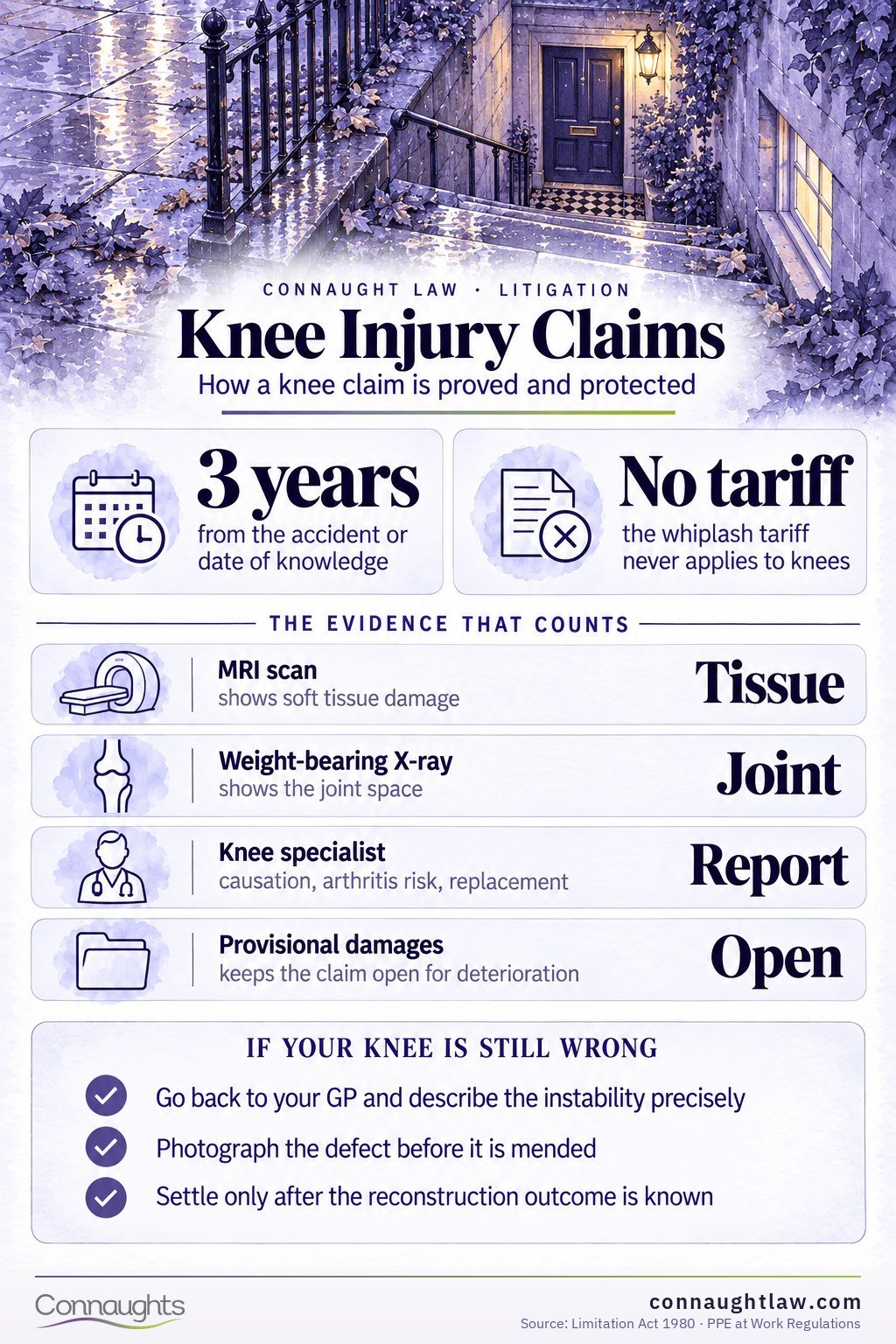
Soft tissue knee injury compensation covers the sprains, strains, twisting injuries and deep bruising that make up most knee claims. These sit in moderate (ii), worth up to £18,150, positioned almost entirely by recovery time: weeks of symptoms sit near the bottom; a year or more of documented restriction climbs toward the top. The whiplash tariff never applies — it covers only neck, back and shoulder soft tissue, so an injured knee in a road accident is valued under the Guidelines.
Sporting injuries add a liability wrinkle: the game’s inherent risks are accepted, but dangerous tackles beyond anything the sport contemplates, defective pitches and negligent return-to-play decisions are not.
Osteoarthritis and Accelerated Degeneration Claims
Post-traumatic osteoarthritis is the knee’s long tail, and an osteoarthritis compensation claim after trauma takes one of two honest forms. Either the injury caused arthritis in a previously healthy joint, or it accelerated degeneration that would have arrived anyway. Courts compensate the difference the accident made: where the evidence says symptoms were brought forward by, say, five or ten years, the award reflects that acceleration period — not a lifetime of arthritis the claimant would eventually have developed regardless.
The Guidelines build this in rather than bolting it on. Moderate (i) expressly includes injuries which accelerate symptoms from a pre-existing condition; severe (iii) prices continuing symptoms with future degeneration risk; the top brackets assume established osteoarthritis and probable replacement. Degenerative changes on imaging do not disqualify a claimant — the question is what the accident changed, answered by comparing function before and after.
Where arthritis is a real risk rather than a present fact, provisional damages let the court award now while preserving the right to return if the defined deterioration happens. The alternative — a percentage discount baked into a final settlement — quietly transfers the risk to the claimant.
Workplace Knee Injury Claims
Work supplies knee claims through impact and through attrition. The impact cases — falls from ladders, slips on unmarked wet floors, crush events — engage the familiar duties on safe systems, housekeeping and equipment. The attrition cases, years of kneeling in construction, flooring and maintenance trades, engage the Personal Protective Equipment at Work Regulations and HSE musculoskeletal guidance: knee protection provided and enforced, tasks rotated, prolonged kneeling designed out where practicable.
Workplace Knee Injury Scenarios
| Workplace Injury Mechanism | Employer Duty Breached | Typical Injuries Sustained |
|---|---|---|
| Repetitive Kneeling Work | Inadequate knee pad provision, insufficient job rotation, poor ergonomic assessment | Chronic bursitis, patellar tendinopathy, cartilage degeneration |
| Slips, Trips, Falls | Unsafe flooring, inadequate lighting, poor housekeeping standards | ACL tears, meniscus damage, patella fractures, ligament ruptures |
| Falls from Height | Inadequate fall protection, unsafe scaffolding, poor ladder stabilisation | Tibial plateau fractures, multi-ligament tears, complex joint trauma |
| Heavy Lifting Accidents | Inadequate manual handling training, no mechanical aids provided | Acute meniscus tears, cartilage damage, knee joint sprains |
Workplace knee awards come from the same Guidelines ladder as every other knee injury, positioned by outcome, with the earnings consequences of a physical trade doing the heavy financial lifting. What the scenarios above decide is liability, and the documents behind them — risk assessments, knee pad issue records, accident book entries — decide the scenarios.
Road and Public Place Knee Claims
Road claims mirror the workplace split at higher energies. Occupant knees strike dashboards in frontal impacts, the classic posterior cruciate mechanism, and are valued under the Guidelines rather than any tariff; our car accident compensation guide covers the liability and insurer process around them. Motorcyclists and cyclists take the worst of it, and claims against uninsured or untraced drivers run through the Motor Insurers’ Bureau.
Falls in public places round out the caseload: supermarket spillages, icy car parks, defective stairs and pothole trips, governed by occupiers’ liability or the highway maintenance regime and decided by inspection systems and their gaps. The knee-specific point is speed: photograph the defect before it is mended, because knee claims mature slowly while defects are repaired quickly.
Tibial Plateau and Serious Fracture Claims
Tibial plateau fractures, the load-bearing surface of the shin at the knee, mark the severe end: high-energy injuries from falls, motorcycles and pedestrian collisions, fixed with plates and grafts, and followed for years because the joint surface never forgets. As fractures extending into the joint they belong in severe (ii), £68,860 to £92,130, and press into severe (i), £92,130 to £127,110, where degeneration is established and replacement becomes probable.
Patella fractures, dislocations and multi-ligament disruptions share the same valuation logic: joint surface damage plus instability plus future surgery equals the upper brackets. These are also the claims where financial losses overtake general damages, and where interim payments and funded rehabilitation earn their place from the first weeks.
Recovery from serious knee surgery is a project: months non-weight-bearing, staged physiotherapy, a phased return to work. The Rehabilitation Code funds much of this during the claim, and the losses schedule should reflect the project’s true length rather than the optimistic first estimate.
Why Settlement Timing Follows the Joint
Settlement timing follows the joint, not the insurer: after reconstruction has declared its outcome, and never while a further operation sits unpriced on the horizon. Part 36 offers do their work once that evidence exists, and interim payments make the waiting affordable.
Knee Replacements and the Severe End
Prostheses close the severe end: where replacement happens young, revision surgery is a near-certainty the claim must fund, since implants have working lives shorter than working-age claimants. A settlement that ignores the revision cycle quietly transfers five-figure future costs from the defendant to the family.
Medical Evidence in Knee Claims
The knee is measurable, and strong claims measure it: MRI for soft tissue, weight-bearing X-rays for joint space, arthroscopy findings where surgery happened, and an orthopaedic knee specialist’s report addressing causation, arthritis risk and the probability and timing of future replacement. NHS guidance on knee pain maps the competent conservative pathway, and a claimant who followed it — physiotherapy attended, reviews kept — presents a treatment history that defends itself.
Degeneration arguments arrive on schedule in claimants past their thirties, and the reply is the same chronology-and-contrast method as in every joint claim: function before, mechanism, function after. Sporting histories cut both ways — defendants blame old football injuries, claimants prove years of symptom-free play since — and honest treatment of both keeps the expert evidence credible.
Functional detail positions awards inside brackets: stairs taken one at a time, kneeling impossible at family moments, driving limited by the operated leg, sport abandoned or adapted. A short diary and family statements supply what imaging cannot, the difference between a knee that photographs badly and one that lives badly.
Time Limits for Knee Injury Claims
The Limitation Act 1980 applies its standard grid: three years from the accident or from knowledge, until the 21st birthday for childhood injuries, no running limit where capacity is lacking. Knowledge matters in kneeling-trade attrition claims, where time runs from connecting the damaged knee to the working pattern, and in staged-presentation injuries diagnosed weeks after the fall; neither should be self-assessed when a solicitor can fix the dates properly.
Children’s knee injuries wait on growth: physeal involvement can disturb development, prognosis firms up late, and settlements are court-approved with limitation running from the 18th birthday. The practical rule for parents is the adult one amplified — record everything now, value nothing yet.
Defence tactics are predictable and answerable: degeneration on imaging, the delayed first complaint, the old sporting history, and in bigger claims surveillance. The consistent answer is measured honesty in every record, because a corroborated claimant is unbeatable and an exaggerating one is uninsurable.
Where the accident also injured other structures — the ankle rolled in the same fall, the wrist braced against it — the claim is presented as one injured person rather than a list of joints: overlapping symptoms are valued once, and the leading injury frames the assessment. Fragmenting a multi-injury claim across separate valuations reliably undervalues all of it.
Delayed diagnosis does not doom the claim; delayed records do. If your knee is still wrong weeks after the accident, go back, describe the instability precisely and push for imaging. The MRI that finally shows the tear will date the claim; the attendance record showing you reported symptoms all along will save it.
Questions about knee injury claims
How much compensation do you get for a knee injury in the UK?
Under the Judicial College Guidelines 18th edition, soft tissue and twisting injuries attract up to £18,150, moderate injuries £19,610 to £34,600, and severe injuries £34,600 to £127,110 depending on permanence, plus financial losses on top.
What is the average payout for a knee injury?
There is no meaningful single average. Most claims settle in the moderate brackets — four or low five figures — because most knees recover well; serious fractures and instability push awards far higher, and lost earnings often exceed the injury award itself.
How much is an ACL injury claim worth?
A reconstructed ACL with good recovery typically sits in moderate (i), £19,610 to £34,600; persistent instability, failed grafts or combined ligament and meniscus damage press into £34,600 to £57,410 and beyond, with earnings and future surgery costs added.
How much compensation for a soft tissue knee injury?
Soft tissue knee injuries — sprains, twisting, bruising — fall within moderate (ii), worth up to £18,150, positioned by recovery time. Injuries resolving within weeks sit low in the band; symptoms lasting a year or more climb toward the top.
What is a meniscus tear claim worth?
Tears resolving with physiotherapy or arthroscopy sit toward the top of moderate (ii); tears leaving instability or requiring meniscectomy carry recognised arthritis risk that lifts them into moderate (i) and shapes any provisional damages conversation.
Can I claim compensation for osteoarthritis after a knee injury?
Yes, where medical evidence links the arthritis to the accident — either caused outright or accelerated. Courts award for the acceleration period the injury produced, and the Guidelines expressly price accelerated degeneration within the moderate and severe brackets.
Can I claim for knee damage from years of kneeling at work?
Yes, where knee protection and task design fell short of the PPE and musculoskeletal duties and medical evidence links the degeneration pattern to the work. Time runs from your knowledge of the connection, so take advice once a doctor makes it.
Does compensation cover a future knee replacement?
Yes. Where the injury makes replacement probable, its cost and timing are claimed now on expert evidence, or protected through provisional damages where the risk is real but uncertain.
Tell us how it happened, what any scan or surgery showed and what the knee still will not do. We’ll tell you which bracket applies and whether arthritis risk should be priced in rather than signed away.
Get Expert Advice