
Slip and fall compensation in the UK is valued by what the fall actually broke, not by the fall itself. Under the Judicial College Guidelines 18th edition (April 2026), a moderate ankle fracture attracts £18,150 to £35,130, a wrist injury with lasting effects £16,640 to £32,370, and financial losses are added in every case. Liability follows the location: occupiers answer for shops, employers for workplaces, highway authorities for pavements. This guide sets out the 2026 payout brackets, the laws that decide who pays, and the evidence that wins these claims.
On This Page

Slip and Fall Compensation UK: Payouts and Legal Rights in 2026
Falls are among the most ordinary accidents the civil courts compensate, and among the most defended, because every occupier’s first instinct is that people should watch where they walk. The law’s answer has been stable for decades: visitors are entitled to premises kept reasonably safe, workers to floors managed against exactly this risk, and pedestrians to highways maintained under inspection systems that actually run. Momentary inattention is foreseeable humanity, not a defence.
Two questions decide every claim: was the surface kept as safe as the law requires in that setting, and can the evidence — photographs, accident book entries, CCTV, cleaning and inspection records — prove the failure before it disappears? The money then follows the medicine: awards track the specific injury, from soft tissue through fractured wrists, ankles and hips to head injuries at the gravest end.
There is no fixed average. Awards follow the specific injury under the Judicial College Guidelines 18th edition (April 2026): most fall claims involving a fracture sit between about £8,730 (simple forearm fracture) and £35,130 (moderate ankle fracture) for the injury alone, with minor injuries lower, serious outcomes far higher, and lost earnings, care and treatment costs claimed on top.
Slip and Fall Compensation Amounts: 2026 Brackets
There is no “slip and fall” bracket: general damages follow the injury under the Judicial College Guidelines, 18th edition, published in April 2026, which raised awards by around 8 per cent over the previous edition. Any table still quoting 2024 figures undervalues a current claim from the first offer.
The brackets below are verified 18th edition figures for the injuries falls most commonly cause, covering pain, suffering and loss of amenity only — financial losses are claimed separately in every case.
Common Fall Injury Brackets
| Common Fall Injury | JCG 18th Edition Bracket |
|---|---|
| Head — minor brain or head injury | £2,920 – £16,870 |
| Back — recovery within around 17 months | £5,750 – £10,420 |
| Arm — simple forearm fracture | £8,730 – £25,370 |
| Wrist — less severe, some lasting disability | £16,640 – £32,370 |
| Hip or pelvis — moderate injury | £16,640 – £35,130 |
| Ankle — modest sprains and undisplaced fractures | Up to £18,150 |
| Ankle — moderate fractures and ligament tears | £18,150 – £35,130 |
| Back — moderate, with continuing symptoms | £36,680 – £51,230 |
Severe outcomes climb their own ladders: severe ankle injuries needing fixation run from £41,370 to £66,140, serious wrist injuries reach £51,750, and severe back injuries run from £51,230 to £92,130 with the gravest cases beyond £100,000. The adjacent frameworks are covered in our ankle injury guide, wrist injury guide, broken arm guide, back injury guide and head injury guide.
Two categories deserve their own note. Hip fractures in older claimants are life-inflection injuries — surgery, rehabilitation, sometimes the end of independent living — and their claims carry care, aids and accommodation components that can dwarf general damages. And wrist fractures, the universal bracing injury, are dominance-sensitive: a broken dominant wrist takes writing, cooking and working with it, and the schedule of losses should say so specifically.
Is There an Average Payout for a Slip and Fall?
Websites quoting a single average payout for falls are guessing: no official body publishes one, and an average across bruised knees and broken hips would describe neither. The honest answer is a range anchored to the diagnosis — minor injuries resolve for four figures, most fractures settle within the five-figure brackets above, and life-changing outcomes are valued individually on specialist evidence.
Financial losses complete every award: earnings through recovery, physiotherapy and private treatment where waiting lists cost function, care including the family hours that never invoice, equipment from slings to stairlifts, and travel. In modest claims these are the difference between token and fair; in serious ones they are most of the money, and our loss of earnings guide covers their evidence.
Multi-injury falls are valued as one event: the wrist that broke the fall, the ankle that caused it and the head that finished it are assessed together, led by the gravest element, with overlapping symptoms valued once. Fragmenting the assessment undervalues it, and the schedule of losses is where the combination’s real cost lives.
Slip and Fall Laws UK: Who Is Liable for a Fall
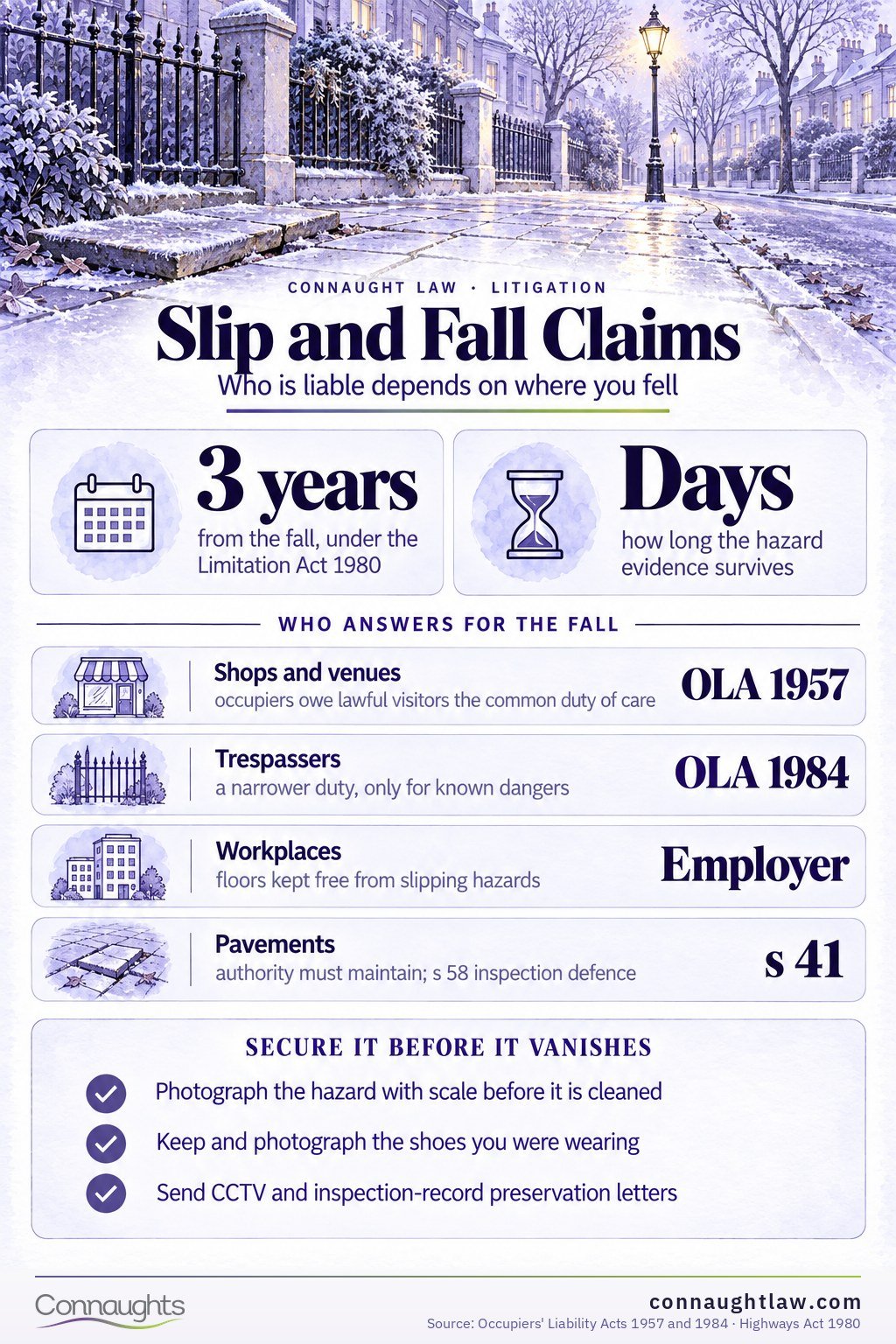
UK slip and fall law is not one statute but four overlapping regimes, and identifying the right one is the first step in any claim because each has its own duty, defendant and proof pattern.
- Occupiers’ Liability Act 1957 — occupiers owe lawful visitors the common duty of care: premises reasonably safe for the purposes they are invited for.
- Occupiers’ Liability Act 1984 — a narrower duty to trespassers, arising only where the occupier knows of a danger and that people may encounter it.
- Employers’ duties — the Health and Safety at Work etc. Act 1974 and Management of Health and Safety at Work Regulations 1999 require slip risks to be assessed and managed.
- Highways Act 1980 — section 41 obliges authorities to maintain adopted highways; section 58 defends those running a reasonable inspection system.
- Contributory negligence and the three-year limitation period apply across all four.
The Occupiers’ Liability Act 1957 governs shops, supermarkets, pubs, gyms, landlords’ common parts and every other place entered lawfully. The occupier must take such care as is reasonable to see visitors are reasonably safe using the premises for their permitted purpose. The standard is reasonable systems rather than perfection — inspection frequencies matched to risk, prompt spillage response, adequate lighting, sound handrails, weather management at entrances — and the Act expressly requires occupiers to expect children to be less careful than adults.
The Occupiers’ Liability Act 1984 covers people outside that invitation, principally trespassers. Its duty is narrower: it arises only where the occupier knows of a danger and knows people may come into its vicinity, and a clear warning will often discharge it. Exclusion notices cannot, however, sign away liability for personal injury caused by negligence.
Workplace falls engage employers’ liability. The Health and Safety at Work etc. Act 1974 and the Management of Health and Safety at Work Regulations 1999 require employers to assess and control slip and trip risks, and the Workplace (Health, Safety and Welfare) Regulations 1992 make it a specific duty to keep floors in good condition and free from slipping hazards. HSE guidance identifies slips and trips as the most common cause of workplace injury, and breach of these duties grounds a claim against the employer’s compulsory insurance.
Pavement and road falls are claimed under section 41 of the Highways Act 1980, which obliges highway authorities to maintain adopted highways — the potholes, raised paving and broken kerbs that trip pedestrians. Section 58 supplies the defence: the authority escapes liability if it proves a reasonable inspection and repair system that actually ran. These claims are decided on the defect’s measured dimensions, its complaint history and the authority’s own inspection records.
Ice, Snow and Winter Falls
Ice and snow do not suspend these duties; they activate them. Occupiers and employers must grit and manage predictable freezing on entrances, car parks and yards, and section 41(1A) of the Highways Act requires authorities to ensure, so far as reasonably practicable, that safe passage is not endangered by snow or ice. Context decides: an authority gritting main routes overnight in a national freeze may well have acted reasonably, while a supermarket that left its entrance sheet ice at noon almost certainly did not. Winter claims turn on gritting records and weather logs rather than indignation.
Where Falls Happen and Who Answers
Supermarkets and shops answer for spillage systems: reasonable inspection cycles, prompt clean-up, and wet floor signage that reflects an actual response rather than decorating the aisle. The classic contest is timing — how long the hazard existed — which is why sweep logs and CCTV matter more than anything a witness thinks they remember. Restaurants, pubs and venues add lighting, stairs and glassware; gyms add wet areas and equipment zones; car parks add gritting decisions each winter.
Workplaces produce the heaviest orthopaedic files — warehouse floors, loading bays, kitchens, wards — and the employer’s duty is proactive: risk assessment, housekeeping systems, footwear policy where conditions demand it, and RIDDOR reporting for serious outcomes. Claims run against compulsory employers’ liability insurance, and disciplining a worker for claiming would itself be actionable.
Private homes are the honest exception: guests hurt by a loose stair carpet can claim against household insurance, but social visits produce fewer and more delicate claims, and advice should weigh cover and relationships together. Rented homes are different — landlords answer for disrepair falls, the rotten step or failed banister, under repair obligations that sit alongside occupiers’ duties, with the tenant’s reporting history doing the work inspection logs do elsewhere.
Public transport falls — hard braking, wet carriage floors, platform gaps and station stairs — are claimed against operators whose cleaning cycles, driver conduct standards and CCTV retention are documented in depth; report on board or at the station so the incident exists in the operator’s records from hour one. Hotel and excursion falls within a UK-sold package can be claimed here against the organiser under the package travel regime, judged on local safety standards evidenced properly.
Falls Involving Children
Playgrounds, school stairs and retail spaces meet occupiers who must expect children to be less careful than adults, a duty the 1957 Act states expressly. Claims run through litigation friends with court-approved settlements, limitation runs from the eighteenth birthday, and orthopaedic evidence must account for growth plates where fractures involve them.
Proving a Slip and Fall Claim
The liability evidence list is short and unforgiving: photographs of the hazard with scale and context before it is cleaned, mended or gritted; the accident report or book entry with its reference; witness names captured on the day; footwear kept and photographed, because defendants always ask; and preservation letters for CCTV and inspection records sent within days. Highway claims add measurements — the defect’s depth and dimensions against the authority’s own intervention levels.
Nothing in litigation vanishes faster than a slipping hazard: spills dry, defects are mended, signs appear, rotas recycle, CCTV overwrites. Photograph everything at the scene if physically able, or have someone do it the same day, and report in writing immediately. The claim’s outcome is usually decided before the swelling goes down.
Medical evidence follows the ordinary pattern — prompt attendance, precise mechanism description, imaging that keeps pace with symptoms — and honesty does the rest: pre-existing conditions declared, capabilities described accurately, the aftermath diarised briefly. Under the Limitation Act 1980 the claim has three years, from 18 for children, unlimited where capacity is lacking; the hazard’s evidence has days. The wider personal injury claim process then runs on the standard pre-action protocols.
Contributory negligence reduces rather than bars a claim: wrong shoes, a phone in hand or a missed warning sign may shave a percentage, but courts treat ordinary human inattention realistically. Keep the footwear and describe it accurately — what harms claims is not the shoes but the shrug when asked about them.
Defence patterns are predictable: the hazard was obvious, the system was reasonable, the fall was exaggerated. Each is answered by the same file — timing evidence, systems disclosure, honest capability descriptions — and the fundamental dishonesty rules that punish exaggeration protect measured claimants by contrast. Funding follows the personal injury norm: conditional fee agreements, adverse-costs insurance, and fixed recoverable costs keeping modest claims proportionate.
A worked example ties the method together. A shopper slips on milk photographed spreading across an aisle, reports at the desk, and fractures a wrist with some lasting weakness: liability turns on the sweep log’s gap, the injury sits in the less severe wrist bracket of £16,640 to £32,370, and earnings, physiotherapy and family help complete a schedule that settles without proceedings. Nothing in that sequence required luck; every element was a decision made in the first week.
Frequently askedQuestions about slip and fall claims
How much compensation do you get for a slip and fall in the UK?
Whatever the specific injury commands under the Judicial College Guidelines 18th edition: minor head injuries from £2,920, simple forearm fractures £8,730 to £25,370, moderate ankle fractures £18,150 to £35,130, with lost earnings, care and treatment costs added in every case.
What is the average payout for a slip and fall in the UK?
No official average exists. Most fracture claims settle within five-figure guideline brackets — roughly £8,730 to £35,130 for common arm, wrist, hip and ankle injuries — while minor injuries resolve for less and life-changing outcomes are valued individually on expert evidence.
Can I claim if I slipped on a wet floor with no warning sign?
Often yes. The question is whether the occupier’s inspection and response system was reasonable: how long the hazard sat there, what the sweep log shows, whether signage reflected an actual response. Absent signage supports the claim; it does not decide it alone.
Who is liable if I trip on a broken pavement?
The highway authority, under section 41 of the Highways Act 1980, unless it proves a reasonable inspection system under section 58. Measured photographs of the defect against a coin or rule, plus its complaint history, decide these claims.
Can I claim against my employer for a fall at work?
Yes. Employers must assess and manage slip risks and keep floors safe under specific workplace regulations, claims run against compulsory employers’ liability insurance, and treating you detrimentally for claiming would itself be unlawful.
Does it matter that nobody saw me fall?
No. Unwitnessed falls succeed on prompt reporting, same-day photographs, consistent medical records and CCTV. What kills unwitnessed claims is silence: an accident reported a fortnight late invites suspicion the evidence cannot cure.
What if I was partly to blame — wrong shoes, looking at my phone?
Contributory negligence reduces rather than bars claims, and courts treat ordinary human inattention realistically. Expect the argument, answer it honestly, and let the systems evidence carry the liability weight.
What is the time limit for a slip and fall claim?
Three years from the fall under the Limitation Act 1980, from the eighteenth birthday for children, unlimited where capacity is lacking. The evidential deadline — photographs, sweep logs, CCTV — is measured in days, not years.
Tell us where it happened, what you slipped or tripped on and whether anyone recorded it. We’ll tell you who is liable for that location and what evidence needs preserving before it recycles.
Get Expert Advice