
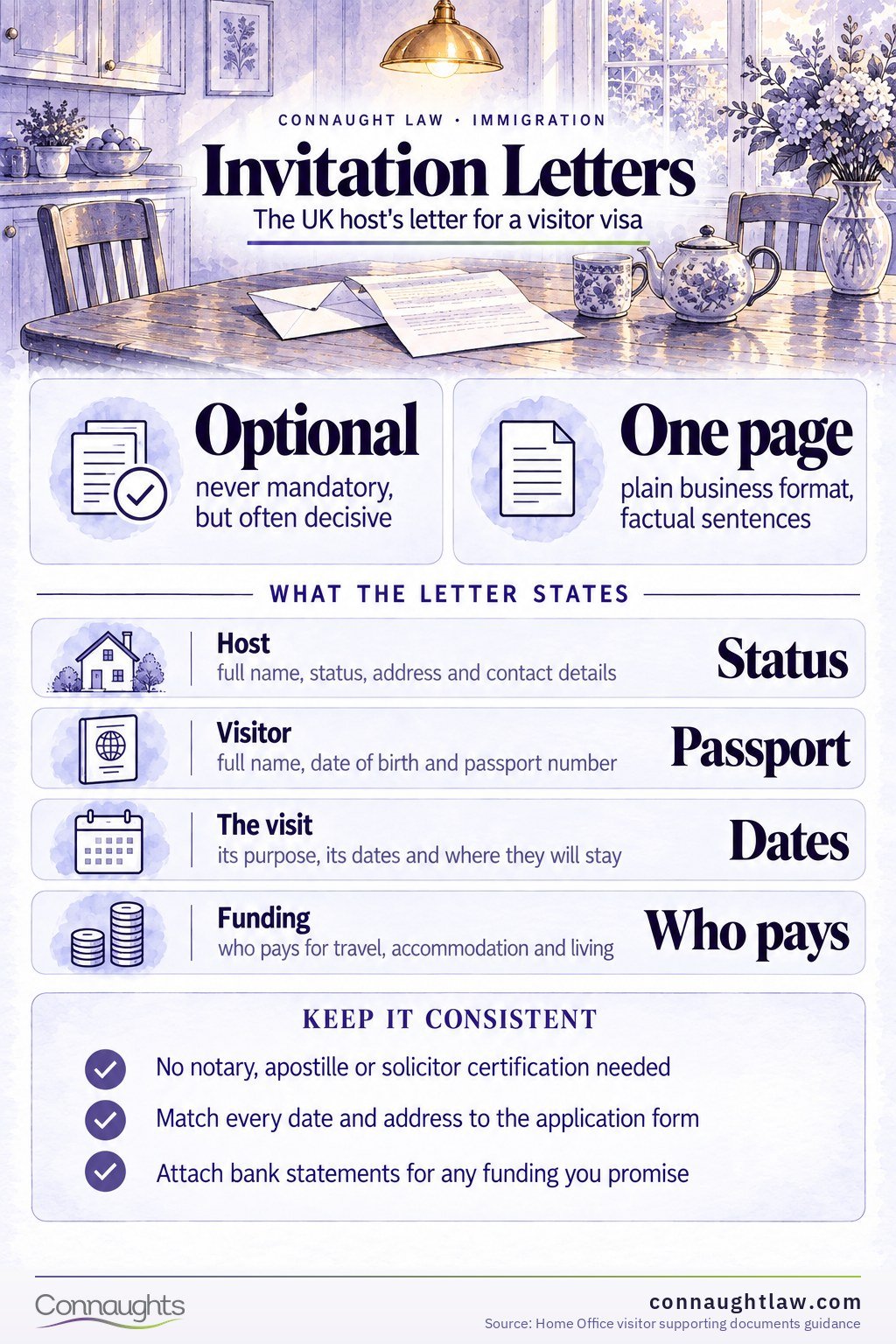
An invitation letter is the UK host's half of a visitor application: never mandatory, frequently decisive. It needs no notary and no apostille — just accurate facts a caseworker can verify against both sides of the file. This guide covers who should write one, what it must contain, how it differs from a sponsorship letter, a worked family-visit sample, and the letter mistakes that delay or refuse applications.
On This Page

The Letter That Anchors a Family Visit
UK visitor rules nowhere require an invitation letter — the supporting documents guidance lists it as helpful evidence, nothing more. Its real function is architectural: it is the one document that ties the applicant's story to the host's documents, and caseworkers read it against both. A letter that reconciles cleanly strengthens everything else in the file; one that contradicts a date, an address or a funding claim undermines it all.
Legal Requirements
Who Can Write One
Any UK host with lawful status: family members, friends, business contacts or institutions. The writer's credibility is the letter's currency — their immigration status, address and finances should be evidenced alongside it, which is why the letter and the host's document pack travel together as described in our visitor sponsorship guide.
Mandatory or Optional?
Optional in law, expected in practice for family visits, private hosting and any visit whose costs a UK party bears. No notarisation, apostille or solicitor certification is required — a signed letter with contact details suffices, and paying to legalise one adds nothing a caseworker values.
Writing the Letter
Essential Information
What the Letter Must Contain
- The host's full name, status, address and contact details.
- The visitor's full name, date of birth and passport number.
- The relationship, and how long it has existed.
- The visit's purpose and its dates.
- Where the visitor will stay.
- Who pays for what — travel, accommodation, living costs.
- A statement that the visitor will leave at the end of the visit.
- Signature and date, with willingness to be contacted.
Formatting and Tone
One page, plain business format, factual sentences. Warmth does not persuade caseworkers; precision does. Write what can be verified, avoid advocacy ("she would never overstay"), and let the enclosed documents prove each claim the letter makes.
Invitation vs Sponsorship Letters
The Terminology Difference
An invitation letter says "come and stay"; a sponsorship letter adds "and I will pay". The distinction matters because a funding commitment converts the host's finances into application evidence — bank statements and income documents must then support exactly what the letter promises.
Financial Commitment Implications
Commit specifically or not at all: "I will provide accommodation and meals; my niece funds her own flights and insurance" is a checkable promise, while open-ended undertakings invite scrutiny of the host's entire financial position. Nothing in a letter creates a legal bond — but a promise the statements cannot support reads as a false representation.
Supporting Documents
What Accompanies the Letter
The letter's claims each need an exhibit: status (passport or eVisa share code), address (council tax or tenancy), accommodation capacity, and — where funding is promised — three to six months of statements. The relationship claim takes certificates for family and history for friends.
Digital Submission
Everything uploads with the visitor's online application as clear scans — no originals, no wet-ink couriering. The host emails the signed letter and documents to the applicant, who uploads them in the application's document section before biometrics.
Common Mistakes
Errors That Delay or Refuse
The recurring failures: dates that differ from the application form, addresses that differ from the host's documents, funding claims the statements contradict, template letters with another family's phrasing left in, and letters silent on facts the form discloses. Every one is a consistency failure — the fix is reading letter, form and documents side by side before anything is submitted.
Compliance and Risk
The letter is a representation to the Home Office: knowingly false statements engage the deception rules for host and visitor alike, with refusal periods that outlast any single trip. Honest letters about imperfect facts — a modest income, a past refusal — consistently outperform polished letters that hide them.
Templates and Sample
Why Templates Alone Fail
Caseworkers process thousands of applications and recognise circulating templates instantly. Use a template for structure only; every sentence should carry facts specific to your household, your visitor and this visit.
Business and Academic Letters
Corporate and institutional invitations follow the same logic on letterhead: the inviting organisation, the event or meetings, dates, and which costs the organisation bears. They pair with the visitor's employment evidence rather than family documents.
Sample Family Invitation Letter
A Worked Example
"I, [host name], a British citizen residing at [address], invite my mother, [name], born [date], passport [number], to visit me from 10 June to 20 July 2026. She will stay at my home, where I hold a tenancy with a spare bedroom. I will provide accommodation and daily living costs; she funds her own return flights and travel insurance, as her enclosed statements show. She lives in [country] with my father and returns before her employer's leave expires on [date]. I enclose my passport copy, tenancy agreement and bank statements, and can be contacted on [phone/email]. Signed, [name], [date]."
Key Elements Explained
Notice what the sample does: names the status, fixes the dates, splits the funding checkably, states the return reason with a verifiable anchor, and lists its own exhibits. Those five moves — not length or eloquence — are what separate letters that help from letters that pad the file.
Timing and ETA Context
Current Processing Standards
Service Levels and Times
Visitor applications run to a three-week standard from biometrics, with the £500 priority service compressing to five working days where offered. Hosts should send the letter early: it is usually the last document assembled and the first one inconsistencies are found in.
ETA Requirements
Non-visa nationals need no invitation letter at all for the £20 ETA — but border officers can still ask arriving visitors about their stay, and a copy of the host's letter in hand luggage answers those questions cleanly. Wider family-route questions — when visits stop being the right vehicle — sit with our family visa team and our broader immigration services.
Frequently askedQuestions about invitation letters
Is an invitation letter mandatory for a UK visitor visa?
No — it is optional supporting evidence. In practice it is expected for family visits and any privately hosted stay, because it is the document that connects the applicant's account to the host's evidence.
Does a UK invitation letter need an apostille or notary?
No. No legalisation, notarisation or solicitor certification is required — a signed letter with contact details and supporting documents is exactly what caseworkers expect. Paying for an apostille adds cost and nothing else.
Who should the invitation letter be addressed to?
"UK Visas and Immigration" or "To whom it may concern" — it is read by the caseworker deciding the application. It uploads with the visitor's online application rather than being posted anywhere.
What documents does the host attach?
Status evidence (passport or eVisa share code), proof of address, accommodation evidence, and bank statements where the host funds any part of the visit — each one proving a claim the letter makes.
Can one letter cover a couple or family group?
Yes — name every visitor with dates of birth and passport numbers, and address the arrangements for each. Each applicant uploads the same letter with their own application so every file is complete on its own.
Why do applications with invitation letters still get refused?
Because the letter cannot cure weak ties or unexplained funds, and a contradictory letter actively harms. Refusals typically cite the applicant's own circumstances — the letter's job is consistency, not rescue.
Send us your draft letter and both document sets. We'll reconcile every fact across the file before your visitor applies.
Get Expert Advice