
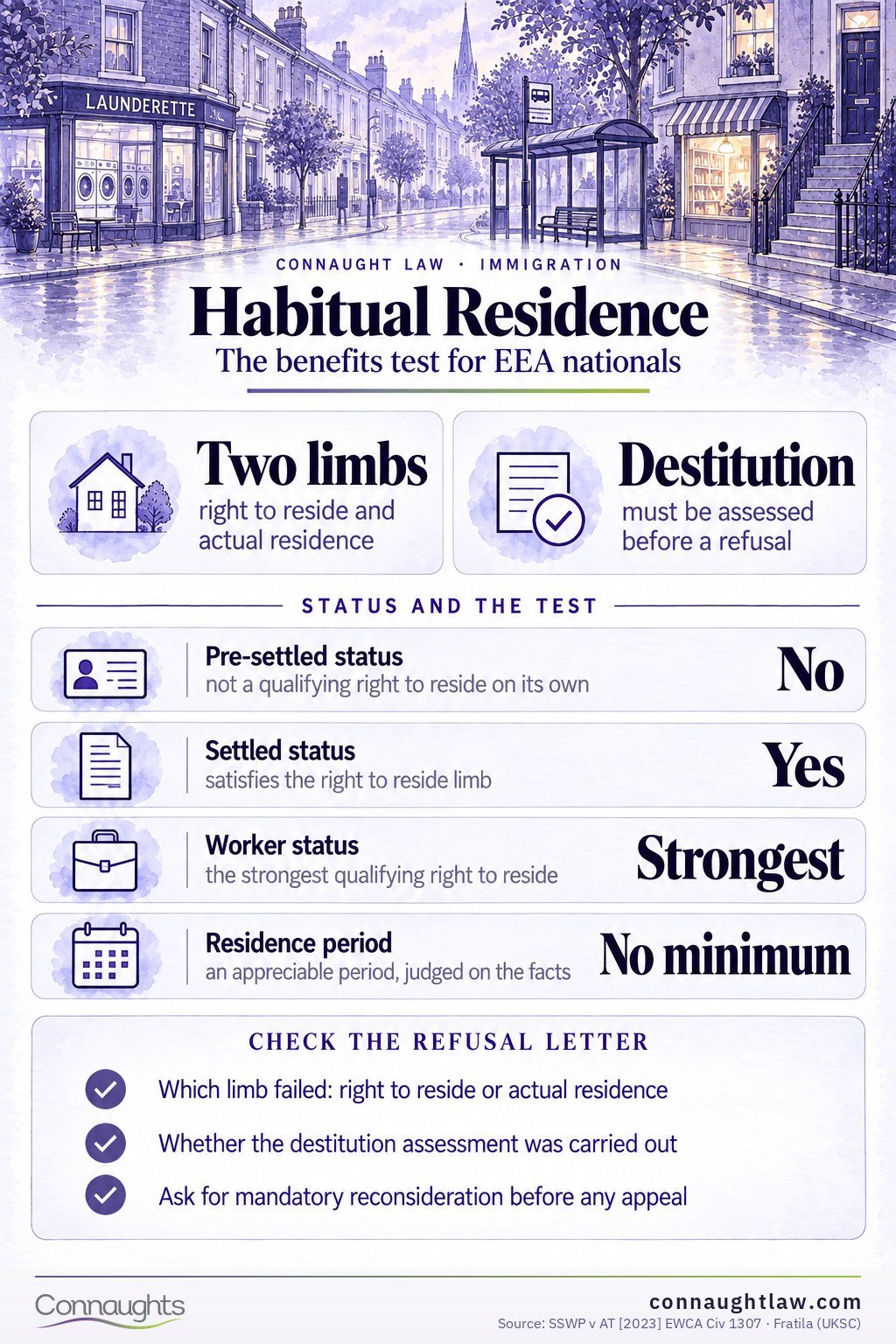
The habitual residence test decides whether an EEA national can claim means-tested benefits in the UK. It has two limbs — a right to reside, and actual habitual residence — and it is a benefits test, not an immigration one. Pre-settled status alone does not satisfy the first limb, but since 2023 a claimant who fails it must still be assessed against a destitution threshold before being refused.
On This Page

The Two Limbs
To pass, a claimant must have a right to reside that counts for benefits purposes, and must be habitually resident in fact. Failing either is enough to refuse the claim, and they are assessed separately on different evidence.
The right to reside limb runs on the Immigration (European Economic Area) Regulations 2016, saved for benefits purposes by Schedule 4 to the 2020 revocation regulations. The 2006 Regulations, which a great deal of published guidance still cites, were revoked on 1 February 2017 and are not the source of anything decided today.
The second limb is factual: an actual settled intention to remain, together with an appreciable period of residence. It is not a fixed number of months, and the decision maker weighs the reasons for coming, the length and continuity of residence, employment prospects and the centre of the claimant’s interests.
Which Right to Reside Counts
Not every right to reside counts. The regulations exclude some categories from the right-to-reside test for benefits, and this is where most refusals originate. The position of pre-settled status holders was settled by the Supreme Court in Fratila in 2021: pre-settled status alone is not a qualifying right to reside. It gives the holder lawful residence for immigration purposes and nothing automatic for benefits.
Settled status is different. It satisfies the right to reside limb, so for a settled-status claimant only the second limb — actual habitual residence — remains live.
In SSWP v AT [2023] EWCA Civ 1307, decided on 8 November 2023, the Court of Appeal held that where a pre-settled status holder has no qualifying right to reside, the decision maker must go on to consider whether refusing benefits would leave them destitute. The Secretary of State’s application to appeal was refused by the Supreme Court on 7 February 2024, so the judgment is final. The threshold is the inability to meet the most basic needs at present or in the near future — extreme material poverty incompatible with human dignity, measured against food, personal hygiene, clothing, housing and adequate heating.
A refusal that stops at “no qualifying right to reside” has not applied the law, and that is the first thing to look for on the decision letter.
Qualified Person Status
The routes to a qualifying right to reside are worker, self-employed person, jobseeker, self-sufficient person and student, together with retained worker status and permanent residence acquired after five years. Worker status is the strongest and the most commonly argued.
One point of frequent confusion: the Minimum Earnings Threshold is a screening trigger used by decision makers, not a statutory test of worker status. Earnings below it do not defeat a claim; they prompt a fuller examination of whether the work is genuine and effective. Arguing the case as though the threshold were the law concedes ground that does not have to be conceded.
Retained worker status matters most for people who have stopped working through illness, pregnancy, involuntary unemployment or vocational training, and it is often the strongest available argument where current employment has ended. Our guide for European nationals covers the immigration side of the same status.
Settled Status and the Withdrawal Agreement
Section 45 of the Border Security, Asylum and Immigration Act 2025, in force from 2 December 2025, treats EU Settlement Scheme status holders as beneficiaries of the Withdrawal Agreement without a separate Article 10 assessment. It removes an argument decision makers previously ran; it does not remove the requirement for a qualifying right to reside.
So the sequence for a pre-settled claimant is now: is there a qualifying right to reside; if not, does the AT destitution assessment apply; and only then a refusal. Skipping the middle step is the commonest error in this area, and it is the one worth checking first on any refusal letter.
Proving Actual Habitual Residence
This limb is about facts rather than status. Decision makers look at why you came, how long you have been here, whether the residence has been continuous, what ties you have retained abroad, and whether your centre of interests has moved to the UK. Bringing family, taking a tenancy, registering with a GP and holding continuing employment all point the same way.
There is no fixed qualifying period. An appreciable period is required, but what counts as appreciable depends on the rest of the picture — someone returning to a country they lived in for years is in a different position from someone arriving for the first time.
Universal Credit
Universal Credit is where the test bites hardest, because habitual residence is a basic condition of entitlement rather than something assessed element by element. Failing it means no award at all, not a reduced one.
The test also applies to Pension Credit, Housing Benefit, income-related Employment and Support Allowance and Income Support. Income-based Jobseeker’s Allowance is closed to new claims, so any guidance built around it is describing a benefit that no longer takes claimants.
If You Are Refused
Start with mandatory reconsideration. A benefit decision cannot go straight to the tribunal — you must ask the department to look again first, and gov.uk sets out the time limit for that request. Only after the mandatory reconsideration notice can an appeal be lodged with the First-tier Tribunal.
- Which limb failed. A decision that does not say whether it turned on right to reside or on actual residence cannot be answered properly.
- Whether the AT assessment was carried out where the claimant has pre-settled status and no qualifying right to reside. If the letter is silent on destitution, that is the point to take.
- Whether retained worker status was considered where work has ended through illness, pregnancy, involuntary unemployment or training.
- Whether the Minimum Earnings Threshold was treated as a rule rather than as a screening trigger.
Where the underlying problem is immigration status rather than benefits, the two run in parallel and should be dealt with together — our appeals team handles the immigration side, and our guide to the EU Settlement Scheme covers status itself.
Frequently askedQuestions about the habitual residence test
What is the habitual residence test?
A two-limb test for means-tested benefits. You need a right to reside that counts for benefits purposes, and you must be habitually resident in fact. Failing either limb is enough for a refusal.
Does pre-settled status pass it?
Not on its own. Fratila settled that pre-settled status is not a qualifying right to reside. But since AT, a decision maker who finds no qualifying right to reside must go on to assess destitution before refusing.
What is the AT destitution threshold?
An inability to meet your most basic needs now or in the near future — extreme material poverty incompatible with human dignity, measured against food, personal hygiene, clothing, housing and adequate heating.
Does settled status pass the test?
It satisfies the right to reside limb. You must still show actual habitual residence, which is a factual question about your ties to the UK rather than about your status.
How long do I have to live here first?
There is no fixed period. An appreciable period of residence is required, judged alongside your reasons for coming, the continuity of residence and where your centre of interests lies.
Which benefits does it apply to?
Universal Credit, Pension Credit, Housing Benefit, income-related Employment and Support Allowance and Income Support. Income-based Jobseeker's Allowance is closed to new claims.
Do low earnings mean I am not a worker?
Not automatically. The Minimum Earnings Threshold is a screening trigger, not a legal test. Below it, the decision maker examines whether the work is genuine and effective rather than refusing outright.
How do I challenge a refusal?
Ask for a mandatory reconsideration first — a benefit decision cannot go straight to appeal. Once the mandatory reconsideration notice arrives, the appeal goes to the First-tier Tribunal.
Tell us what status you hold, what work you have done here and what the refusal letter says. We'll tell you which limb failed and whether the destitution assessment was carried out.
Get Expert Advice