
Short courses in the UK run through two different doors: the Short-term study visa — £228, for English language courses of 6 to 11 months at accredited providers — and the visitor rules, which allow study up to 6 months on almost any course without a study visa at all. Choosing the wrong door is the commonest error in this corner of the system. This guide covers both routes, their costs and their hard limits in 2026.
On This Page

Two Doors Into a Short UK Course
The confusion is built into the names. The Short-term study visa exists for exactly one thing: English language courses longer than 6 months and up to 11. Everything shorter — English included, and almost any other subject — is studied under the visitor framework instead. Which door applies is decided by course length and subject, not preference, and applications through the wrong one are refused on arrival at the rules.
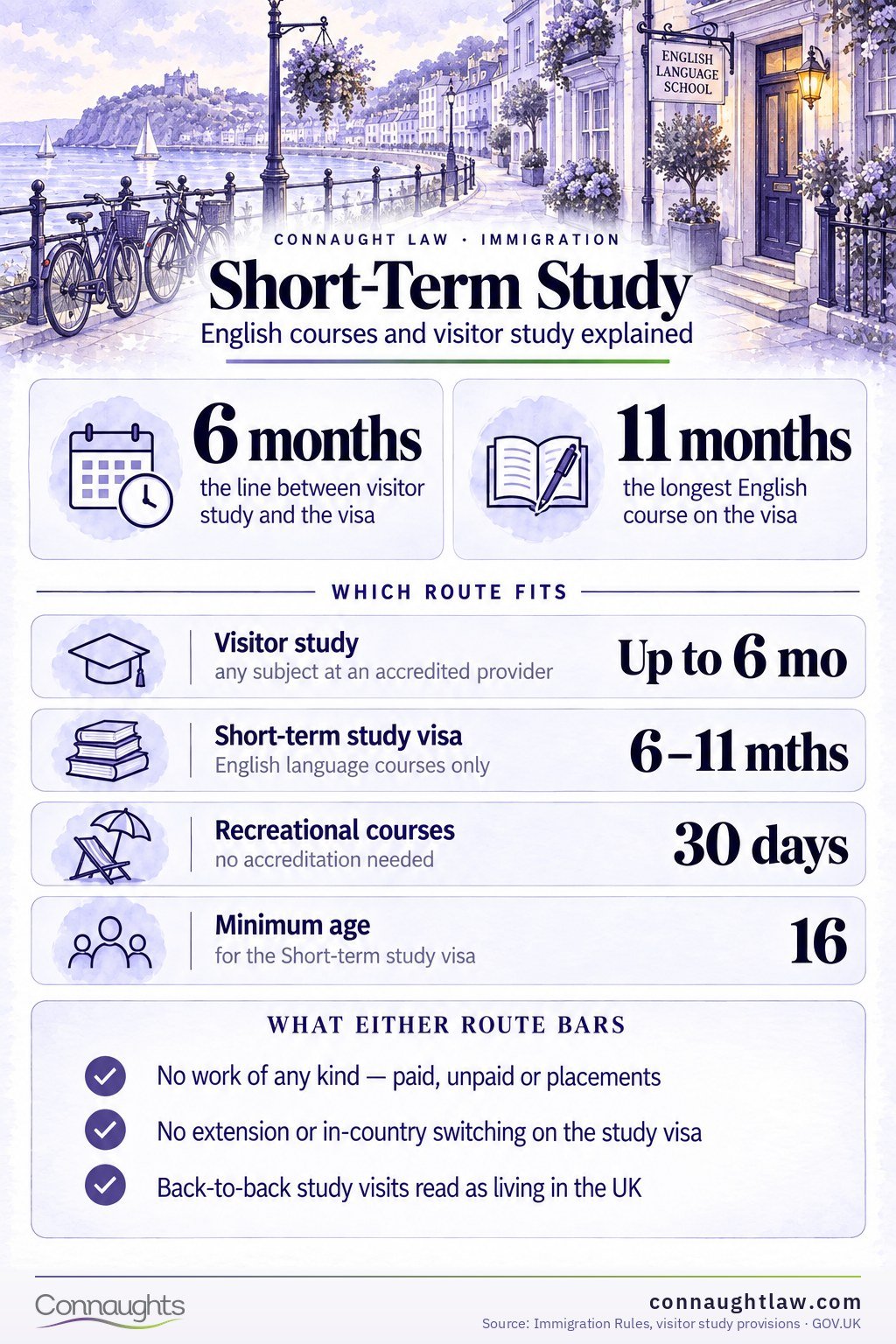
Types of Short-Term Study Route
The Short-Term Study Visa: English for 6–11 Months
The dedicated visa costs £228 plus a £776 healthcare surcharge, requires the applicant to be 16 or over, and covers a single English language course of more than 6 and at most 11 months at an accredited provider. It is deliberately a dead end: no extension, no switching into other routes from inside the UK, no dependants and no work of any kind. For a committed year of English, it is the right tool; for anything more ambitious, the Student route is the honest starting point.
Visitor Study up to 6 Months
Visitors can study for up to 6 months at an accredited institution — any subject, not just English — under the visitor study provisions. Nationals who need a visa apply as a Standard Visitor at £135; non-visa nationals can simply arrive with their course documents and, since 2025, an electronic travel authorisation. Recreational courses of up to 30 days sit inside the same framework without accreditation requirements.
Research and Study Visits for Visitors
The visitor route also carries the academic traffic that never fits a study visa: researchers on sabbatical placements, academics attending conferences, doctors and dentists on clinical attachments, and prospective students visiting institutions before committing. Each activity has its own conditions in the visitor rules, and the recurring theme is genuineness — a "research visit" that is really a rolling programme of UK study invites refusal at the border.
Study Routes Compared
| Route | Length | Courses | Cost |
|---|---|---|---|
| Short-term study visa | 6–11 months | English language only | £228 + £776 surcharge |
| Standard Visitor (visa nationals) | Up to 6 months | Any course at an accredited provider | £135 |
| Visitor study (non-visa nationals) | Up to 6 months | Any course at an accredited provider | ETA only |
Short-Term Student Requirements
Essential Requirements
The application must show four things: a confirmed place on a qualifying English course at an accredited provider; the money to pay for the course and support yourself without working; accommodation arrangements or the funds for them; and the intention to leave when the course ends. The intention point carries real weight — this is a visitor-family route, and caseworkers read it through visitor-rule eyes.
Financial Requirements
Unlike the Student route, no fixed monthly maintenance figure is prescribed — the test is having enough for the course fees, living costs and return travel without working or recourse to public funds. Bank statements showing stable funds comfortably covering the stated budget, with the money's source explicable, do the work here; large unexplained deposits shortly before applying are the classic red flag.
Accredited Institutions
The course provider must hold accreditation recognised under the rules — in practice, English language schools accredited by recognised bodies and institutions on the official registers. Checking the provider's accreditation before paying a deposit is a two-minute task that prevents the worst outcome in this route: a refused visa and a course fee in dispute. A provider that cannot name its accreditation is answering the question.
The 6-Month Line
Six months is the boundary that organises everything. At 6 months or less, the visitor framework covers the study and no study visa exists to apply for — searchers asking for a "6-month study visa" are really asking for visitor study. Beyond 6 months, only English language study is possible short of the full Student route. Course lengths are worth designing around this line: a 24-week course travels lighter than a 26-week one.
Visitor Study Limitations
Visitor study permits no work, no extension beyond the visit, and no course-hopping into a longer UK stay. Repeat visits attract scrutiny: a pattern of back-to-back study visits reads as de facto residence by instalments, and border officers refuse entry on exactly that reasoning. Anyone planning sequential courses over more than a year is describing a Student visa application, not a visitor pattern.
English Language Requirements
No Mandatory English Test
Neither route demands a pre-arrival English test — a genuine distinction from the Student visa's formal requirements. The practical assessments happen anyway: providers place students by level, and a visa interview conducted in English forms its own view. The absence of a test lowers the paperwork, not the scrutiny.
Applying for the Visa
Step-by-Step Application
Book the course, gather the evidence, apply online up to 3 months before travel, enrol biometrics, and expect a decision in around 3 weeks from outside the UK. The sequence matters at the front: the course booking anchors everything else, and the application's dates, funds and accommodation story must match it exactly.
Document Requirements Checklist
- Passport, and course confirmation from the accredited provider with dates and fees.
- Bank statements covering course costs and living expenses, with the funds' source explicable.
- Accommodation details, and evidence of ties supporting the intention to leave — work, study or family commitments at home.
- TB certificate where the applicant's country is on the testing list; parental consent documents for 16 and 17 year olds.
Visa Eligibility Checklist
Short-Term Study Eligibility Criteria
Run the test in order: aged 16 or over; an English course of more than 6 and at most 11 months; an accredited provider; funds without working; and a credible intention to leave. Fail any one and the answer is a different route, not a more hopeful application through this one.
Common Application Issues
Refusals cluster on three things: financial evidence that does not add up to the stated plan, weak home ties suggesting the course is a vehicle rather than a purpose, and course lengths that put the applicant in the wrong route entirely. Refusals here carry no right of appeal in most cases — a fresh, corrected application is usually the remedy, though our appeals team advises where more is in play.
Visa Limitations and Restrictions
Work and Employment Restrictions
No work of any kind attaches to either route — paid, unpaid, placements or self-employment. Breach is not a technicality: it follows the applicant into every future UK application, and for a route family built on trusting the applicant's intentions, a working "student" is the case the rules were written against.
Extension and Switching Limitations
The Short-term study visa cannot be extended and cannot be switched from inside the UK — the 11 months end and the holder leaves. Anyone whose plans have grown applies from abroad for the route that fits, usually the full Student visa; the wider study landscape, including the changes reshaping it, is in our student visa changes guide, and short visits for other purposes run through the visitor visa rules.
Frequently askedQuestions about short-term study in the UK
What is the difference between the short-term study visa and visitor study?
Length and subject. The Short-term study visa covers only English courses of 6 to 11 months, at £228 plus the £776 surcharge. Study of up to 6 months — in any subject at an accredited provider — happens under the visitor rules instead, with no study visa needed.
Can I work on a short-term study visa?
No — no paid or unpaid work, placements or self-employment on either the visa or visitor study. Working in breach follows you into every later UK application. Students who need work rights alongside study are describing the full Student route.
Is there a 6-month study visa for the UK?
Not as such — study of up to 6 months runs under the visitor framework, as a Standard Visitor (£135) for visa nationals or with just an ETA for others. The dedicated study visa only begins where courses exceed 6 months, and only for English.
Can I extend or switch once I am in the UK?
No. The Short-term study visa cannot be extended and cannot be switched from inside the UK, and visitor study ends with the visit. Longer plans mean applying from abroad for the Student route or another visa that fits.
Do I need an English test to apply?
No — neither the Short-term study visa nor visitor study requires a pre-arrival English test. Providers assess your level for course placement, and any visa interview is itself conducted in English, but there is no IELTS-style formal requirement.
Can I take repeated study visits to the UK?
Occasional further courses are fine; a pattern of back-to-back study stays is not. Border officers refuse entry where repeat visits amount to living in the UK by instalments — sequential long study belongs on the Student route, planned properly.
Tell us the course length, the provider and your plans afterwards. We'll confirm which route fits, what the money evidence must show, and how to keep a short course from becoming a refusal record.
Get Expert Advice