Two paid services accelerate UK visa decisions: priority at £500 on top of the application fee, targeting five working days — thirty for family entry clearance — and super priority at £1,000 for a decision by the end of the next working day after biometrics. Neither is available on every route or at every location, and neither buys an outcome. This guide covers current fees, eligibility, booking mechanics, and when the money is well spent.
On This Page

Buying Queue Position, Not Outcomes
The Home Office sells speed through its faster decision services, and the product is precisely defined: your application moves to the front of the caseworking queue. The decision itself follows the same rules, the same checks and the same refusal grounds as a standard application — which is why the paid tier rewards clean, deadline-driven cases and quietly wastes money on complex ones.
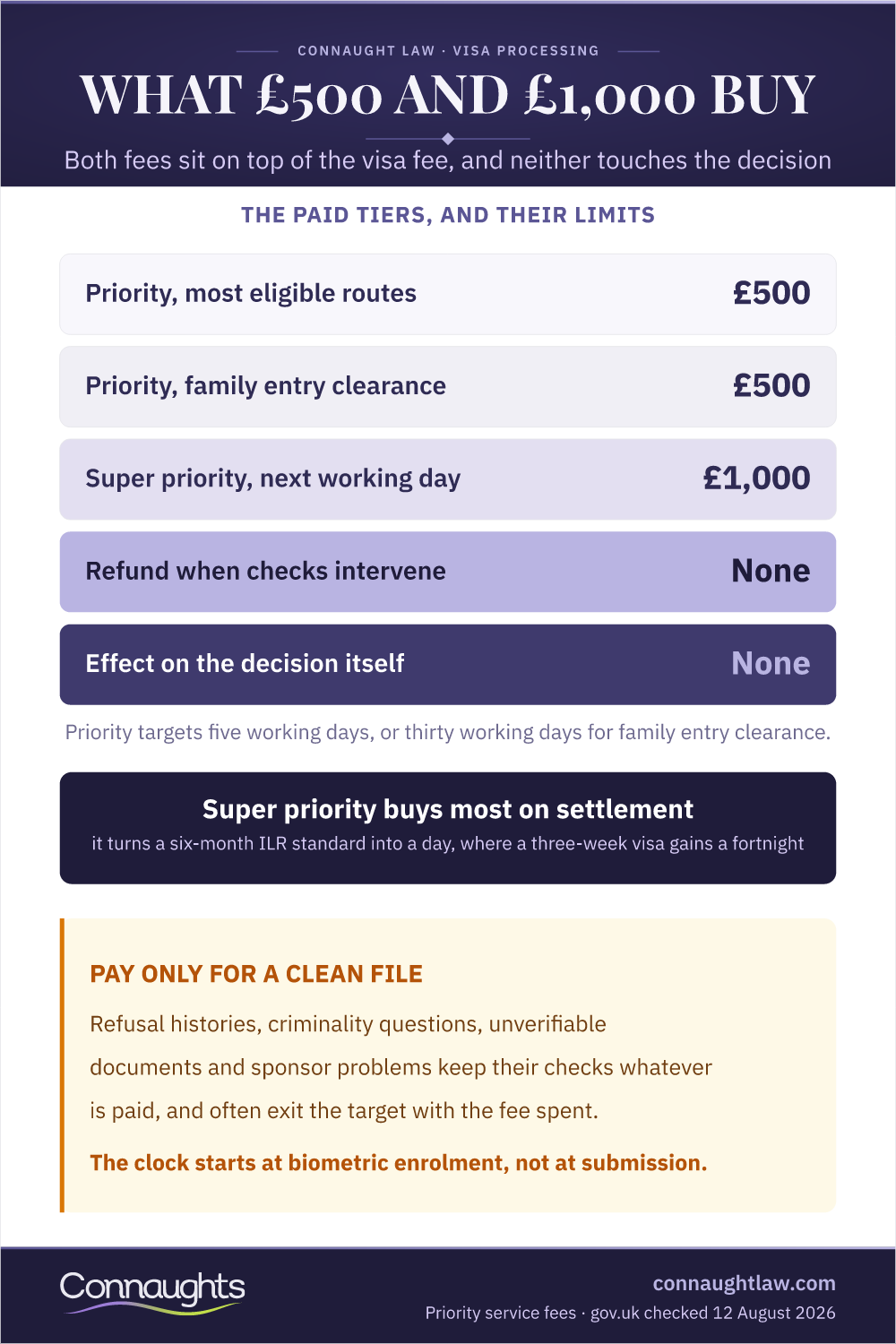
Service Options
Priority Service
£500 buys a decision usually within five working days of biometric enrolment for most eligible routes — the exception is family entry clearance, where priority targets thirty working days against the twelve-week standard. The service exists both for applications made overseas and for eligible in-country routes.
Super Priority Service
£1,000 buys a decision by the end of the next working day after your appointment — two working days where the appointment falls on a weekend or bank holiday. It is the settlement applicant's favourite: a clean ILR case that would otherwise occupy the six-month standard resolves before the week ends.
Availability and Restrictions
The Overseas Dimension
Overseas availability is location-specific: application centres offer priority where local capacity supports it, and services suspend without notice when demand surges — as they have during past crises. The eligible visas list is the authoritative check on any given day, and it changes.
Fees and Booking
Official Fees
Priority: £500 on top of the visa fee, targeting five working days (thirty for family entry clearance). Super priority: £1,000, targeting the next working day after biometrics. Both fees are per applicant, non-refundable in the ordinary course, and additional to any application centre charges for appointments.
Appointment Scheduling
The paid service is selected during the online application or at the booking stage, and its clock starts at biometrics — so appointment availability is part of the real timeline. In peak season the fastest route is sometimes a standard application with an immediate appointment rather than a priority application waiting a fortnight for one.
Eligibility
Eligible Categories
Work, student and family routes carry priority options in most locations, with super priority concentrated on in-country work, study and settlement applications. Citizenship applications take priority (thirty working days) but never super priority. Availability differs between applying inside and outside the UK for the same route — check the specific list for where you are applying from.
Suspensions and Limits
Services suspend by route and by post when volumes spike, and reinstatement is unannounced. Applications already flagged for interviews or verification fall outside the target regardless of payment — the fee's terms promise expedited handling of straightforward cases, not the suspension of checking.
How to Book
Online Application
Complete the standard application on gov.uk, select the paid service where offered at payment, then book biometrics — through UKVCAS for in-country applications or the local visa application centre overseas. The service cannot usually be added after submission, so the speed decision belongs at the application stage.
Biometric Requirements
Enrolment — fingerprints, photograph, document upload or scan — is what starts the clock. Bring everything: a priority case sent home for missing documents burns its own working days, and the target measures from complete enrolment.
After Booking
Decisions arrive by email, with the eVisa or vignette following. If the target passes silently, the case has usually been taken out of the straightforward pile; the fee is refundable only where the service was never delivered as promised, not where checks intervened.
Premium vs Standard
Variations by Application Type
Standard Against Premium Times
The arithmetic differs by route: super priority converts a six-month ILR standard into a day — the system's biggest time purchase — while priority on a three-week work visa buys roughly a fortnight. Family entry clearance sits between: thirty working days against twelve weeks. Price the purchase against your route's standard, set out in our processing times hub.
Targets Against Experience
The paid targets hold for the overwhelming majority of clean cases — that is what the fee buys. The failure mode is predictable: applications with refusals, complex histories or verification triggers keep their checks, and the letter announcing that a case "cannot be decided within the service standard" refunds nothing and reveals nothing.
When It Helps
Pay for speed when the case is clean and the deadline is real — a start date, term registration, a wedding, travel booked against settlement. The fee is proportionate exactly where delay costs more than £500 or £1,000, and the case gives caseworkers nothing to check twice.
Cases That Should Not Pay
Refusal histories, criminality questions, unverifiable documents, sponsor problems, and any application relying on discretion: these keep their checks whatever is paid, and frequently exit the paid target with the fee spent. The money is better invested in the file itself.
Alternatives for Complex Cases
The Real Cost-Benefit Test
For complex cases the effective accelerators are unpaid: complete evidence, pre-empted questions, legalised documents and early filing inside the application window. Where a deadline is genuinely immovable and the case is genuinely complex, professional preparation before submission — our immigration team's core work, including for visitor applications — beats any fee paid to the queue.
Frequently askedQuestions about priority services
How much is the UK priority visa fee in 2026?
£500 per applicant on top of the standard visa fee, targeting a decision within five working days of biometrics — thirty working days for family entry clearance. Super priority costs £1,000 for the next working day.
Is super priority available for my visa type?
It concentrates on in-country work, study and settlement applications, with availability varying by route and location. Check gov.uk's eligible visas lists for where you are applying from — the lists change without much notice.
Does priority service guarantee a decision in five days?
No — it targets five working days for straightforward cases. Applications flagged for interviews or verification keep their checks, and the fee is not refunded merely because checking took the case past the target.
When does the priority clock start?
At biometric enrolment, not submission. Appointment availability is therefore part of your real timeline — in busy periods, factor the wait for a biometric slot into any deadline calculation before paying.
Can I add priority service after applying?
Generally no — the service is selected during the application and payment stage. If circumstances change after submission, options are limited; that asymmetry argues for deciding the speed question deliberately at the outset.
Is priority service worth it for complex cases?
Rarely. Complexity keeps its checks at any price, and the fee frequently buys nothing but an earlier place in a queue the case then leaves. Spend on completing the evidence instead — it is the only acceleration complex cases respond to.
Tell us the route, the date and the case history. We'll tell you honestly whether £500 buys you anything — and prepare the file so it does.
Get Expert Advice