
UK visa processing runs to published service standards — three weeks for most entry clearance including Skilled Worker and visitor visas, twelve weeks for family routes, eight weeks for most in-country applications — but the standards are targets, not promises. This guide sets out the current times by category, what pushes cases beyond them, the £500 and £1,000 acceleration options, and the escalation ladder when a decision goes silent.
On This Page

How Long UK Visas Actually Take
Two clocks govern every application: the published service standard, and the reality of the caseload the Home Office is working through when yours arrives. The standards — set out for applications outside the UK and inside the UK — hold for most straightforward cases; planning around the exceptions is what this guide is for.
The Service Standards Framework
In-Country Standards
Applications made from inside the UK run to an eight-week standard for most work, study and family extensions, with exceptions in both directions: Health and Care Worker at three weeks, settlement applications at six months, and slow lanes like Turkish ECAA businessperson cases at six months and partner applications on the private life route at twelve. The clock starts at identity verification, not submission.
What the Standards Exclude
Every standard carries the same caveat: it applies to "straightforward" applications. Verification checks, interviews, missing documents and referrals stop the clock without breaching the standard, which is why a case can run months past the published time while remaining, in Home Office terms, on target. The standards also exclude the time your own side adds — biometric appointment availability and document assembly.
Times by Category
Current Standard Waiting Times
| Application | Where made | Standard |
|---|---|---|
| Visitor visa | Outside UK | 3 weeks |
| Skilled Worker and most work visas | Outside UK | 3 weeks |
| Student and Child Student | Outside UK | 3 weeks |
| Partner, parent, child (family) | Outside UK | 12 weeks |
| Most extensions and switches | Inside UK | 8 weeks |
| Health and Care Worker | Inside UK | 3 weeks |
| Settlement (ILR) | Inside UK | 6 months |
| Partner (private life) and parent routes | Inside UK | 12 months |
Reading Standards Against Reality
Work Visas
Skilled Worker entry clearance generally performs to its three-week standard because sponsorship pre-resolves the hard questions — the certificate of sponsorship carries the job, salary and sponsor vouching. Where work cases slow, the cause is usually the applicant side: tuberculosis certificates, criminal record certificates, or credibility checks on new sponsors.
Family and Settlement Routes
Family entry clearance is the long pole at twelve weeks, and the most variable — financial requirement verification and relationship evidence drive extensions of time. Applicants tracking spouse visa and ILR waits in detail should use our dedicated family and settlement processing times guide; route strategy sits with our family visa team.
Student Visas
Student processing is the system's efficiency showcase — three weeks, frequently faster, because CAS-backed applications arrive pre-verified. The seasonal exception is the August–September surge, when the standard holds but the margin disappears; our student visa team plans against course start dates.
Visitor Categories
Visitor applications hold three weeks across most posts, with peak-season stretch before summer and December. The variable is the post itself — high-volume application centres see the widest swings, which rewards applying at the early edge of the three-month window.
What Extends a Decision
Complexity Variables
Previous refusals, criminal history, unverifiable documents, sponsor concerns and interview referrals each move a case from the straightforward pile to the checked pile. None means refusal — they mean weeks, and occasionally months, of verification you cannot accelerate by enquiry.
Seasonal Pressure
The caseload breathes: student surges in late summer, visitor peaks before holidays, and policy deadlines — fee rises, rule changes — that pull applications forward. Filing against the seasonal grain is the cheapest acceleration available.
External Shocks
Crises reshape queues without notice, as pandemic-era suspensions proved — a history we tracked in our COVID legal response chronicle — and as sanctions regimes and evacuation schemes have since confirmed: caseworkers redeploy toward emergencies and routine queues lengthen quietly.
Priority Services
The Two Paid Tiers
Two paid accelerations exist where offered: priority at £500, targeting five working days (thirty for family entry clearance), and super priority at £1,000 for a next-working-day decision after biometrics. Availability varies by route and location — the full mechanics, eligibility and booking realities are in our priority services guide, with the official list on gov.uk.
What Paying for Speed Cannot Buy
Paid services buy queue position, not outcome — a case flagged for verification keeps its checks, and the fee is not refunded when the target is missed for that reason. Complex cases often waste the fee entirely, which is the calculation to make before paying, not after.
When the Fee Makes Sense
Priority pays when the case is clean and the deadline is real: a job start date, a course registration, a wedding. It is poor value where the file carries known complexity, and unnecessary where the standard already beats your timetable.
Timing Strategy
Using the Application Window
Entry clearance can be filed three months before travel; extensions up to 28 days before expiry without losing continuity. Filing at the window's open edge converts the service standard from a risk into a buffer.
Avoiding the Peaks
Where dates are flexible, avoid filing into the student surge or pre-holiday visitor peaks, and mind announced fee or rule changes — each one pulls a wave of applications forward and thickens the queue you join.
Status Protection While You Wait
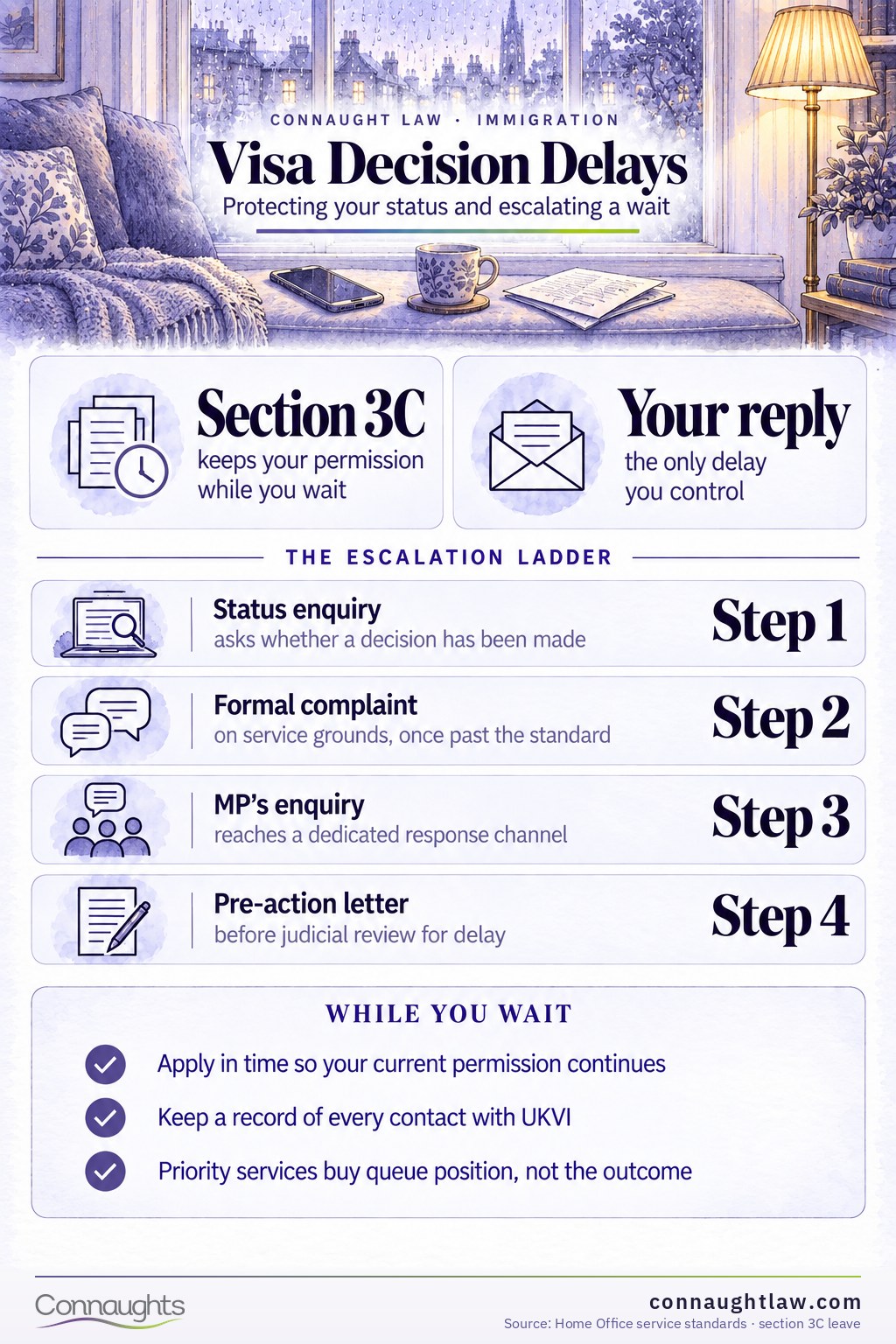
An in-time application protects status while it pends: section 3C leave continues your existing permission — conditions included — until the decision and any appeal window resolve. How that protection works, and its edges, is covered in our section 3C guide.
Managing Delays
Common Delay Causes
- Verification of documents, sponsors or finances with third parties.
- Security and criminality checks, which run to their own timetable.
- Interview referrals and the scheduling they require.
- Evidence requests awaiting your response — the only delay you control.
- Sheer volume in seasonal peaks and post-announcement surges.
The refusal-risk causes announce themselves — a request for more evidence is the system telling you where the doubt sits, and answering it fast and completely is the one acceleration entirely in your hands.
Seeking Resolution
Contacting UKVI
Enquiries to UKVI answer questions of fact — is a decision made, is evidence awaited — but do not accelerate decisions. Keep records of every contact; they become the paper trail any later escalation stands on.
The Escalation Ladder
Past the standard: a status enquiry, then a formal complaint on service grounds, then an MP's enquiry — which reaches a dedicated response channel — and finally pre-action correspondence. Each rung needs the previous one documented, which is why the file of polite enquiries matters.
Legal Remedies
Where delay becomes unlawful — no decision within any reasonable time, no explanation, prejudice accruing — judicial review for delay compels a decision, though not a favourable one. It is the remedy of last resort, and the threat of it in a well-drafted pre-action letter usually produces the decision first.
Professional Support
Advisers earn their fee in delay cases twice: diagnosing which delay type is running — benign queue or adverse check — and framing the escalation so it helps rather than antagonises. Work and business cases with commercial deadlines sit with our business immigration team.
Frequently askedQuestions about processing times
How long does a UK visa take in 2026?
Three weeks for most entry clearance — visitor, work, student — twelve weeks for family routes, and eight weeks for most in-country applications, measured from identity verification. Settlement runs to a six-month standard.
How long does a Skilled Worker visa take?
Three weeks from outside the UK, eight weeks for in-country switches — with the £500 priority and £1,000 super priority services compressing clean cases to five working days or next day where available.
Why is my application taking longer than the standard?
Usually verification — documents, sponsors, security checks or an interview referral. These pause the standard rather than breach it. A request for further evidence tells you where the doubt is; silence usually means queue, not problem.
Can I pay to speed up my UK visa?
Where offered: £500 priority targets five working days (thirty for family entry clearance); £1,000 super priority targets the next working day. Both buy queue position only — flagged cases keep their checks regardless of fee.
Does my status lapse while I wait for an in-country decision?
No — an application filed before expiry triggers section 3C leave, continuing your existing permission and conditions until the decision and any review period conclude. Working and living arrangements continue on the old terms.
What can I do about a seriously delayed decision?
Escalate in order: status enquiry, formal complaint, MP enquiry, then pre-action correspondence threatening judicial review for delay. Document each step — the record is what makes the final letter credible.
Tell us the route, the dates and what the Home Office has said. We'll diagnose the delay and run the escalation that fits it.
Get Expert Advice