
Family and settlement applications run on the Home Office's slowest clocks: twelve weeks for spouse visa entry clearance, eight weeks for in-country partner extensions, and a six-month standard for ILR — with financial verification, relationship assessment and document authentication driving cases beyond each. This guide sets out the current waits, what actually extends them, how appeals and reviews add their own timelines, and the timing strategy that protects families in between.
On This Page

The Slowest Queues in the System
Family and settlement casework is deliberately unhurried: relationships are verified, finances are audited against Appendix FM's requirements, and settlement files are read whole. The published standards — twelve weeks for family entry clearance under the family customer service standards, six months for ILR — are working assumptions, not ceilings, and planning a family's year around them is what this guide is for.
Spouse visa from abroad: twelve weeks. Partner extension in-country: eight weeks. ILR: up to six months, usually less. Each clock starts at identity verification, each assumes a "straightforward" case, and financial or relationship checks pause them without breaching the standard.
Current Waits
Family and Settlement Standards
| Application | Where made | Standard |
|---|---|---|
| Partner or spouse entry clearance | Outside UK | 12 weeks |
| Partner extension (5-year route) | Inside UK | 8 weeks |
| Partner (private life) and parent routes | Inside UK | 12 months |
| Child and adult dependent relative | Inside UK | 8 weeks |
| Settlement (ILR) — all family routes | Inside UK | 6 months |
Reading the Family Standards
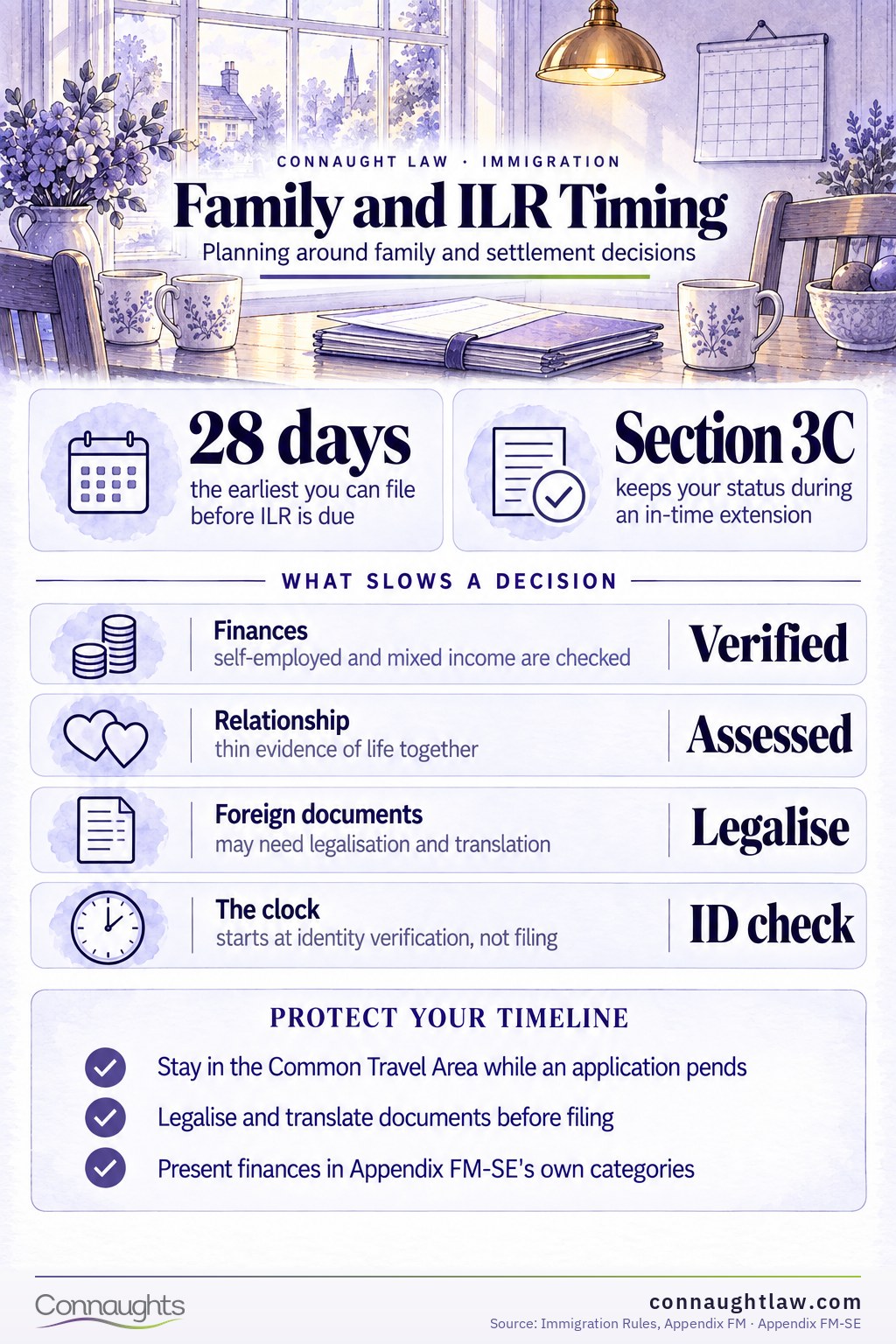
Two features distinguish family waits from the rest of the system. The clock starts at identity verification, not submission — so biometric appointment availability adds real weeks — and the "straightforward case" caveat bites harder here than anywhere, because financial and relationship verification routinely takes cases out of the straightforward pile without any fault in the application.
Spouse Visa Realities by Location
Country-Specific Patterns
The twelve-week standard is global; performance against it is not. Posts serving high-volume corridors — South Asia prominent among them — run closer to the standard's edge, and verification into local documents and finances takes longer where records are harder to check. The pattern is queue depth and verification friction, not differential rules: the requirements are identical everywhere.
Financial Verification Impact
The minimum income requirement is the single largest driver of family delay: salaried income verifies fastest, while self-employment, mixed sources and cash-adjacent income invite document-by-document checking. Files that present the financial case the way caseworkers audit it — specified evidence, in Appendix FM-SE's own categories, reconciled to the penny — stay in the fast lane.
ILR Timelines
The Six-Month Standard in Practice
Most ILR applications decide well inside six months, but the standard exists because settlement files get the system's fullest read: residence history, absences, English and life-in-UK requirements, and suitability across the whole record. Super priority — where offered — compresses clean settlement cases to days, which is why it is disproportionately bought for ILR.
Route-by-Route Comparison
Five-year partner route ILR benefits from a file the Home Office has already seen twice; ten-year long residence applications take longer reads because two decades of status history can hide gaps; work-route settlement sits between, anchored by sponsor records. The variable is auditability of the past, not the form filled in.
Timing an ILR Application
ILR can be filed up to 28 days before the qualifying period completes — earlier filings refuse automatically, late ones risk continuity. The disciplined pattern: diarise the earliest date, assemble absences and evidence in the prior quarter, and file at the window's open edge with priority service only if the case is genuinely clean.
Appeals and Reviews
Remedy Timelines
Refusals open their own clocks: administrative review for caseworking errors in points-based decisions, First-tier Tribunal appeals for human rights refusals — with hearing waits published quarterly in the tribunal statistics and commonly running many months — and judicial review where no other remedy exists. Families should price these timelines in before refusal, because remedy time is family separation time.
Comparing the Remedies
Administrative review is fast and narrow — error correction, not re-argument. Appeals re-decide the case on evidence, at tribunal pace. Judicial review polices legality alone. Each fits a different refusal, and choosing by speed rather than fit wastes the fastest route of all: a corrected fresh application.
Choosing the Challenge Route
The choice discipline is the refusal notice: an evidence gap points to reapplication, a misapplied rule to review or appeal, procedural unfairness to JR. Our appeals team maps notice to remedy before any clock is chosen.
Delay Factors
Relationship Assessment
Genuineness checks extend where evidence is thin at the edges: short acquaintance before marriage, limited cohabitation records, previous sponsorships on either side. The cure is longitudinal evidence — communication, finances and living arrangements over time — assembled before filing rather than demanded after.
Document Authentication
Foreign marriage, birth and divorce documents may need legalisation, and verification with issuing authorities moves at the issuing country's pace. Getting documents legalised and translated before submission removes the slowest third party from the critical path.
Timing Strategy
Submission Strategy
File early in every window, never against travel or expiry deadlines, and remember section 3C protection: an in-time extension application continues existing status throughout the wait, as explained in our section 3C guide. The system-wide picture across all routes sits in our processing times hub.
Financial Preparation
Six months of specified evidence is the practical minimum for salaried cases, a full financial year for self-employment — which means the preparation calendar starts before the application year does. Families switching income sources mid-qualification should take advice before the switch, not after; our family visa team plans the evidence period backwards from the filing date.
Priority Service Strategy
Family entry clearance priority targets thirty working days rather than five, and settlement super priority is the best value in the paid tier for clean files. The complex case rule holds everywhere: verification-flagged applications keep their checks whatever was paid, per the mechanics in our priority services guide.
Frequently askedQuestions about family and ILR waits
What is the ILR processing time in 2026?
The published standard is six months, and most applications decide inside it. Settlement files get the fullest review in the system — residence, absences, suitability — and super priority service, where available, compresses clean cases to days.
How long does a spouse visa take from outside the UK?
Twelve weeks is the published standard, with priority service targeting thirty working days where offered. Financial verification is the main variable — salaried, well-documented cases run fastest in every country.
Why do family applications take longer than work visas?
No sponsor pre-verifies the case. Caseworkers assess the relationship's genuineness and audit the financial requirement themselves, and both checks involve third parties — banks, employers, foreign registries — moving at their own pace.
Can I travel while my in-country application pends?
Leaving the common travel area before decision withdraws most in-country applications. Families should plan around the eight-week (or longer) wait, and take advice before booking anything that assumes the decision date.
How long do appeals add after a family refusal?
First-tier Tribunal waits run many months and vary by hearing centre — the tribunal publishes its timeliness statistics quarterly. That cost makes the remedy choice strategic: a corrected fresh application is often faster than a won appeal.
When can I apply for ILR at the earliest?
Twenty-eight days before completing your qualifying period — applications earlier than that are refused. File at that edge with evidence assembled in advance, and your six-month standard starts as early as the rules allow.
Tell us the route, the dates and the income picture. We'll build the evidence to survive verification first time — the only reliable acceleration there is.
Get Expert Advice