
Section 3C of the Immigration Act 1971 keeps your existing leave alive when you apply to extend it in time and the Home Office has not decided by the time it expires. You are not an overstayer, and your old conditions continue. What it does not do is give you anything new — and proving you have it, to an employer or a landlord, is a separate problem.
On This Page

Leave That Continues Itself
Section 3C does one thing, and it does it automatically. If you held limited leave, applied to vary it before that leave expired, and the leave ran out before the Home Office decided, your leave is extended by operation of law until the application is decided or withdrawn. Nobody grants it. There is no letter, no visa, and no expiry date to point at.
That last point is the practical difficulty. A person on section 3C leave is lawfully here on exactly the terms of the permission that expired — same work rights, same study rights, same public funds condition — but holds no document saying so. A judicial review of that gap succeeded at first instance in 2024; the Court of Appeal allowed the Secretary of State’s appeal in November 2025, holding that the phased rollout of digital status was not irrational.
Section 3C is also narrow. It covers applications to vary existing leave, made in time, to the Secretary of State. It does not cover entry clearance applications, applications made a day late, or applications that are invalid when submitted. Outside those boundaries there is no protection at all, and the person becomes an overstayer on the day their original leave expires.
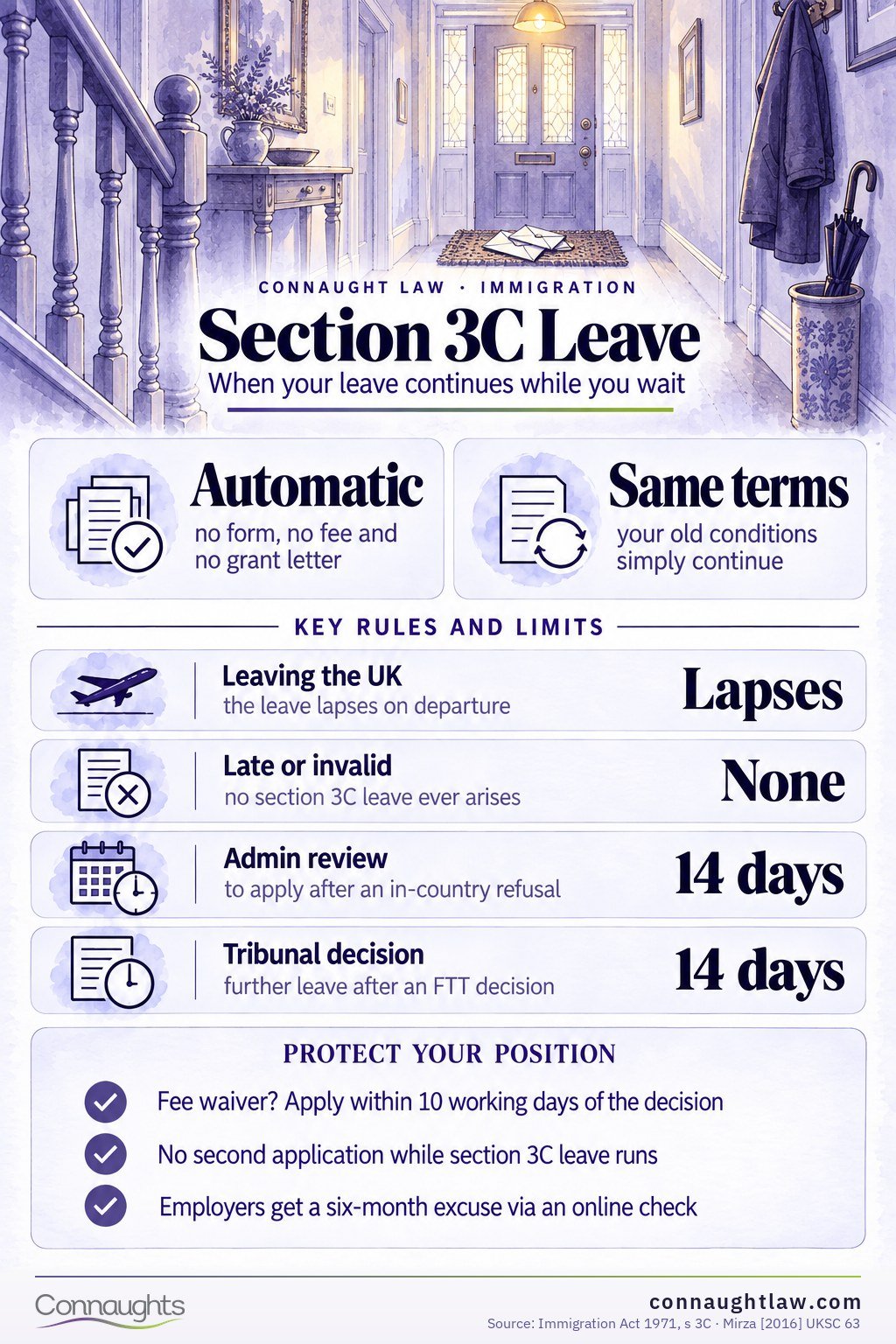
What Section 3C Leave Is
Section 3C of the Immigration Act 1971 was inserted in 2003 and has been amended five times since. Subsection (1) sets the entry conditions. Subsection (2) then lists the periods during which leave is extended: while the application is neither decided nor withdrawn, while an in-country appeal could be brought or is pending, and while an administrative review could be sought or is pending.
- You held limited leave to enter or remain in the UK.
- You applied to the Secretary of State to vary that leave.
- The application was made before the leave expired, and the leave expired without it having been decided.
Two further subsections matter in practice. Under subsection (3) the extended leave lapses if you leave the UK, which is why travelling while an in-country application is pending ends the protection rather than pausing it. Under subsection (3A), inserted by the Immigration Act 2016, it may be cancelled if you breach a condition of the leave or use deception. Subsection (4) bars a second variation application while section 3C leave is running.
When It Applies and When It Does Not
Timing is everything, and the date an application is “made” is a technical question rather than the day you pressed submit. An invalid application generates no section 3C leave at all: the Supreme Court held in Mirza [2016] UKSC 63 that where an application fails a validity requirement, there is nothing capable of extending leave, and the person has been an overstayer from the moment their original permission expired.
Fee waivers are the live trap. In R (Hussain) v SSHD [2026] UKUT 82 (IAC) the Upper Tribunal held that a fee waiver request anchors the application date — but only if the completed application is submitted within 10 working days of receiving the fee waiver decision. Miss that window and the anchor fails, the application is late, and no section 3C leave ever arose.
Applications under the EU Settlement Scheme sit in their own part of the section: subsection (2)(ca) and (cb), inserted in 2020, extend leave while a Citizens’ Rights appeal could be brought or is pending. Anyone in that position should read the position for European nationals alongside this, because the appeal route and the time limits differ from the ordinary ones.
Right to Work and How to Prove It
Section 3C continues the conditions attached to the leave that expired. If that leave permitted work, work continues; if it carried a study restriction or no recourse to public funds, those continue too. The Secretary of State can vary conditions during section 3C leave under section 3(3)(a) of the 1971 Act, so the position is not frozen — but nothing about the extension itself enlarges what you were allowed to do.
The difficulty is evidential. An employer needs a statutory excuse against a civil penalty, and a person on section 3C leave has no in-date document. The employer’s guide to right to work checks resolves this through the Home Office online check or, where that is not possible, the Employer Checking Service. Both produce a time-limited excuse rather than an open-ended one.
Proving the Right to Work
| Situation | What the employer does | Excuse obtained |
|---|---|---|
| eVisa holder with an outstanding in-time application | Asks for a share code and runs the Home Office online right to work check | Six months, then a follow-up check |
| No share code available | Contacts the Employer Checking Service, which aims to respond within five working days | Six months from the date specified in the Positive Verification Notice |
| Appeal or administrative review outstanding | Waits at least 14 calendar days after it was delivered or posted, then requests the check | Six months from the date specified in the notice |
The point to take from the table is that the excuse expires on a date fixed by the check rather than by the immigration decision. An employer whose member of staff is still waiting after six months has to run a follow-up check to keep the excuse alive, and an employer who declines to use the Employer Checking Service at all leaves the employee with very little they can do about it.
How Long It Lasts
There is no fixed period. Section 3C leave runs for as long as one of the subsection (2) limbs is satisfied, which in a straightforward case means until the Home Office decides the application. Where the decision refuses the application and carries a right of appeal, it continues through the period in which an in-country appeal could be brought, and then for as long as that appeal is pending.
The Home Office guidance on 3C and 3D leave fills in the detail. An appellant always has a further 14 days of section 3C leave after receiving a First-tier Tribunal decision. An appeal to the Court of Appeal extends it until judgment is given. An appeal to the Supreme Court does not extend section 3C leave at all, and nor does a Cart-style judicial review.
Time on section 3C leave is not wasted for settlement purposes. Home Office long residence guidance treats permission extended by section 3C as lawful presence where the underlying route counts, so a delayed decision does not break the qualifying period. The exception is time after appeal rights are exhausted, which is not lawful presence — a distinction that matters when counting breaks in lawful leave towards settlement.
Administrative Review and Section 3C
Subsection (2)(d) extends leave while an administrative review could be sought or is pending, and subsection (7) leaves it to the Immigration Rules to define when one is pending. Appendix Administrative Review answers that at AR 4.2: a review is pending while the time limit for applying has not passed, or while an application has been made and not rejected as invalid, decided or withdrawn.
The time limits are short. AR 2.6 allows 14 calendar days for an in-country refusal, seven calendar days if the applicant is detained, and 28 calendar days for an entry clearance decision. AR 4.4 treats a pending review as withdrawn the day before any new application is made, so applying again while a review is running ends the review — and with it the section 3C leave that depended on it.
One limit is often missed. If you did not already have section 3C leave, the right to seek an administrative review does not create it, however promptly the review is filed. An out-of-time review does not extend leave either, though if the Home Office accepts it, section 3C leave runs from the date of acceptance rather than retrospectively.
When It Ends for Good
Section 3C leave ends when the last of the subsection (2) limbs falls away, and there are more ways for that to happen than most applicants expect. Withdrawing the application ends it immediately. So does a decision that is not appealed within the time limit, and so does leaving the UK, because subsection (3) makes the extended leave lapse on departure rather than suspending it.
Where a decision brought section 3C leave to an end and the Home Office later withdraws that decision, the guidance is that section 3C leave resurrects from the point of withdrawal. It does not fill the intervening period: there is a real break in leave, which the Home Office treats as lawful presence in a later application but which is not itself leave. A decision that is quashed by a court is different — section 3C leave will never have ended.
Cancellation is the other route out. Under subsection (3A) the Home Office may cancel section 3C leave where the person has failed to comply with a condition of the leave or has used deception in seeking leave to remain, successfully or not. Cancellation is discretionary rather than automatic, but it converts a lawfully present applicant into an overstayer, with consequences for any future application and for the grounds on which a refusal can be challenged.
Travel is the trap that catches the most people. Someone who leaves the UK while on section 3C leave loses it on departure and cannot use it to return, whatever the state of the application; a returning resident application is a different route with different requirements. Where a refusal is appealed, the appeal must be brought and pursued in country for section 3C to keep running. Each of these turns on dates rather than on the merits, which is why the first step in a UK immigration problem of this kind is a timeline.
Frequently askedQuestions about section 3C leave
Do I have to apply for section 3C leave?
No. It operates automatically where the statutory conditions are met. There is no form, no fee and no grant letter, which is why the only way to confirm it is to check the dates: when your leave expired, when you applied, and whether that application was valid.
Can I work while on section 3C leave?
Only if the leave that expired permitted it. Section 3C continues the old conditions and adds nothing. Your employer establishes a statutory excuse through the Home Office online check using a share code, or through the Employer Checking Service, and that excuse lasts six months.
Does section 3C leave count towards settlement?
Yes, where the underlying route counts towards the qualifying period. Home Office long residence guidance treats permission extended by section 3C as lawful presence. Time after appeal rights are exhausted is the exception and does not count.
What happens if I travel abroad?
The leave lapses on departure under section 3C(3) and does not revive on return. You will need entry clearance to come back, and the pending application may be treated as withdrawn. Travelling while an in-country application is outstanding is rarely worth the risk.
Can I make a second application while on section 3C leave?
Section 3C(4) prohibits a further application to vary leave while section 3C leave is running, although subsection (5) allows you to vary the application you have already made. A new application also ends any pending administrative review the day before it is submitted.
What if my application was refused for being invalid?
Then no section 3C leave arose, and you have been an overstayer since your original leave expired. That is the effect of Mirza [2016] UKSC 63. Fee waiver cases turn on the 10 working day rule confirmed in Hussain, so the validity date needs checking before anything else.
Tell us the date your leave ended and the date you applied. We will tell you whether section 3C leave is running, what conditions attach to it and what would bring it to an end.
Get Expert Advice