
A gap in permission and a gap in the settlement clock are two different problems, and most advice conflates them. The rules can preserve your continuous residence across a period without permission and still refuse to count that period towards the qualifying years. Knowing which of the two has happened to you is the difference between applying now and applying considerably later, and it is a question the rules answer precisely rather than generously.
On This Page

What Breaks Continuous Residence
Continuous residence is broken in four broad ways: by a conviction leading to imprisonment, by being subject to a deportation or exclusion order, by removal directions, and by not having permission when you needed it. The last of those is the one that catches ordinary applicants, and it is the only one with exceptions worth knowing.
Separately, and often confused with it, there is the absence limit. Spending too long outside the United Kingdom breaks continuous residence even where your permission was perfect throughout. The two failures are independent: you can lose settlement to either, and satisfying one requirement tells you nothing about the other.
Quick answer — continuity and the clock are different things
Where an exception applies, the gap does not break your continuous residence. But under CR 4.2 the time you spent without permission is still excluded from the calculation of the qualifying period. Your ten or five years remains unbroken; it simply takes longer to complete. Only one exception credits the time back, and it is a 2020 pandemic provision.
Appendix Continuous Residence and Which Routes It Covers
Appendix Continuous Residence is a single set of rules used by many routes but not all of them, and checking that it applies to you is the first step. It covers Skilled Worker, Global Talent, Innovator Founder, T2 Minister of Religion, International Sportsperson, UK Ancestry, Scale-up, Representative of an Overseas Business, Domestic Worker in a Private Household, Temporary Work — International Agreement, Hong Kong National (Overseas), ECAA Settlement, Settlement Family Life, Private Life for settlement, Appendix Long Residence, and the legacy Tier 1 Entrepreneur and Investor routes.
It does not govern five-year partner and parent settlement under Appendix FM, the EU Settlement Scheme, or nationality applications. Those have their own residence requirements, and importing the rules below into them produces the wrong answer.
One point of history matters for anyone whose qualifying period is long. Appendix Long Residence replaced paragraphs 276A to 276D on 11 April 2024, and those paragraphs are now marked DELETED in Part 7. Sources still analysing settlement by reference to paragraph 276B are more than two years out of date, though the appendix does carry transitional absence limits for older periods.
Gaps in Permission, and the Five Exceptions
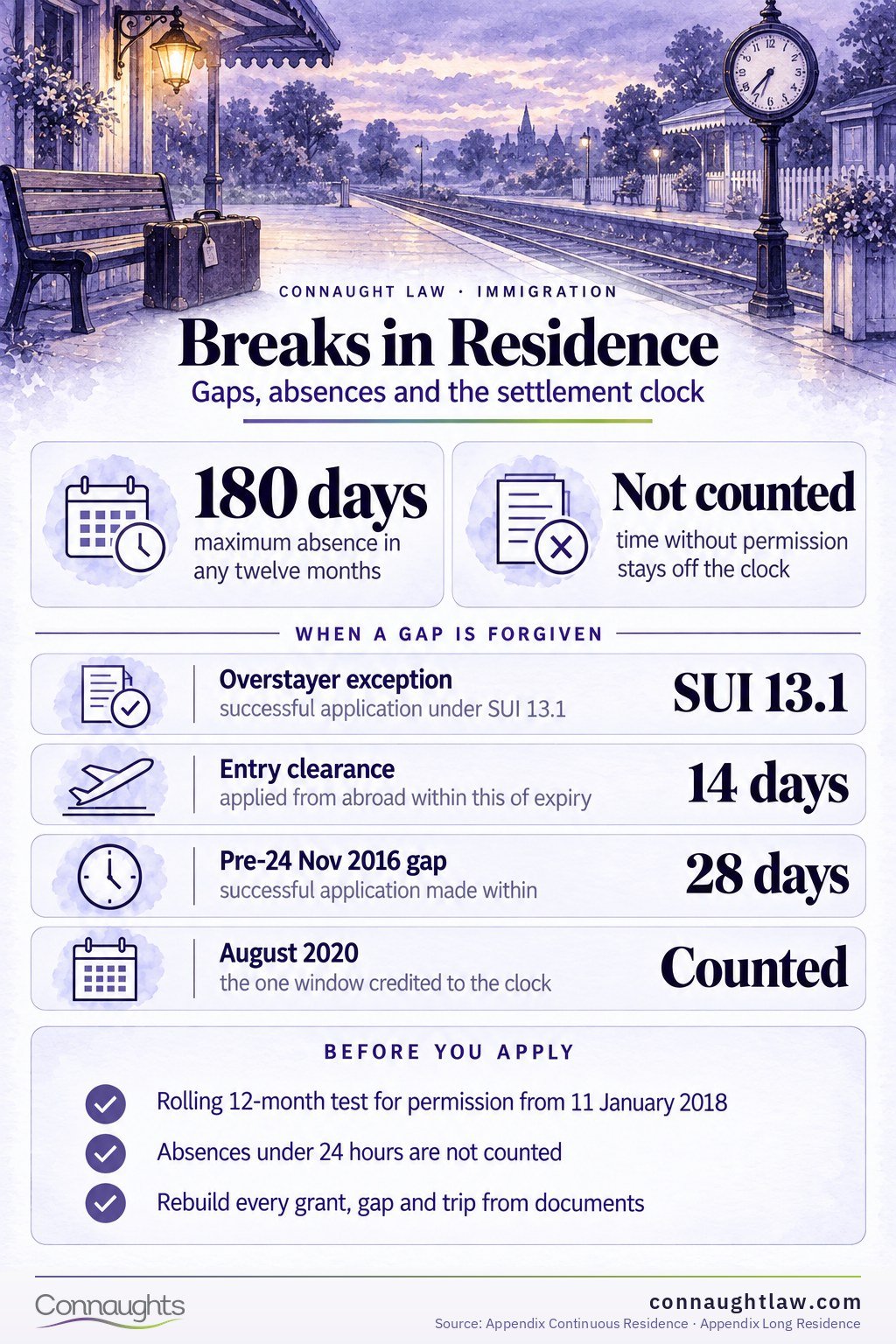
CR 4.1(d) provides that continuous residence is broken where the applicant does not currently have, or did not have, permission. Five exceptions follow, and each is narrower than its summary suggests.
Five exceptions — when a gap does not break it
- A successful application under the overstayer exception — where permission was granted following an application to which the exceptions for overstayers section of Part Suitability applied. That is SUI 13.1, the provision that used to be paragraph 39E.
- Entry clearance applied for in time from abroad — where you had permission when you left, applied for entry clearance before it expired or within 14 days of expiry, and that application succeeded. This exception does not apply to Appendix Long Residence.
- Long Residence returns — for Long Residence applications only, where you had permission when you left and returned with valid permission, provided the absence limits are not exceeded.
- The old 28-day rule — for any period without permission before 24 November 2016, where a successful application was made within 28 days of the previous permission expiring.
- The August 2020 window — where the days without permission fell between 1 and 31 August 2020 and you had permission immediately before.
Read those five together and a pattern emerges. Each is tied to a specific event — a successful application, a timely entry clearance application, a return with valid permission, an application inside the old window, or a fixed calendar month in 2020. None is a general dispensation for having been without permission, and none can be established after the fact by explanation alone.
Disregarded but not credited — the trap in CR 4.2
For the first four exceptions, CR 4.2 excludes the period without permission from the calculation of the qualifying period. Continuity survives; the time is lost. Only the August 2020 window is different — CR 4.3 recognises that period as lawful presence and counts it. Anyone assuming a fourteen-day gap simply vanishes has misread the rule by several months.
Absences and the 180-Day Limit
CR 3.1 requires that the applicant must not have been outside the United Kingdom for more than 180 days in any twelve-month period. How that twelve months is measured depends on when the permission was granted, which is the detail most absence calculators get wrong. Only whole days count; an absence of less than twenty-four hours is not counted at all.
How Absences Are Measured
| Permission granted | How the period is measured | Limit |
|---|---|---|
| On or after 11 January 2018 | On a rolling basis, over any twelve-month period | 180 days |
| Before 11 January 2018 | In consecutive twelve-month periods ending on the date of application | 180 days |
| Long Residence, where the absence began before 11 April 2024 | Across the whole qualifying period | 548 days in total, and no single absence over 184 days |
CR 3.4 takes certain absences out of the calculation entirely. They are assisting with a national or international humanitarian or environmental crisis; travel disruption caused by natural disaster, military conflict or pandemic; and compelling and compassionate personal circumstances such as the applicant's own life-threatening illness or the life-threatening illness or death of a close family member. Further heads cover specified research roles, Global Talent endorsed research, prestigious prizes, and accompanying a partner on Crown service.
These are exemptions from counting, not excuses to be argued after the event, and they are evidenced like anything else. Our guide to the 180-day rule works through the arithmetic, and the Ahmed case covers how the tribunal has approached a disputed break.
Before and After 24 November 2016
Until 24 November 2016 the rules allowed twenty-eight days in which an overstayer could regularise. Statement of Changes HC 667 abolished that and replaced it with the fourteen-day exception that survives today as SUI 13.1. The change applied to applications made on or after that date, with earlier applications decided under the previous rules.
That distinction is not merely historical, and this is where the post most often needs to be read carefully. CR 4.1(d)(iv) preserves the twenty-eight-day rule for any period without permission that fell before 24 November 2016. If your qualifying period reaches back that far — which a ten-year long residence application easily can — the older rule still governs the older gap.
Long Residence is stricter — the ten-year clock
Appendix Long Residence goes further than Appendix Continuous Residence. LR 3.2 and LR 11.2 exclude from the qualifying period any overstaying between periods of permission — before 24 November 2016 even where a further application was made within 28 days, and on or after that date even where the exceptions for overstayers apply. For the ten-year route, a disregarded gap is still a gap in the count.
Where People Come Unstuck
The most common miscalculation is treating a fourteen-day gap as costless. It preserves continuity and removes fourteen days or more from the clock, so an applicant who expected to qualify on a particular date finds themselves short. On a ten-year route with two such gaps the shortfall can be a month or more, and it is discovered at the point of refusal.
The second is applying the rolling twelve-month test to permission granted before January 2018, or the consecutive test to permission granted after it. The two produce materially different answers for the same travel history, and only one of them is the answer the caseworker will reach.
The third is time in prison. A sentence of imprisonment breaks continuous residence outright, and guidance is explicit that time before the sentence and the sentence itself both fall away. There is a narrow carve-out for settlement under Appendix Settlement Family Life and Appendix Private Life where the sentence was twelve months or less, and even there the time inside does not count towards the qualifying period.
How the Qualifying Period Is Counted
CR 1.1 counts back from whichever date is most beneficial to the applicant: the date of application, any date up to twenty-eight days after it, the date of decision, or — on the UK Ancestry route in defined circumstances — the expiry of the most recent UK Ancestry permission. That choice of dates is genuinely useful and is routinely overlooked.
In practice it means an application that is marginally short at the date of submission may qualify by the date of decision, and the caseworker should take the more favourable date. It does not rescue an application that is short by months, but it can rescue one that is short by days.
Before applying, reconstruct the history from documents rather than memory: every grant and expiry date, every application date and outcome, and every departure and return. The gaps and the absences are then visible, and the question of which exception applies to which gap can be answered rather than assumed.
Frequently askedQuestions about breaks in continuous residence
Does a short gap in leave stop me getting settlement?
Not necessarily. If one of the five exceptions in CR 4.1(d) applies, continuity is preserved. But the time without permission is excluded from the qualifying period, so you reach the five or ten years later than you expected.
Is the 180-day limit rolling or fixed?
It depends on the permission. For permission granted on or after 11 January 2018 it is rolling over any twelve-month period. For earlier permission it is consecutive twelve-month periods ending on the date of application.
Does the old 28-day rule still apply to anything?
Yes, but only backwards. CR 4.1(d)(iv) preserves it for periods without permission before 24 November 2016. For Long Residence, though, such a gap is still excluded from the ten-year count under LR 11.2.
Does time in prison count towards settlement?
No. A sentence of imprisonment breaks continuous residence, and guidance states that time before the sentence and the sentence itself do not count. A narrow exception exists for Settlement Family Life and Private Life where the sentence was twelve months or less.
Does Appendix Continuous Residence apply to a spouse visa?
Not to five-year partner or parent settlement under Appendix FM, which has its own residence requirement. It does apply to Appendix Settlement Family Life and to Appendix Private Life settlement applications, so check which route you are actually on.
Is paragraph 276B still the long residence rule?
No. Appendix Long Residence replaced paragraphs 276A to 276D on 11 April 2024, and those paragraphs are marked DELETED. Transitional absence limits for periods before that date survive within the appendix itself.
Send us every grant, expiry, application and travel date you have. We will tell you whether continuity survived, which exception applies, and the date you actually qualify.
Get Expert Advice