
When does a gap in lawful status destroy ten years of residence? The Court of Appeal answered across three cases — Ahmed, Hoque and Afzal — that now govern every long residence application with an imperfect history: open-ended overstaying is fatal, book-ended gaps are disregarded but never counted, and the overstaying disregard protects less than most applicants hope. This case analysis works through the judgments, the scenarios they decide, and the planning that follows.
On This Page
Three Judgments, One Counting Rule
Long residence law's hardest question was never the ten years — it was the gaps. Between 2019 and 2021 the Court of Appeal built the modern answer in stages: Ahmed [2019] EWCA Civ 1070 on gaps between grants, Hoque [2020] EWCA Civ 1357 drawing the open-ended/book-ended distinction, and Afzal [2021] EWCA Civ 1909 settling what a disregarded gap is actually worth: nothing, but not less than nothing. The Supreme Court affirmed that reading in R (Afzal) v SSHD [2023] UKSC 46.
Case Background
Each case presented the same human pattern: an applicant with a decade in the UK whose record contained short periods without leave — an application filed days late, a refusal cured by a fresh grant — asking whether the disregard provisions rescued the accumulated years. The stakes explain the litigation: for applicants at year nine or ten, the difference between a disregarded gap and a broken period is the difference between settlement and starting again.
Legal Framework
Where the Disregard Stops
The overstaying disregard — paragraph 39E until the Immigration Rules were restructured on 3 August 2026, now SUI 13.1 of Part Suitability — excuses defined short overstaying — where the late application followed within the permitted window or good reasons applied — and the old paragraph 276B, now Appendix Long Residence, told caseworkers to disregard such periods.
The judicial work was deciding what "disregard" means: Hoque held that overstaying still running at the application date ("open-ended") defeats the application outright, and Afzal resolved that a gap sandwiched between grants ("book-ended") is overlooked as a defect but contributes no days to the count — our paragraph 39E guide takes the provision itself in detail.
Risk by Scenario
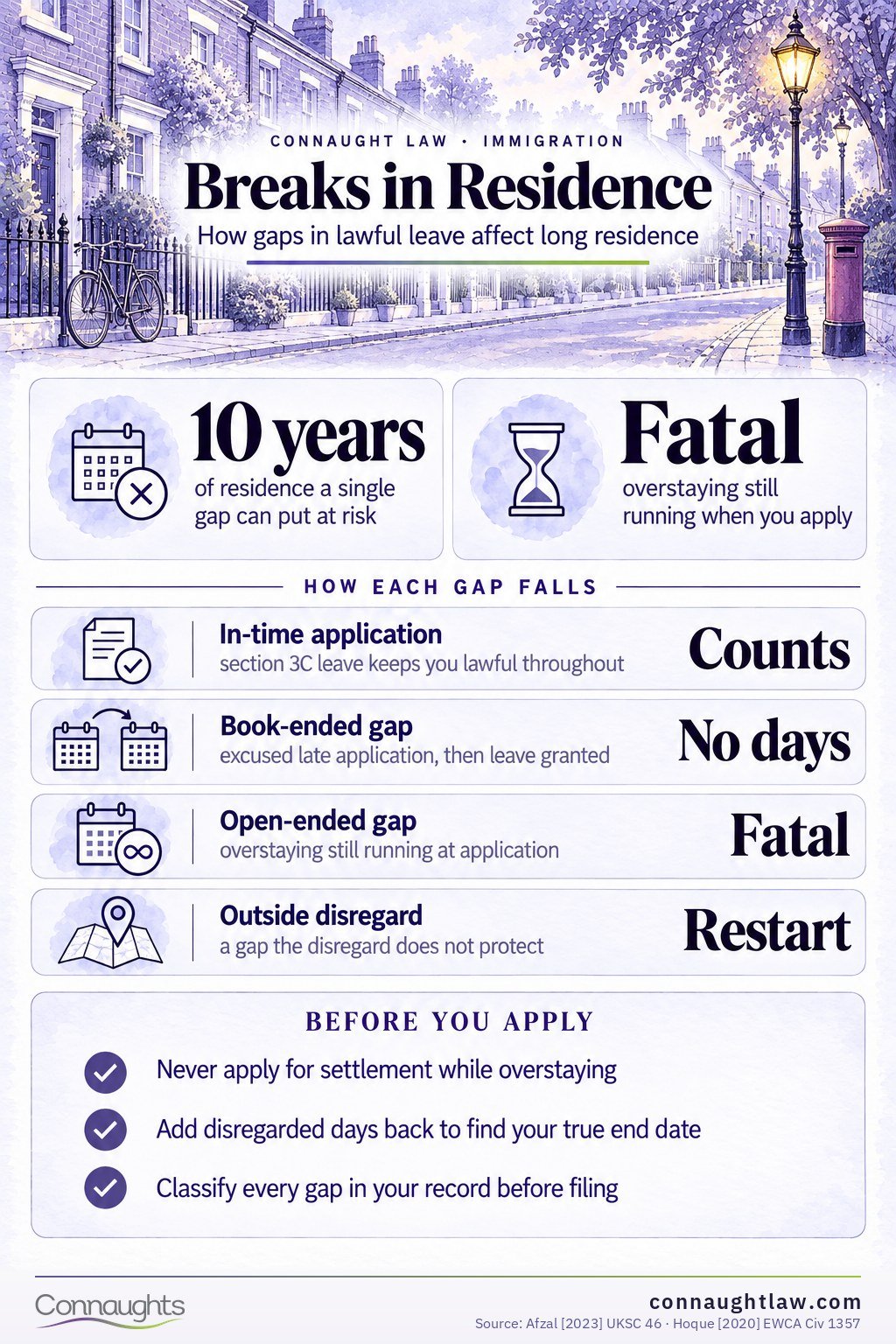
- In-time application, decision delayed: section 3C leave — lawful throughout, full credit.
- Late application within the disregard's windows, then granted: disregarded gap — continuity survives, days don't count.
- Overstaying still running when the ILR application is filed: fatal on the authorities, whatever preceded it.
- Gap outside the disregard's protection: continuity broken — the ten years restart.
Impact Analysis
What the Numbers Show
Before and After the Trilogy
Before the trilogy, outcomes on gap cases varied with the caseworker's reading and the tribunal drawn; the Home Office's own guidance shifted between editions. After Afzal the discretion has largely gone: refusals on open-ended overstaying are now near-mechanical, while book-ended cases succeed or fail on arithmetic — whether ten countable years exist around the disregarded days. Predictability improved; generosity did not.
Book-Ended Against Open-Ended
The distinction is the analysis's heart. Book-ended overstaying is sealed history — leave was granted afterwards, so the Home Office once forgave it. Open-ended overstaying is a present breach, and the courts declined to let a settlement application be built on it. The practical translation: regularise first, always — an applicant out of status must fix status before ILR is even arguable, a sequencing question our regularisation guide maps.
Practical Implications
Worked Timelines
Consider a student-turned-worker with leave from 2016, a 20-day late renewal in 2020 granted under the disregard, continuous status since. The gap is book-ended: disregarded, not fatal — but her ten countable years complete 20 days later than the calendar suggests, and filing on the anniversary would fail on arithmetic. Contrast an applicant whose last leave expired in 2025 and who files for ILR in 2026 from overstaying: open-ended, refused, whatever his first nine years looked like.
Strategic Considerations
The trilogy's planning rules: audit the record for every gap and classify each; recalculate the true completion date adding back disregarded days; never apply from overstaying; and where a gap falls outside the disregard, take advice on whether any residence either side remains usable before assuming the worst. The full route requirements sit in our 10-year long residence guide, with adjacent break scenarios in our breaks in lawful leave guide.
Future Developments
Guidance and Rule Drift
Appendix Long Residence absorbed the case law's outcomes, and the current long residence guidance reads with the judgments rather than against them. The open question is legislative: the earned settlement proposals would rebuild qualifying periods generally, and any new framework will inherit these counting principles unless it explicitly rewrites them.
Planning in an Unsettled Landscape
For applicants the uncertainty argues one way: those with ten clean or cleanly-disregarded years should file promptly under the rules as they stand. Marginal cases — arithmetic close to the line, gaps of arguable classification — warrant a professional audit before the fee is spent; our settlement team runs the classification exercise the caseworker will run, first.
Frequently askedQuestions about breaks in continuous residence
What did the Ahmed case decide?
Ahmed [2019] opened the Court of Appeal's examination of gaps in long residence, refined by Hoque [2020] and settled by Afzal [2021], affirmed [2023] UKSC 46: excused gaps between grants are disregarded but add nothing to the count, and current overstaying defeats the application.
What is book-ended overstaying?
A period without leave sealed by grants on both sides — typically a late renewal later approved under the overstaying disregard (SUI 13.1, formerly paragraph 39E). It no longer breaks continuity, but after Afzal it contributes no days, so the true ten years completes later than the calendar shows.
Can I apply for ILR while overstaying?
Not viably on long residence grounds — open-ended overstaying is fatal on the authorities. Status must be regularised first, and only then does the question of what the earlier years are worth become live.
Does the overstaying disregard make a late application safe?
It can preserve continuity for defined short periods, but it converts nothing into lawful residence. Treat the disregard as damage limitation with a price in days — never as a planning tool.
How do I know if my gap broke my residence?
Classify it: in-time application (3C — no gap), late-but-excused (disregarded), or outside the disregard (broken). The classification turns on dates and the grant that followed, and it is worth professional confirmation before building an application on it.
Do these cases still matter under Appendix Long Residence?
Yes — the appendix codified the framework the judgments built, and caseworkers apply their logic to every gap case. Any future earned settlement regime is likely to inherit the same counting principles.
Send us the dates — every grant, every application, every expiry. We'll classify each gap under the case law and tell you what your decade is actually worth.
Get Expert Advice