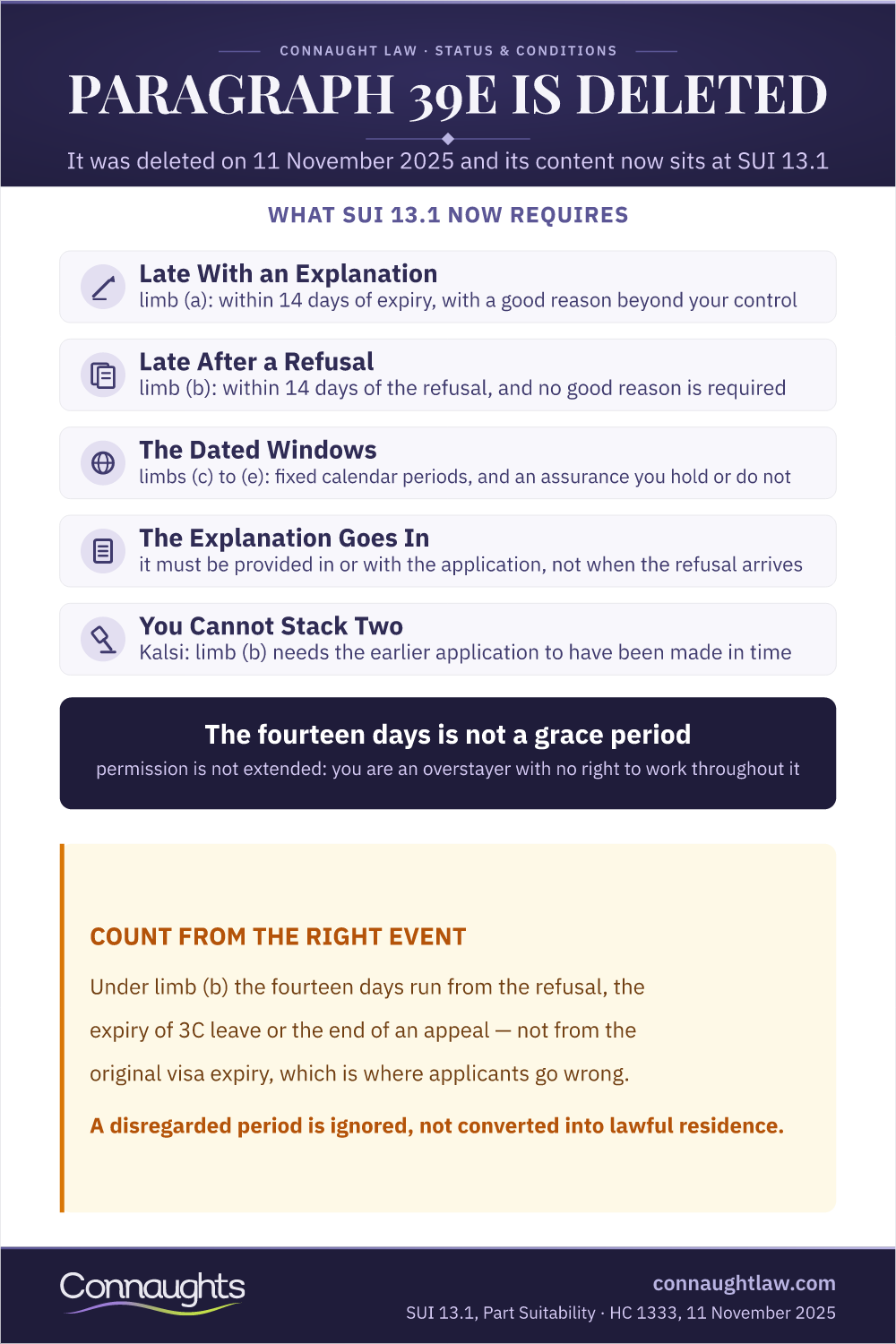
Paragraph 39E no longer exists. It was deleted on 11 November 2025 and its content now sits at SUI 13.1 in the new Part Suitability. The substance survived the move, so if you were searching for 39E you are in the right place — but the number has changed, the deletion carried no saving, and the fourteen days everyone calls a grace period is not a grace period at all.
On This Page

Paragraph 39E Has Been Deleted
Statement of Changes HC 1333, laid on 14 October 2025, deleted paragraph 39E and paragraph 39F and removed Part 9 of the Immigration Rules in its entirety, all with effect from 11 November 2025. In their place the Rules gained a new Part Suitability, and the exceptions for overstayers reappeared there as SUI 13.
If you look at Part 1 of the Rules today you will still find the number. It reads "39E. DELETED", and the Part heading still describes itself as covering paragraphs 7 to 39E. That is why the old number keeps turning up in search results and in advice written before November 2025, and why so much of what is still published about it is describing a rule that is no longer there.
Quick answer — where 39E went
The provision moved rather than disappeared. What was paragraph 39E is now SUI 13.1, inside Part Suitability. The five limbs are recognisably the same, the fourteen days are the same, and a decision maker applying SUI 13.1 today is doing what one applying 39E did before November 2025.
The move was part of a wider reorganisation of the Rules, which the explanatory memorandum to HC 1333 ties to the Law Commission's 2019 recommendations on simplifying the Immigration Rules. That sets a useful expectation: the exercise was meant to restructure rather than to tighten, so where the wording differs from the old paragraph the difference is usually structural.
Deleted, not saved — and that distinction matters
HC 1333 carried a transitional saving, but it was expressed to apply to a named list of changes, and the deletion of Part 9 and of paragraph 39E was not on it. Some of the family appendices brought inside Part Suitability were. So the move of 39E to SUI 13 took effect without a saving, while parts of the same statement of changes did carry one.
What the Rule Says Now
SUI 13.1 in Part Suitability opens: "An applicant will not be treated as an overstayer if:". Five limbs follow, and it is worth reading them as five rather than as one general dispensation, because only the first requires you to explain yourself.
Two limbs — and only one needs a good reason
- (a) Late with an explanation — the application was made within 14 days of the previous permission expiring, and the decision maker considers there was a good reason beyond the control of the applicant or their representative, provided in or with the application, why it could not be made in time.
- (b) Late after a refusal — the application followed the refusal or rejection of a previous application which was made in time, and was made within 14 days of that refusal or rejection, of the expiry of any section 3C leave, of the expiry of the time limit for an in-time administrative review or appeal, or of any such review or appeal concluding, being withdrawn, abandoned or lapsing. No good reason is required for this limb.
- (c), (d) and (e) — the dated windows — overstaying between 24 January and 31 August 2020; overstaying between 1 July 2020 and 31 January 2021 for those on the Hong Kong BN(O) route; and overstaying between 1 September 2020 and 28 February 2023 covered by an exceptional assurance.
An exceptional assurance is defined at SUI 13.2 as a written notice given by the Home Office stating that the person would not be considered an overstayer for the period specified in it. It is a document you either have or do not have; it is not an argument that can be made after the event.
The Fourteen Days, and What It Is Not
Calling this a grace period is the most common mistake made about it, and it is a mistake with consequences. Nothing in SUI 13.1 extends your permission. You are an overstayer from the day after it expires, and you remain one throughout the fourteen days. What the rule does is tell a decision maker to disregard that overstaying when deciding a later application.
The practical difference shows up immediately. Because permission has not been extended, you have no right to work, no right to rent on the basis of that permission, and no lawful status to point to if you are encountered. The rule protects your application, not your presence.
Where the fourteen days run from depends on the limb. Under limb (a) it is the expiry of the previous permission. Home Office guidance puts it precisely: time is calculated from the later of the last day of the most recent grant of permission or the end of any extension under section 3C or 3D, and the first day after permission expires is the first day of the fourteen. Under limb (b) it is the later refusal, expiry or conclusion event, which can be considerably after the original expiry.
On what counts as a good reason under limb (a), the current caseworker guidance, version 13.0 of 3 August 2026, asks caseworkers to weigh the plausibility of the reason, whether it was genuinely outside the applicant's control or describes difficulties that could realistically have been surmounted, and the credibility of the evidence. Its own examples are emergency hospital admission, a close family bereavement, and an institution being slow to issue a Confirmation of Acceptance for Studies — each expected to be evidenced.
The instruction that the explanation be "provided in or with the application" is not decorative. An explanation offered later, when the refusal arrives, is an explanation that was not provided in or with the application.
Section 3C Does Something Different
These two provisions are constantly confused because both concern the gap between one permission and the next. They do opposite things. Section 3C of the Immigration Act 1971 extends your existing leave while an in-time application is undecided, so there is no gap at all. SUI 13.1 applies precisely where there is a gap, and asks a decision maker to ignore it.
How the Two Compare
| Question | Section 3C | SUI 13.1 |
|---|---|---|
| What it does | Extends your existing leave by operation of law | Disregards a period of overstaying when a later application is decided |
| What it requires | The application for variation was made before the leave expired | The application was made late, within 14 days of a specified event |
| Your status meanwhile | Lawfully present with leave, on the same conditions | An overstayer, with no permission and no conditions to rely on |
| What ends it | Decision, withdrawal, or the end of appeal and review rights. It lapses if you leave the UK | Nothing to end — it is a rule about how one application is treated |
One consequence follows from the table and is worth stating on its own. Because section 3C requires an in-time application, a person who applies late has never had 3C leave, and cannot acquire it by applying again. SUI 13.1 is what stands between that person and a refusal on suitability grounds.
What the Courts Have Decided
In Kalsi [2021] EWCA Civ 184, decided on 16 February 2021, the Court of Appeal considered whether the overstayer exception could rescue an application where the earlier application had itself not been made while the applicant held valid leave. It could not. Elisabeth Laing LJ held that the Rules required refusal and that the Secretary of State "had no residual discretion" to grant it.
The reading that matters for anyone relying on limb (b) is this: that limb is expressed to follow the refusal of a previous application which was made in-time. If the earlier application was itself late, the chain does not start, and a second late application does not repair the first.
The other decision usually cited here is Afzal, and it is frequently cited wrongly. It is a Supreme Court decision — [2023] UKSC 46, 28 November 2023, heard with Iyieke — not the Court of Appeal decision that preceded it. The appeal was dismissed. Its useful holding for present purposes is on the meaning of a disregard: a disregarded period of overstaying "is indeed 'disregarded', that is ignored". It is not converted into lawful residence.
Why There Is No Official Overstayer Count
Articles about overstaying routinely open with a figure for how many overstayers are in the United Kingdom. There is no such published figure. The Home Office's accredited statistics cover migration flows, work, study and family routes, asylum, detention, returns and settlement. None of them counts the overstaying population, and no table in the release attempts to.
That is not an oversight so much as a measurement problem. Establishing that someone has overstayed requires knowing both that they entered and that they did not leave, and the exit checks data that would support that has not been published as a current series for years. A number circulating without a named table behind it is an estimate someone has made, not a statistic the government publishes.
This matters more here than it would elsewhere. If you are trying to judge your own risk, a headline population figure would tell you nothing about it anyway. What is published, and what does bear on your position, is what the Home Office actually does — which is recorded in the returns data below.
Returns Data and What It Shows
The current release is Immigration system statistics, year ending March 2026, published on 21 May 2026. It records around 39,000 returns from the United Kingdom in that year. Within that total, table Ret_D01 gives 9,723 enforced returns and 29,284 voluntary returns.
The proportion is the point. Voluntary returns outnumber enforced returns by roughly three to one, and a voluntary return is what usually follows when someone without permission engages with the system rather than waiting to be encountered by it. The figures do not tell you how many of those people were overstayers as opposed to refused applicants or illegal entrants, and the tables do not break returns down that way.
Read the period carefully before quoting any of this. These are year-ending-March-2026 figures and the series is quarterly, so a more recent release may exist by the time you read this. A figure without its period attached is not a sourced figure.
If You Have Missed the Deadline
Work out which limb you are on before anything else, because the two demand different things. If your permission simply expired and you did not apply, you are on limb (a) and you need a good reason beyond your control, in writing, with evidence, submitted with the application. If your late application follows the refusal of an earlier in-time one, you are on limb (b) and you need no reason at all — only to be inside the fourteen days from the right event.
Count the days from the correct starting point. Under limb (b) that is the refusal or rejection, the expiry of section 3C leave, the expiry of the time limit for an in-time review or appeal, or the conclusion of one. Applicants regularly count from the original visa expiry and conclude they are out of time when they are not.
Beyond fourteen days, SUI 13.1 does not help, and the question becomes a different one: whether there is any route that can be applied for from within the United Kingdom, and what a period of overstaying will cost in a future application. It bears on the mandatory refusal periods, since a disregarded period is also disregarded for those purposes. Our guides to re-entry bans and to regularising status cover what follows, and the immigration service page sets out how we act.
No published count — what to do with that
Because no overstayer population figure exists, be sceptical of any advice that opens with one. It is a reliable marker that the rest of the page has not been checked either, and pages of that kind are still describing paragraph 39E as though it were in force.
Questions about paragraph 39E and late applications
Does paragraph 39E still exist?
No. It was deleted on 11 November 2025 by HC 1333, along with paragraph 39F and the whole of Part 9. The Rules still show "39E. DELETED" in Part 1. The exception for overstayers now sits at SUI 13.1 in Part Suitability.
Is the 14 days a grace period?
No, and the distinction matters. Your permission is not extended and you are an overstayer throughout. The rule only tells a decision maker to disregard that overstaying when deciding a later application. You have no right to work or rent during the period.
Do I always need a good reason for being late?
Only under limb (a), where permission simply expired. If your late application follows the refusal of an earlier application that was made in time, limb (b) applies and no reason is required — only that you are within 14 days of the right event.
When exactly do the 14 days start?
Under limb (a), the day after your permission expires, counting from the later of your last grant or the end of any section 3C or 3D extension. Under limb (b), from the refusal, the expiry of 3C leave, the expiry of the review or appeal time limit, or the conclusion of one.
Can I use the exception twice?
Not by stacking late applications. Limb (b) requires the earlier application to have been made in time. In Kalsi the Court of Appeal held the Rules required refusal where that condition was not met, and that there was no residual discretion to grant.
Does a disregarded period count as lawful residence?
No. The Supreme Court in Afzal held that a disregarded period is ignored, not converted into leave. It does not fill a gap for the purposes of a route that requires continuous lawful residence.
Send us the expiry date, any refusal, and what happened in between. We will tell you which limb of SUI 13.1 applies, whether you are still inside the fourteen days, and what needs to go in with the application.
Get Expert Advice