Almost every UK immigration route now asks for English at a stated CEFR level. Which level depends on the route, and a test is only one of five ways to satisfy it. Two dated changes matter this year: B2 arrived for Skilled Worker, High Potential Individual and Scale-up on 8 January 2026, and B2 at settlement is already written into the Rules for applications made on or after 26 March 2027.
On This Page

Which Level Applies, and How to Meet It
The requirement is set route by route, not once for the whole system. Appendix English Language governs most work, study and settlement routes and lists the ways of satisfying it; each route appendix then states the level. Appendix FM is the exception — partner and parent applications run on their own self-contained scheme with their own levels and their own exemptions.
- Nationality. A national of one of the 18 majority English-speaking countries listed at EL 4.1.
- A degree. A UK degree, or a degree-level qualification taught or researched in English (EL 5.2). If it was awarded outside the UK it must be confirmed by the qualification and language assessments provider (EL 5.4).
- A UK school qualification. A GCSE, International GCSE, A level or Scottish equivalent in English, taken at a UK school in education begun before you turned 18 (EL 7.1).
- A previous grant. You met the requirement in an earlier successful application — but only at the level your new application requires (EL 3.1).
- A test. A passed Secure English Language Test with a valid digital reference number, taken in the two years before the date of application (EL 6.1).
The fourth of those is where applications come unstuck. A Skilled Worker who met B1 on a first grant does not automatically carry that forward now the route asks for B2; EL 3.1 only helps where the earlier level matches or exceeds the new one. The Rules do carve out existing Skilled Worker and Scale-up holders, but that carve-out lives in the route appendix, not in EL 3.1, and it does not extend to everyone.
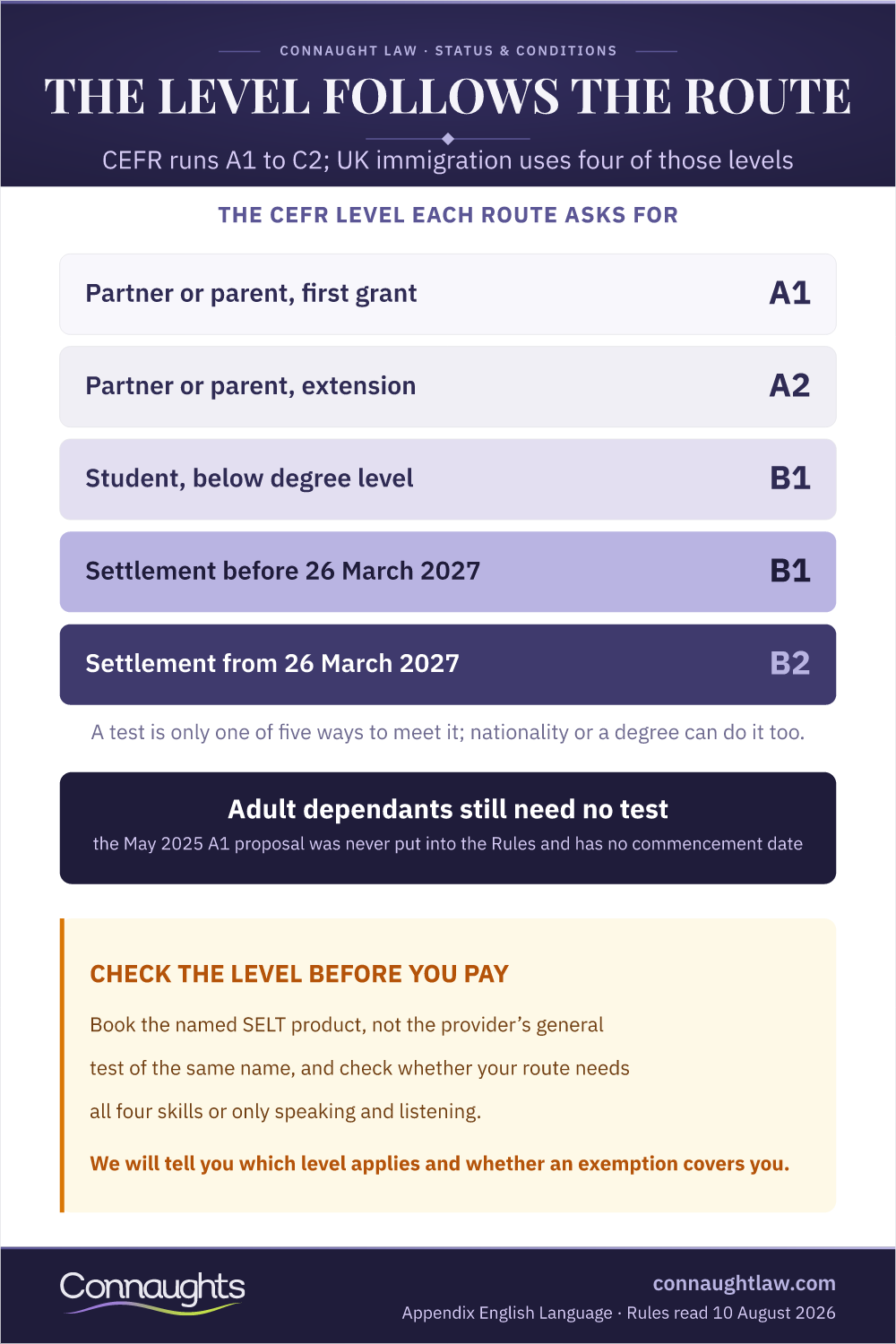
CEFR Levels by Route
CEFR runs from A1 to C2. UK immigration uses four of those levels, and it matters whether the route tests all four skills or only speaking and listening — a Life Skills style test covers two, and will not satisfy a route that wants reading and writing as well. The Home Office levels table is the quickest cross-check.
Requirements by Route
| Route | Level | Skills tested | Rule |
|---|---|---|---|
| Skilled Worker and Health and Care Worker | B2, or B1 where the most recent permission was as a Skilled Worker granted subject to a B1 requirement | All four | SW 4.1 |
| High Potential Individual | B2, with no carry-back | All four | HPI 4.1 |
| Scale-up | B2, or B1 where the most recent permission was as a Scale-up worker at B1 | All four | SCU 4.3 |
| Student, degree level or above | B2 | All four | ST 13.1 |
| Student, below degree level or pre-sessional | B1 | All four | ST 13.1, ST 15.2 |
| Innovator Founder and Minister of Religion | B2 | All four | Route appendix |
| Global Talent | None at entry or extension; B1 at settlement | Speaking and listening | GT 13.1 |
| Partner or parent, entry clearance and first grant | A1 | Speaking and listening | E-ECP.4.1, E-LTRP.4.1 |
| Partner or parent, extension after 30 months | A2 | Speaking and listening | E-LTRP.4.1A |
| Settlement and citizenship, most routes | B1, rising to B2 for applications made on or after 26 March 2027 | Speaking and listening | Appendix KOL UK; PL 16.1 for private life |
Who Is Exempt from a Test
Exemption and satisfaction are different things, and the distinction decides which evidence you file. The five routes in the box above are ways of meeting the requirement. A true exemption removes it. At settlement, EL 1.1 exempts an applicant who is 65 or over at the date of application, is under 18, or has a physical or mental condition that prevents them meeting it.
There is also a long-residence exemption that is easy to miss. A partner, parent or dependent child over 18 applying for settlement who has spent a continuous period of 15 years in the UK with permission can rely on an A2 speaking and listening qualification plus 75 guided learning hours and a teacher’s confirmation that they are unlikely to reach the required level through further study. That target level is B1 now and B2 for applications made on or after 26 March 2027.
Appendix FM keeps its own exemptions for partner and parent applications, and the majority English-speaking country list is repeated there at GEN.1.6. Our separate guide to English language test exemptions works through the evidence each one needs, which is where most refusals in this area actually originate.
Approved SELT Providers
Only a Secure English Language Test from an approved provider, sat at an approved location, will be accepted. There are five providers, and the list is not the same inside and outside the UK — a point that costs applicants money every year, because an ordinary academic English test booked by mistake produces a result the Home Office will not look at.
Providers and Their Tests
| Provider | Where you can test | Approved tests |
|---|---|---|
| IELTS SELT Consortium | Inside and outside the UK | IELTS for UKVI; IELTS Life Skills |
| LANGUAGECERT | Inside and outside the UK | LANGUAGECERT Academic SELT; General SELT; International ESOL SELT |
| Pearson | Inside and outside the UK | PTE Academic UKVI; PTE Home |
| Trinity College London | Inside the UK only | Integrated Skills in English (ISE); Graded Examinations in Spoken English (GESE) |
| PSI Services (UK) Ltd | Outside the UK only | Skills for English UKVI |
A result sat in the UK can be used for an overseas application and a result sat overseas can be used for an application made in the UK. What cannot be done is to sit a Trinity test outside the UK or a Skills for English test inside it — those providers are not approved in those places, and the result will not verify. Results are valid for two years from the date of award.
Booking a Test and the Reference Number
Book directly with the provider and choose the named SELT product, not the provider’s general test of the same name: PTE Academic UKVI rather than PTE Academic, IELTS for UKVI rather than IELTS. Check the level and the components your route needs before you pay, using the table above, and allow for the two-year validity window running back from the date of application rather than the date you file. Coming to the UK to study English first is its own route — see short-term study for English courses.
What actually goes on the application form is the SELT unique reference number. It appears on the result under a different name for each provider — UER for Trinity College London, UKVI number for the IELTS SELT Consortium, Candidate URN for LANGUAGECERT, SELT URN for Pearson, and URN for PSI Skills for English. The gov.uk SELT guidance states plainly that an application may be refused if the number is not included.
No certificate is submitted. The Home Office verifies the score directly with the provider through the SELT online verification system, which is why the reference number, not the paper result, is the operative document. Students have an extra step: the test provider, the reference number and the score in each component must appear on the Confirmation of Acceptance for Studies under ST 13.4, so a student visa sponsor needs the number before the CAS is assigned.
What Changed in 2026, and What Changes in 2027
Statement of Changes HC 1333 raised the requirement from B1 to B2 for Skilled Worker, High Potential Individual and Scale-up with effect from 8 January 2026. Applications made before that date were decided under the Rules in force on 7 January 2026. Skilled Worker and Scale-up carry a standing carve-out for people already on the route at B1; High Potential Individual does not, because HC 1333 substituted a bare B2 there.
The settlement change is further off but already law. HC 1691 wrote the B2 standard into the Rules on 26 March 2026, date-gated so that it bites on applications made on or after 26 March 2027. It reaches the routes covered by Appendix KOL UK together with Skilled Worker, Scale-up, Global Talent, Innovator Founder, UK Ancestry, Minister of Religion, International Sportsperson, Long Residence, Bereaved Partner, Private Life and Settlement Family Life.
Two features of that change are worth stating precisely. It applies to people already on a settlement pathway — there is no protection for those part-way through a five or ten year route, and the year’s deferral is the mitigation. And for Skilled Worker and Scale-up it is not an upgrade of an existing requirement but a new one: SW 22A.1 and SCU 16A.1 create a settlement-stage English requirement those routes did not previously have.
The May 2025 immigration white paper proposed an A1 requirement for adult dependants of workers and students, rising over time. It has not been implemented. No Statement of Changes between March 2025 and July 2026 introduced it, no appendix contains it, and no commencement date has been published. Anyone told that a dependant needs a test to come to the UK on a work or study route should ask which rule says so.
One quieter change is worth knowing if you are gathering evidence. Since 26 March 2026 the Rules no longer name Ecctis: EL 5.4 and EL 8.4(b) refer to “the qualification and language assessments provider”. Home Office guidance still names Ecctis as that provider, so the practical step is unchanged — but a submission that quotes the Rules should quote them as they now read, and a refusal is rarely improved by citing a superseded version.
Frequently askedQuestions about the English language requirement
Which English test does UKVI accept?
Only a Secure English Language Test from IELTS SELT Consortium, LANGUAGECERT, Pearson, Trinity College London or PSI Services, sat at an approved location. Trinity is approved inside the UK only and PSI outside the UK only. An ordinary academic IELTS or PTE is not a SELT.
How long is a SELT result valid?
Two years from the date the test is awarded, and the two years are measured back from the date of application. A result that expires between filing and decision is not a problem; one that had already expired on the date of application is.
Do I need a test if I have a degree?
Not if the degree is a UK bachelor’s, master’s or doctorate, or a degree-level qualification taught or researched in English. A qualification awarded outside the UK also needs confirmation from the qualification and language assessments provider under EL 5.4.
What is a SELT unique reference number?
The number the Home Office uses to verify your score directly with the test provider. It is called UER, UKVI number, Candidate URN, SELT URN or URN depending on the provider. Leaving it off the application form can lead to refusal on its own.
Does the B2 change affect my extension?
Only if you are not covered by the carve-out. A Skilled Worker or Scale-up worker whose most recent permission was granted at B1 keeps B1 on the same route. Anyone switching in, or applying on High Potential Individual, needs B2.
Do adult dependants need an English test?
No. The A1 requirement for adult dependants of workers and students was a white paper proposal in May 2025 and has not been put into the Rules. Partners applying under Appendix FM are different — they have always needed A1 at entry and A2 at extension.
What level do I need for settlement?
B1 speaking and listening for applications made before 26 March 2027, and B2 for applications made on or after that date. The change is already written into the Rules and applies to people part-way through a settlement route.
Tell us the route you are applying under and any qualification or test you already hold. We will tell you which CEFR level applies, whether an exemption covers you, and what the 2027 settlement change means for you.
Get Expert Advice