
Appendix V is the legal engine of every UK visit: the genuine visitor test in V4.2, the financial provisions in V4.3 to V4.6 — which set no minimum amount — the permitted activities list, and the V15A diplomatic visitor route added in 2025. This technical guide works through the provisions as decision-makers apply them, the statements of changes that reshaped them, and the refusal grounds each one generates.
On This Page

The Rulebook Behind Every Visit Decision
Since consolidation, all visitor decisions — tourists, family visitors, business travellers, transit passengers — flow from Appendix V: Visitor, read with its companion appendices and the Home Office's published visit guidance. Practitioners read the three layers together: the rule sets the requirement, the guidance tells caseworkers how to assess it, and the refusal notice reveals which layer actually failed.
Structure of Appendix V
Core Provisions
The appendix runs in functional blocks: validity requirements (V1), suitability (V2–V3), eligibility (V4) — where the genuine visitor test and funds provisions live — permission and conditions (V5–V9), and the specialist parts covering marriage visitors, permitted paid engagements, transit and, since 2025, diplomatic visitors in V15A. Permitted activities sit outside the main appendix in Appendix Visitor: Permitted Activities, which is why the activity question and the eligibility question are decided separately.
Statement of Changes Impact
How the 2025 Amendments Landed
Two 2025 statements of changes reshaped visitor practice: HC 836, effective 24 June 2025, integrated the ETA scheme's operation with visitor eligibility for non-visa nationals, and HC 1298, effective 4 September 2025, adjusted related routes with transitional provisions. Each statement of changes amends the consolidated text directly, so the version in force on the decision date — not the application date — governs; the statements of changes collection is the audit trail.
The V4.2 Genuine Visitor Test
V4.2 Sub-Paragraph Breakdown
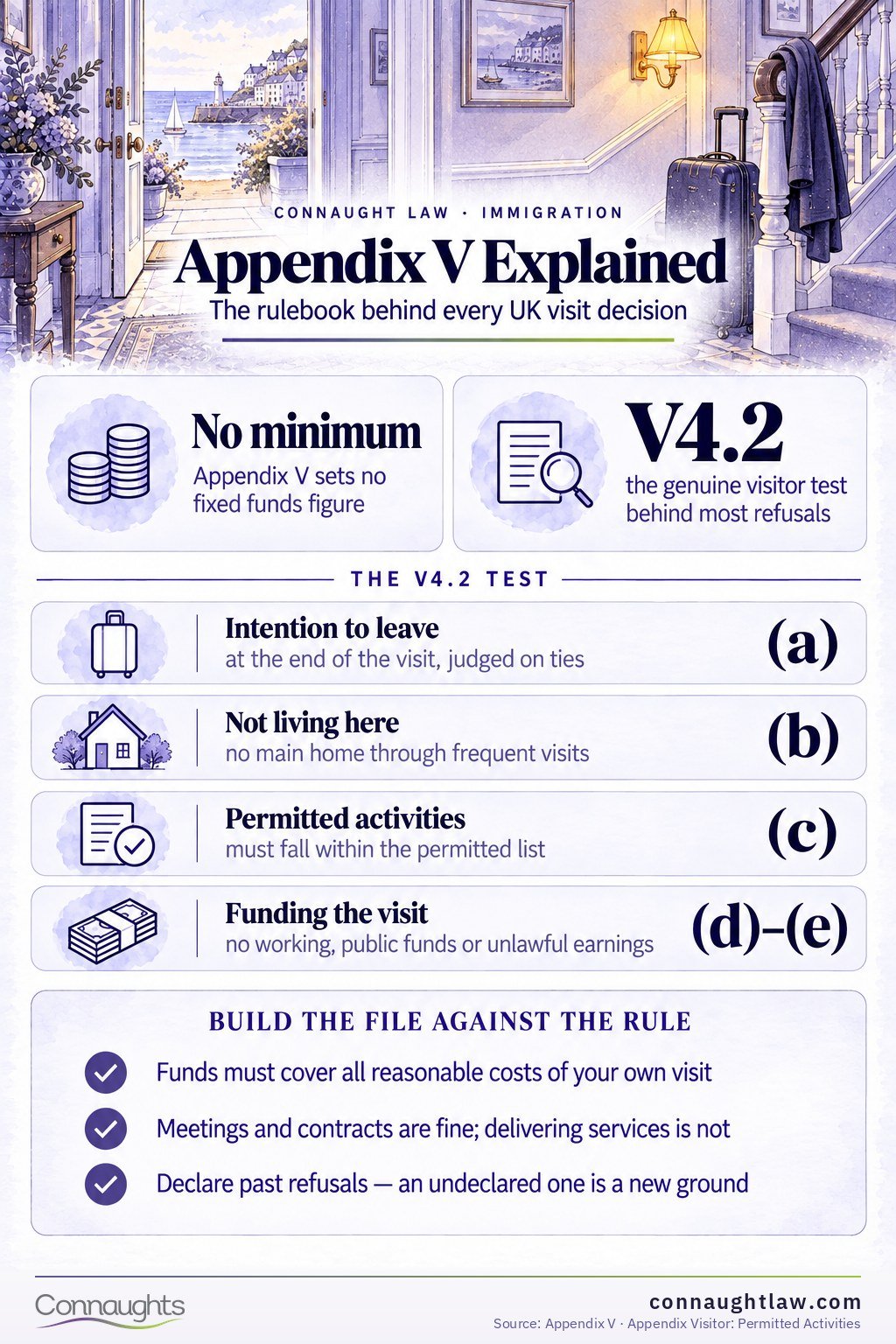
- V4.2(a): a genuine intention to leave at the end of the visit, assessed through ties, history and plausibility.
- V4.2(b): no living in the UK through frequent or successive visits, and no making the UK a main home.
- V4.2(c): the planned activities must fall within Appendix Visitor: Permitted Activities.
- V4.2(d)–(e): the visit's cost must be met without working, recourse to public funds, or reliance on unlawful earnings.
V4.3 to V4.6: Funds and Third-Party Support
The financial provisions set a standard, not a figure — there is no minimum amount anywhere in Appendix V. V4.3 requires funds sufficient for all reasonable costs of the visit; V4.4 to V4.6 govern who may provide them, permitting third-party support where the sponsor is genuine, able to pay, and where V4.6's relationship condition is met. In practice the open standard cuts against weak files: with no threshold to clear, sufficiency is assessed against the applicant's own itinerary and circumstances, which is where unexplained deposits and disproportionate trip costs fail.
Permitted Activities Analysed
The PA Framework
The permitted activities appendix groups what visitors may do: tourism and family visits, business meetings and negotiations, professional development, research and exchange for visiting academics, creative and sports engagements, medical treatment, and defined study allowances. Read restrictively at the edges — each PA paragraph is a permission, and anything not within one is prohibited work by default.
Business Activity Boundaries
Where Business Visits End and Work Begins
The recurring advisory question is the client-facing boundary: attending meetings, negotiating and signing contracts are permitted; delivering the contracted services in the UK is not. Intra-corporate activity follows the same logic — briefings and oversight are visits, productive work is employment requiring sponsorship. The remote-work tolerance added in recent years permits keeping up an overseas job during a genuine visit without converting the visit into work.
V15A: Diplomatic Visitors
Technical Requirements of the Route
Part V15A, introduced with effect from 18 February 2025, created a bespoke route for diplomatic passport holders from designated states — initially China, Indonesia, South Africa, Turkey and Vietnam — travelling on official business. Its architecture differs from the standard route: two-year multiple-entry validity with six-month stays, government support evidenced by Note Verbale, and assessment reflecting the official character of the travel. For advisers its significance is precedential as much as practical — a designated-country model grafted onto the visitor framework.
Refusal Grounds
Where Applications Fail
Refusals map onto the structure: V4.2(a) departure-intent findings dominate, followed by funds failures under V4.3, activity mismatches under V4.2(c), and suitability refusals under Part 9 grounds — false representations chief among them. The distribution across nationalities and profiles, with the evidence patterns behind each ground, is analysed in our refusal reasons and rates guide.
Mitigating Each Ground
Because each ground attaches to a specific provision, mitigation is provision-specific: departure intent answers with ties evidence, funds grounds with reconciled statements, activity doubts with itineraries drafted in the PA framework's own language, and suitability risk with disclosure — a declared refusal is a fact, an undeclared one is a fresh ground.
Case Strategy for Advisers
Building Files Against the Rule
The disciplined method is to draft the application as a submission on Appendix V: identify each requirement, attach the evidence answering it, and pre-empt the guidance's known concern points for the applicant's profile. Files built this way also fail better — when a refusal comes, the divergence between the file and the notice is where a challenge lives. The applicant-facing version of these requirements is in our Standard Visitor guide.
Current Developments
Monitoring Areas
Three areas warrant standing watch: further ETA-driven amendments as the scheme matures, expansion of the V15A designated-country list, and continued tightening of visitor guidance on successive visits. Statements of changes land several times a year, and visitor provisions have moved in most recent rounds.
Direction of Travel
The trajectory is digitisation and pre-screening: ETA data enriching decisions before travel, guidance pushing assessment toward documentary consistency, and the appendix absorbing specialist routes rather than spawning new ones. For applicants that means the written file matters more each year; for advisers it means the consolidated text and its change log are the working documents.
Frequently askedQuestions about Appendix V
What is Appendix V of the Immigration Rules?
The consolidated rulebook governing all UK visitors — eligibility, suitability, permitted stay and conditions — read alongside Appendix Visitor: Permitted Activities and the Home Office's visit guidance. Every visitor refusal notice cites its provisions.
What does paragraph V4.2 require?
The genuine visitor test: an intention to leave, no residence through successive visits, activities within the permitted list, and the ability to fund the visit without working or public funds. It is the ground on which most refusals stand.
Is there a minimum amount of funds for a visitor visa?
No — V4.3 sets no figure. Funds must be sufficient for all reasonable costs of your particular visit, judged against your itinerary and circumstances. Third-party support is permitted under V4.4 to V4.6 where the sponsor is genuine and able to pay.
What changed in Appendix V during 2025?
Two statements of changes: HC 836 from 24 June 2025 integrated the ETA scheme's operation, and HC 1298 from 4 September 2025 adjusted related provisions. Part V15A for diplomatic visitors from designated countries had taken effect on 18 February 2025.
Who does Part V15A apply to?
Diplomatic passport holders from designated states — initially China, Indonesia, South Africa, Turkey and Vietnam — travelling on official business, with two-year multiple-entry validity, six-month stays and Note Verbale support from their government.
Which version of the rules applies to my application?
The consolidated text in force at the date of decision, as amended by every statement of changes to that point. Where a change lands between application and decision, transitional provisions in the statement itself say which regime governs.
Whether you're building an application or attacking a refusal notice, we work from the consolidated text and guidance line by line. Send us the facts and we'll map them to the provisions.
Get Expert Advice