
If you have experienced domestic abuse, legal aid can pay for the advice and representation you need — for a protective injunction, in child arrangements, or in the family court more widely. Qualifying turns on two things: evidence that you are a victim, and a means test on your income and savings. This guide explains who qualifies, what evidence counts, how to apply, and what the funding covers.
On This Page

Funding Protection When You Cannot Afford a Solicitor
Legal aid exists so that nobody stays trapped in a dangerous situation simply because they cannot afford a solicitor. For family and protection matters, domestic abuse is one of the clearest routes to funding: the law treats abuse victims as a priority for civil legal aid, and the evidence rules have been widened repeatedly so that more forms of proof now count.
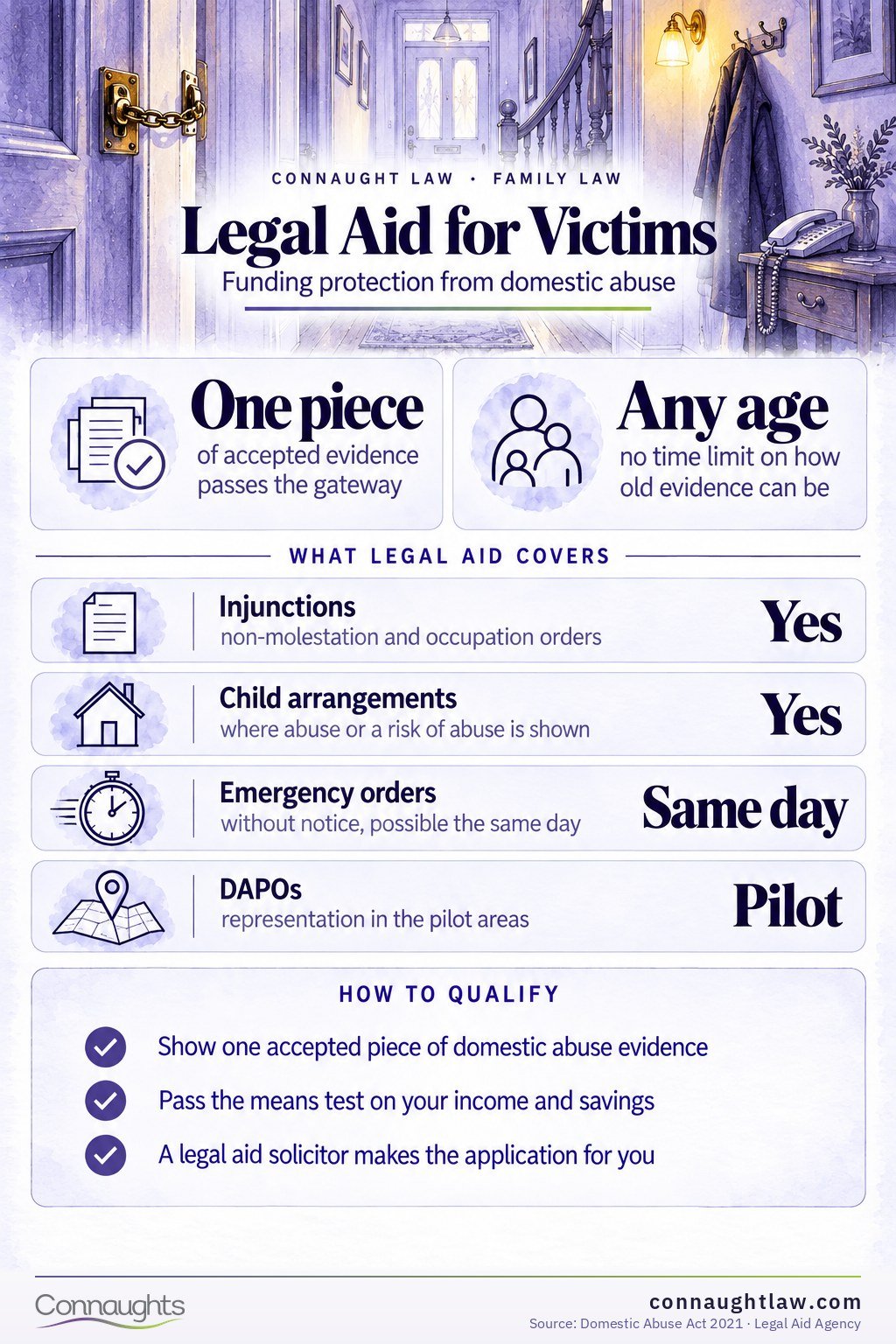
Most victims can get legal aid. You need one accepted piece of evidence that you are a victim of domestic abuse — a police record, a protective order, a letter from a doctor, refuge or support service, among others — and to pass a means test on income and savings. There is no time limit on how old the evidence can be, and many people on benefits or a low income qualify.
Who Qualifies for Legal Aid in Domestic Abuse Cases
Two tests decide whether you get legal aid for a family or protection matter as a victim of domestic abuse. The first asks whether you can show you are a victim; the second asks whether you can afford to pay for legal help yourself. You normally need to satisfy both, and for some proceedings the Legal Aid Agency also weighs the merits of the case before granting funding.
Passing the Domestic Abuse Gateway
The gateway is the requirement to provide evidence that domestic abuse has occurred or is at risk of occurring. The Domestic Abuse Act 2021 defines abuse broadly, covering not just physical violence but also emotional, psychological, economic and coercive or controlling behaviour. That wide definition matters, because the abuse you rely on does not have to have been physical, and it does not have to have been reported to the police.
How the Means Test Works
The means test looks at your income and your capital, such as savings and property. If you receive certain income-based benefits you are usually passported through the income part automatically, and people on a low income often qualify for free or low-cost help. The government has also committed, in its response to the legal aid means test review, to stop means testing victims on universal credit who apply for protective orders, and to disregard assets an abuser controls that you cannot actually reach. Those changes are being brought in in stages, so ask your solicitor what applies on the day you apply.
Meeting the Merits Test
For some proceedings there is also a merits test, which asks whether it is reasonable to fund your case — broadly, whether the likely benefit justifies the cost and whether the matter is one a sensible person would pay for if they had the money. For urgent protective injunctions this is rarely an obstacle, because the need for protection is clear. A legal aid solicitor assesses merits alongside your evidence and finances before submitting the application, so you know early on where you stand.
What Evidence You Need to Show
The rules set out a wide list of documents that satisfy the domestic abuse gateway, so you can usually find a form of evidence that fits your situation. You only need one qualifying piece, not all of them. The official guidance confirms evidence can come from the courts, the police, social services, health professionals, refuges and support services — and, for economic abuse, from your bank, your employer, or an education provider.
- A conviction, caution, arrest, charge or police bail for a domestic abuse offence
- A protective injunction, restraining order or domestic violence protection notice
- A letter from a domestic abuse support organisation or refuge
- A letter from a health professional confirming injuries or abuse
- A MARAC (multi-agency risk assessment conference) referral
- Evidence of financial abuse, such as bank records or a letter from your employer
The previous five-year time limit on domestic abuse evidence was removed in 2018. It does not matter how long ago the abuse occurred, which means survivors of historic abuse can still qualify on the strength of older evidence. If you have nothing in writing yet, standard template letters exist for doctors, support services and other professionals to complete — your solicitor can send the right template to the right person so they know exactly what to confirm.
Legal Aid for Child Arrangements Where There Is Abuse
Legal aid is not generally available for private children proceedings in England and Wales — unless you can show evidence of domestic abuse, or of a risk of abuse to the child. The same gateway evidence that funds a protective injunction also opens funding for disputes about where a child lives and who they spend time with, provided you pass the means test for that application too.
This matters in practice because abusive ex-partners often continue the abuse through children proceedings. With legal aid you are represented at every hearing, and the court can also put protections in place — separate waiting areas, screens, and a bar on the abuser cross-examining you personally. Tell your solicitor about the abuse at the first conversation, even if your immediate question is only about the children.
How to Apply for Legal Aid, Step by Step
You do not apply to the government directly for this kind of legal aid. In practice a solicitor who holds a legal aid contract makes the application for you once they have checked that you qualify, which keeps the process manageable at a difficult time.
- Contact a legal aid family solicitor, or call Civil Legal Advice on 0345 345 4345
- Explain your situation — you do not need all your evidence ready for this first step
- Gather the gateway evidence and details of your income and savings
- Your solicitor assesses eligibility and submits the application to the Legal Aid Agency
- Emergency funding can be arranged where you need urgent protection
Where safety is at immediate risk, a solicitor can apply for emergency legal aid and seek a protective order the same day, without notice to the other person. If you are ever in immediate danger, call 999 first.
What Legal Aid Covers, Including DAPOs
Legal aid for domestic abuse victims covers the legal steps most people need to become safe and to sort out arrangements for children and the home. That includes advice, help with an application, and representation at court hearings.
Legal aid funds protective injunctions such as non-molestation and occupation orders, child arrangements proceedings where abuse is a factor, emergency and without-notice applications for urgent protection, and representation in family court proceedings connected to the abuse.
If your right to remain in the UK depends on an abusive partner, funded advice can extend to the immigration side of your situation too — see our guide to domestic violence immigration rights for how the settlement route works.
Domestic Abuse Protection Orders (DAPOs)
A newer form of protection, the Domestic Abuse Protection Order, combines the strengths of existing orders into a single flexible order that can both prohibit contact and impose positive requirements, such as attending a behaviour-change programme. DAPOs are still being piloted: the scheme began in November 2024 in Greater Manchester and the London boroughs of Croydon, Bromley and Sutton, extended during 2025 to the Cleveland area and North Wales, and is due to run to 24 November 2026 before decisions on any wider roll-out.
Victims in a pilot area can apply directly to the family court using form DA1, and there is no court fee. Legal aid can fund representation subject to the usual means and merits tests. Because availability depends on where the person you need protection from lives, check the current position — or ask us — before deciding between a DAPO and a non-molestation order.
Where to Turn if You Do Not Qualify
Failing the means test does not leave you without options. Civil Legal Advice can confirm the assessment is right, applying for a non-molestation order carries no court fee even without a solicitor, and some charities and law centres provide free representation. If you must represent yourself, a McKenzie friend can support you in the courtroom. We also advise on fixed-fee options where legal aid is not available — the cost of initial advice is often far lower than people fear.
Frequently askedQuestions about qualifying for and applying for legal aid
Who qualifies for legal aid in domestic abuse cases?
You qualify if you can provide accepted evidence that you are a victim of domestic abuse and you pass a means test on income and savings. Certain benefits passport you through the income part, and there is no time limit on how old the abuse evidence can be.
What does legal aid for domestic abuse cover?
Advice and representation for protective injunctions such as non-molestation and occupation orders, child arrangements proceedings where abuse is a factor, emergency and without-notice applications, and related family court proceedings. It can also fund representation for a Domestic Abuse Protection Order in the pilot areas.
What evidence do I need for legal aid as a domestic abuse victim?
One accepted piece of gateway evidence — a conviction, caution or arrest, a protective order, a letter from a support service, refuge or health professional, a MARAC referral, or evidence of financial abuse. Historic evidence counts, and template letters exist for professionals to complete.
Can I get legal aid if I am on universal credit or a low income?
Often, yes. Income-based benefits passport you through the income part of the means test, and people on a low income frequently qualify. Capital such as savings is also assessed, but assets an abuser controls that you genuinely cannot reach should not be held against you.
Can I get legal aid for a child arrangements case?
Yes, if you have gateway evidence of domestic abuse or of a risk of abuse to the child, and you pass the means test. Without such evidence, legal aid is not generally available for private children proceedings in England and Wales.
How do I apply for legal aid for a domestic abuse case?
Contact a family solicitor who holds a legal aid contract, or call Civil Legal Advice on 0345 345 4345. You do not need all your evidence ready for the first conversation — the solicitor checks eligibility, helps gather evidence and submits the application. Emergency funding is available for urgent protection.
Tell us what has happened, what evidence you already have and what you need help with. We will tell you whether the gateway is met and what the next step would be.
Get Expert Advice