
A McKenzie friend sits beside you in court when you represent yourself — taking notes, keeping papers in order, and quietly suggesting points to raise. They cannot speak for you or run your case, and there is no official form for bringing one: you tell the court, and the judge decides. This guide covers the notification step, what they can and cannot do, realistic costs, and where free help exists.
On This Page
Help beside you, not a lawyer for you
The name comes from McKenzie v McKenzie, a 1970 Court of Appeal decision confirming that a litigant in person is entitled to reasonable assistance from a layperson in court. Half a century later the role matters more than ever: a large share of people in the family court now attend without a lawyer, most often in child arrangements and financial hearings, and a calm second pair of hands changes how those hearings feel.
The courts' approach is set by the Practice Guidance on McKenzie Friends issued in July 2010, which starts from a presumption in your favour: you may have a McKenzie friend unless the judge finds good reason to refuse. Refusals are the exception — disruption, unfairness, a personal stake in the outcome, or someone who cannot be trusted with confidential papers.
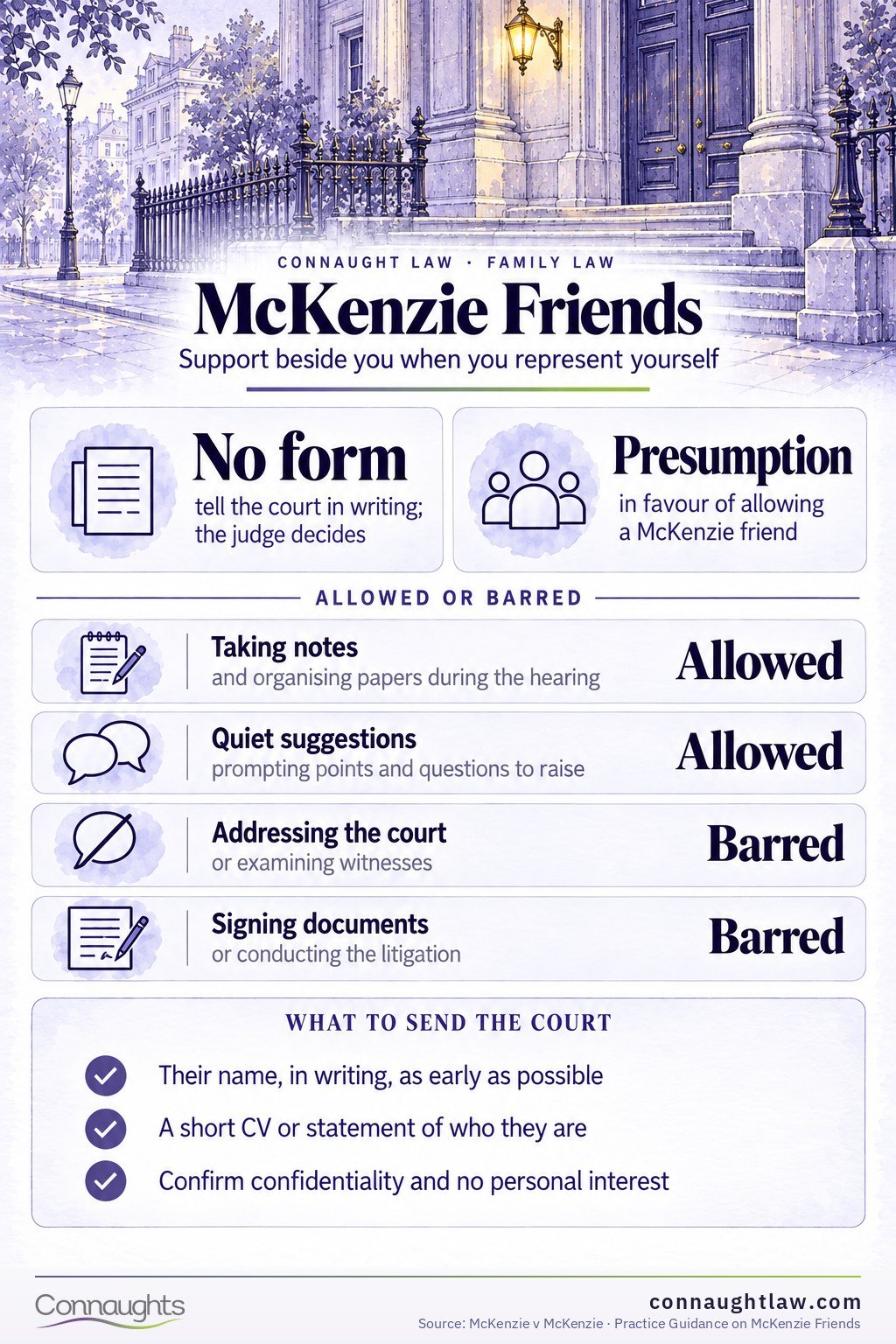
A McKenzie friend may take notes, organise documents, prompt you and give quiet advice during the hearing. They may not address the judge, question witnesses or conduct the litigation — those need the court's express permission, granted only exceptionally.
Telling the Court — Is There a Form?
There is no single official McKenzie friend form for the family court or the civil court — searches for one usually end here for exactly that reason. What the court expects instead comes from the Practice Guidance: notice, given early, so the judge and the other side know who will be sitting beside you and why.
- The McKenzie friend's name, in writing to the court and the other party, as early as possible before the hearing.
- A short CV or statement setting out who they are, their experience and any relevant background.
- Confirmation that they understand the duty of confidentiality and have no personal interest in the case.
- If notice was impossible, ask the judge at the start of the hearing — permission can be given on the day.
Family and civil courts apply the same guidance, so the same package works in both — which is why there is no separate family court form and civil court form to hunt for. Put the case number on everything and bring spare copies to the hearing.
What a McKenzie Friend Can and Cannot Do
A McKenzie friend is any person who helps a litigant in person during a hearing — a relative, a trusted friend, a charity volunteer or a paid professional. The label describes the role, not a qualification: nothing about being a McKenzie friend confers legal status, and the boundary of the role is what makes it acceptable to the court.
- Allowed: taking notes, organising papers, quietly suggesting points and questions, moral support through the hearing.
- Allowed: helping you prepare outside the courtroom — chronologies, position statements, sorting disclosure.
- Barred: addressing the court, examining witnesses, signing court documents or conducting the litigation.
- Barred: running the case in their own name — correspondence with the court and the other side stays yours.
So a McKenzie friend cannot represent you in the way a solicitor or barrister would. You remain the litigant; every application, statement and decision stays in your name. What they change is how well you deliver your own case.
Can a McKenzie Friend Speak for You?
Not without permission. Addressing the court — a right of audience — and conducting litigation are reserved activities, and a McKenzie friend has neither. The court can grant a right of audience for a particular hearing, but the Practice Guidance is explicit that this is exceptional: judges will not grant it routinely simply because it would be helpful or save money.
In practice, permission tends to be considered where the litigant genuinely cannot present the case — illness, severe anxiety under cross-examination, communication difficulties — and the proposed speaker is competent and disinterested. Ask at the start of the hearing, explain why, and have the McKenzie friend's background ready. If the judge refuses, the friend stays: silent, but still useful.
How to Become a McKenzie Friend
There is no qualification, licence or exam. Anyone a litigant trusts can act as their McKenzie friend for a hearing, subject to the court's control — that is the whole of the formal position. Becoming a good one, or charging for it, is another matter.
Training and the Voluntary Code
Paid McKenzie friends typically build real knowledge of family procedure and courtroom conduct, complete relevant training, and many join the Society of Professional McKenzie Friends — a voluntary body whose members sign a code of conduct and carry professional indemnity insurance. None of this is required by law, which cuts both ways: entry is open, and quality varies as widely as you would expect. Anyone paying should ask about training, insurance and references before the first hearing.
Costs and Free McKenzie Friend Help
A relative or friend acting as your McKenzie friend costs nothing. Paid professionals set their own fees — typically an hourly rate, or a fixed fee per hearing with preparation included — and because the market is unregulated, prices and quality both vary. Courts do not usually order the other side to reimburse McKenzie friend fees, so budget on the basis that the cost is yours.
McKenzie friends are not regulated by the Solicitors Regulation Authority or the Bar Standards Board, and there is no mandatory insurance or complaints scheme. For professional costs, the court service publishes solicitors' guideline hourly rates and our own fee structure is set out openly. If your case involves domestic abuse, check legal aid first — it survives for exactly these cases.
Free support exists. Support Through Court — formerly the Personal Support Unit — provides trained volunteers in many court buildings; university law clinics and some charities help with preparation; and GOV.UK's guidance on representing yourself is the official starting point. Book ahead: volunteer services are stretched, and none can be arranged reliably on the morning of a hearing.
Frequently askedQuestions about McKenzie friends in family proceedings
What is a McKenzie Friend and what can they do?
Someone who supports a litigant in person during a hearing: taking notes, organising papers, prompting and giving quiet advice. They cannot address the judge, question witnesses or run the litigation unless the court grants express permission, which is exceptional.
Is there a McKenzie Friend form for the family court?
No — no official form exists for the family or civil court. Write to the court and the other party before the hearing with the McKenzie friend's name and a short CV or statement, confirming confidentiality and no personal interest. If time ran out, ask the judge at the start.
Can a McKenzie Friend speak in court on my behalf?
Only with the court's permission, granted exceptionally for a particular hearing — for example where illness or communication difficulties genuinely prevent you presenting your own case. Otherwise they support you silently while you speak.
How do I become a McKenzie Friend in the UK?
No qualification or licence is required — the court controls the role hearing by hearing. Paid McKenzie friends usually complete training in family procedure, and many join the Society of Professional McKenzie Friends, whose voluntary code includes indemnity insurance.
Are McKenzie Friends regulated?
No. Neither the Solicitors Regulation Authority nor the Bar Standards Board oversees them, and there is no mandatory insurance or complaints scheme. The Society of Professional McKenzie Friends offers voluntary self-regulation for its members only.
How much does a McKenzie Friend cost?
A friend or relative costs nothing. Professionals charge an hourly or fixed hearing fee set by the market, not a regulator — confirm the price, what preparation it includes, and insurance in writing first. Courts rarely make the other side pay it back.
Can the court refuse to allow my McKenzie Friend?
Yes, but the presumption runs the other way. Under the 2010 Practice Guidance a judge refuses only for good reason: likely disruption, unfairness to the other side, a personal interest in the outcome, or doubts over confidentiality.
Where can I find free McKenzie Friend support?
Support Through Court provides trained volunteers in many court centres, university law clinics help with preparation, and some charities assist in specific case types. Book in advance — none operates reliably as a same-day service.
If your case is complex or a lot is at stake, representation may protect you better than support alone. Tell us what the hearing is about and we will tell you what a solicitor would add.
Get Expert Advice