
Non-molestation orders and occupation orders are the two main protective injunctions under the Family Law Act 1996. They do different jobs: a non-molestation order stops someone harassing, threatening or abusing you, while an occupation order decides who is allowed to live in the family home. This guide explains what each order does, the evidence courts expect, how to apply on form FL401 free of charge, and how the new DAPOs compare.
On This Page
Two Orders, Two Different Jobs
Both orders come from Part IV of the Family Law Act 1996 and are made in the family court. They are civil orders, not criminal charges, but they carry real force — breaching a non-molestation order is itself a criminal offence. You can apply for one or the other, or both together, depending on whether your concern is your safety, your home, or both.
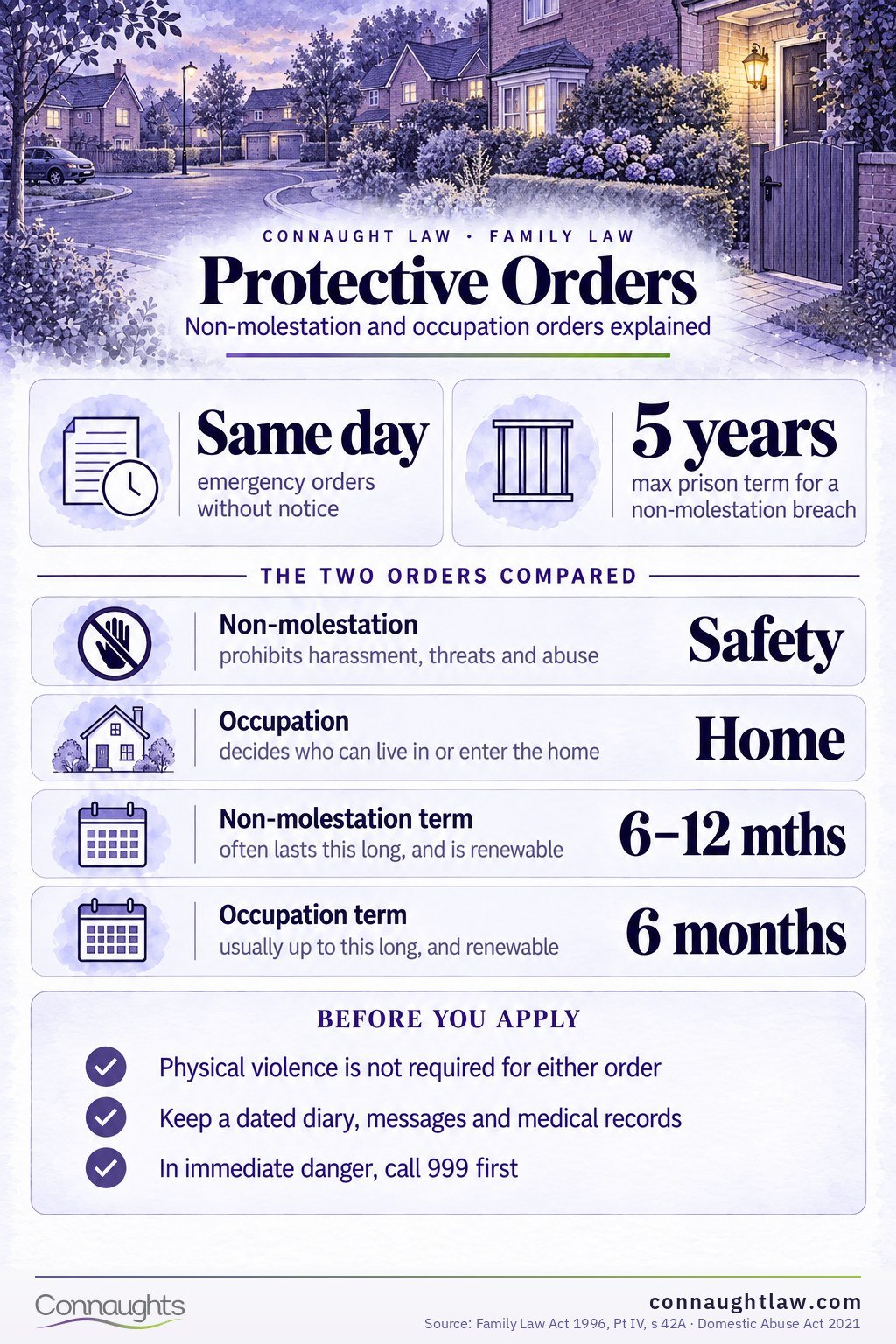
A non-molestation order prohibits harassment, threats and abuse; an occupation order decides who can live in or enter the family home. Neither requires physical violence, there is no court fee to apply, and in an emergency the court can make an order the same day without the other person being told first.
What Is an Occupation Order
An occupation order regulates who can live in the family home and on what terms. The court can exclude one person from the property entirely, order them to stay away from a defined area around it, allow someone back in who has been shut out, or set rules for how a shared home is used while a dispute is resolved. It can also deal with who pays the mortgage, rent and bills in the meantime.
Occupation orders are used where a relationship has broken down or there has been abuse and it is no longer safe or workable for both people to remain under the same roof. Because they can remove someone from their own home, the court weighs the application carefully rather than granting one automatically.
The Balance of Harm Test
The central question for an occupation order is the balance of harm test. The court compares the harm you and any children would suffer if the order is not made against the harm the other person would suffer if it is. If the harm to you or the children is likely to be significantly greater, the court will normally make the order. Judges look at each person's housing needs and resources, financial position, health and safety, the conduct of both parties, and above all the welfare of any children.
Who Can Apply
To apply you must be an "associated person" — broadly, someone connected to the other person through family or relationship. That includes current or former spouses and civil partners, cohabitants, people who have been in an intimate relationship of significant duration, relatives, and people who share parental responsibility for a child. An intimate relationship does not have to have been sexual to qualify.
What Is a Non-Molestation Order
A non-molestation order protects you from being "molested" — a deliberately wide term that covers harassment, pestering, threats, intimidation and any behaviour that causes you distress. It is not limited to physical violence, and it can prohibit contact of every kind, whether in person, by phone or message, through social media, or through other people.
- Using or threatening violence against you or your children
- Contacting you directly or through someone else
- Coming to your home, workplace, or your children's school
- Following, watching or otherwise harassing you
- Damaging or interfering with your property or possessions
Power of Arrest and What Happens on a Breach
Breaching a non-molestation order is a criminal offence under section 42A of the Family Law Act 1996, carrying a maximum sentence of five years' imprisonment. That criminal status is what makes the order powerful: the police can arrest a suspected breach and put the matter before the criminal courts, without you needing to bring a separate case. This is a key difference from most other civil injunctions, where enforcing a breach falls to the person who obtained the order.
Orders for Emotional and Coercive Abuse
Neither order requires you to have suffered physical violence. Molestation covers emotional and psychological abuse, and the Domestic Abuse Act 2021 puts coercive and controlling behaviour, economic abuse and threats squarely within the legal definition of domestic abuse. Courts grant both orders on the strength of that kind of conduct — an occupation order can be made where staying under the same roof as an emotionally abusive partner harms you or your children, with no bruise ever photographed.
Proving it is about pattern, not a single incident. A diary of incidents with dates, saved messages and voicemails, witness accounts from family or colleagues, and records from a GP or counsellor showing the effect on you all build the picture. Describe specific occasions — what was said, when, and what it did to you — rather than characterising the behaviour in general terms.
The Difference Between the Two Orders
The two orders solve different problems and can be used together. The table below sets out how they compare on the points that matter most when deciding which you need.
Comparing the Two Orders
| Aspect | Non-molestation order | Occupation order |
|---|---|---|
| Main purpose | Stop harassment, threats and abuse | Decide who can live in or enter the home |
| What the court asks | Whether an order is needed to protect health, safety or wellbeing | The balance of harm test |
| Breach | A criminal offence — up to 5 years' imprisonment | Contempt of court, or arrest where a power of arrest is attached |
| Typical length | Often 6 to 12 months, renewable | Usually up to 6 months, renewable |
Where an abuser both harasses a victim and refuses to leave the home, the two orders are often applied for together, so that safety and housing are dealt with at the same time.
Evidence That Supports an Application
A detailed witness statement describing the incidents and their effect on you is the core of any application — the court decides most without-notice applications on the statement alone. You do not need every kind of supporting evidence; a credible, specific account backed by what you have is enough to start.
Messages, emails and call logs; photographs of injuries or damage; medical and counselling records; police incident numbers and reports; and statements from anyone who witnessed the behaviour. Keep originals, note dates, and do not confront the other person to obtain more material — the statement carries the application, and the rest corroborates it.
How to Apply, and Emergency Orders
You apply for either order — or both — on form FL401, supported by a witness statement describing the abuse. There is no court fee, and legal aid may cover representation if you pass the domestic abuse gateway and means test.
- Complete form FL401 with a witness statement describing the abuse
- File it at the family court, in urgent cases asking for a hearing without notice
- At a without-notice hearing the court can make a short-term order the same day
- A full hearing is then listed so the other person can respond
- Legal aid may be available, and a solicitor can seek emergency funding
In an emergency the court can make a without-notice order before the other person is told, where warning them would defeat the purpose or increase the danger. A without-notice order is short — commonly around a couple of weeks — and holds the position until a full hearing takes place with both people present. If you are ever in immediate danger, call 999 first.
Where the New DAPOs Fit
The Domestic Abuse Protection Order is a newer order being piloted since November 2024 — currently in Greater Manchester, the London boroughs of Croydon, Bromley and Sutton, the Cleveland area and North Wales, with the pilot running to 24 November 2026. A DAPO combines features of both existing orders in one: it can prohibit contact like a non-molestation order, exclude someone from the home like an occupation order, and additionally impose positive requirements such as attending a behaviour-change programme, with electronic monitoring available.
Inside a pilot area a victim can apply directly to the family court on form DA1, again with no court fee, and breach is a criminal offence. Everywhere else, non-molestation and occupation orders remain the orders to apply for — and they remain available in the pilot areas too, so the right choice depends on your situation and where the other person lives. Victims of domestic abuse should take advice on which combination gives the strongest protection.
Responding to or Disputing an Order
If an application has been made against you, or a without-notice order has already been served on you, you are entitled to respond at the full hearing before any final order is made. Taking early advice matters, because these orders can affect where you live and, in the case of a non-molestation order, expose you to criminal liability. The court can refuse the order, narrow it, or accept undertakings — formal promises to the court — where the situation justifies protection without a full order.
Do not breach an order while you dispute it. An order remains fully in force until a court changes or discharges it, even if you believe it was wrongly made. Breaching a non-molestation order is a criminal offence regardless of the merits of the underlying application — challenge it through the court, not by ignoring it. If your immigration status depends on the abusive relationship, our guide to domestic violence immigration rights explains the settlement route that protects you when you leave.
Frequently askedQuestions about applying for and responding to protective orders
What is the difference between a non-molestation order and an occupation order?
A non-molestation order stops someone harassing, threatening or abusing you by prohibiting their behaviour. An occupation order decides who can live in or enter the family home and can exclude the other person from it. One protects your personal safety; the other protects your housing. Many people apply for both together.
How do I get an occupation order in the UK?
You apply on form FL401, showing that you are an "associated person" and setting out why an order is needed. There is no court fee. The court applies the balance of harm test, weighing the harm to you and any children if no order is made against the harm to the other person if it is.
What evidence do I need for an occupation or non-molestation order?
A detailed witness statement describing the incidents and their effect on you is the core of any application. Supporting evidence can include messages, photographs, medical records, police reports and witness accounts. You do not need every kind — a credible account supported by what you have can be enough.
Can I get an order for emotional or coercive abuse rather than violence?
Yes. Neither order requires physical violence. Molestation covers emotional and psychological abuse, and the Domestic Abuse Act 2021 recognises coercive control and economic abuse as domestic abuse. Courts grant orders on evidence of a pattern of controlling or intimidating conduct and its effect on you.
What happens if someone breaches a non-molestation order?
Breaching a non-molestation order is a criminal offence under section 42A of the Family Law Act 1996, with a maximum of five years' imprisonment. The police can arrest a suspected breach and the criminal courts deal with it. Report a breach to the police and keep any evidence of it.
An order has been made against me — what should I do?
Take advice quickly and attend the full hearing, where you can file your own statement and challenge the application. The court can refuse an order, limit it, or accept undertakings instead. Do not breach the order in the meantime, because breach carries criminal consequences regardless of the dispute.
Tell us who the order would be against, what has been happening and how urgent the risk is. We will tell you which order fits and whether a same-day application is possible.
Get Expert Advice