
Surrogacy is legal in the UK, but the law around it is old and awkward: agreements are unenforceable, the surrogate is the legal mother at birth, and intended parents must apply to court for a parental order after the child arrives. The Law Commission published a full reform blueprint with a draft Bill in 2023 — and no government has yet taken it forward. This guide explains the law as it stands, the reform position, and how parental orders and payments actually work.
On This Page

Legal, but Built on a 1985 Framework
UK surrogacy runs on the Surrogacy Arrangements Act 1985 and the Human Fertilisation and Embryology Act 2008 — a framework designed long before surrogacy became a mainstream route to parenthood. It permits altruistic surrogacy, bans advertising and commercial brokering, and leaves intended parents legally exposed in the gap between birth and court order.
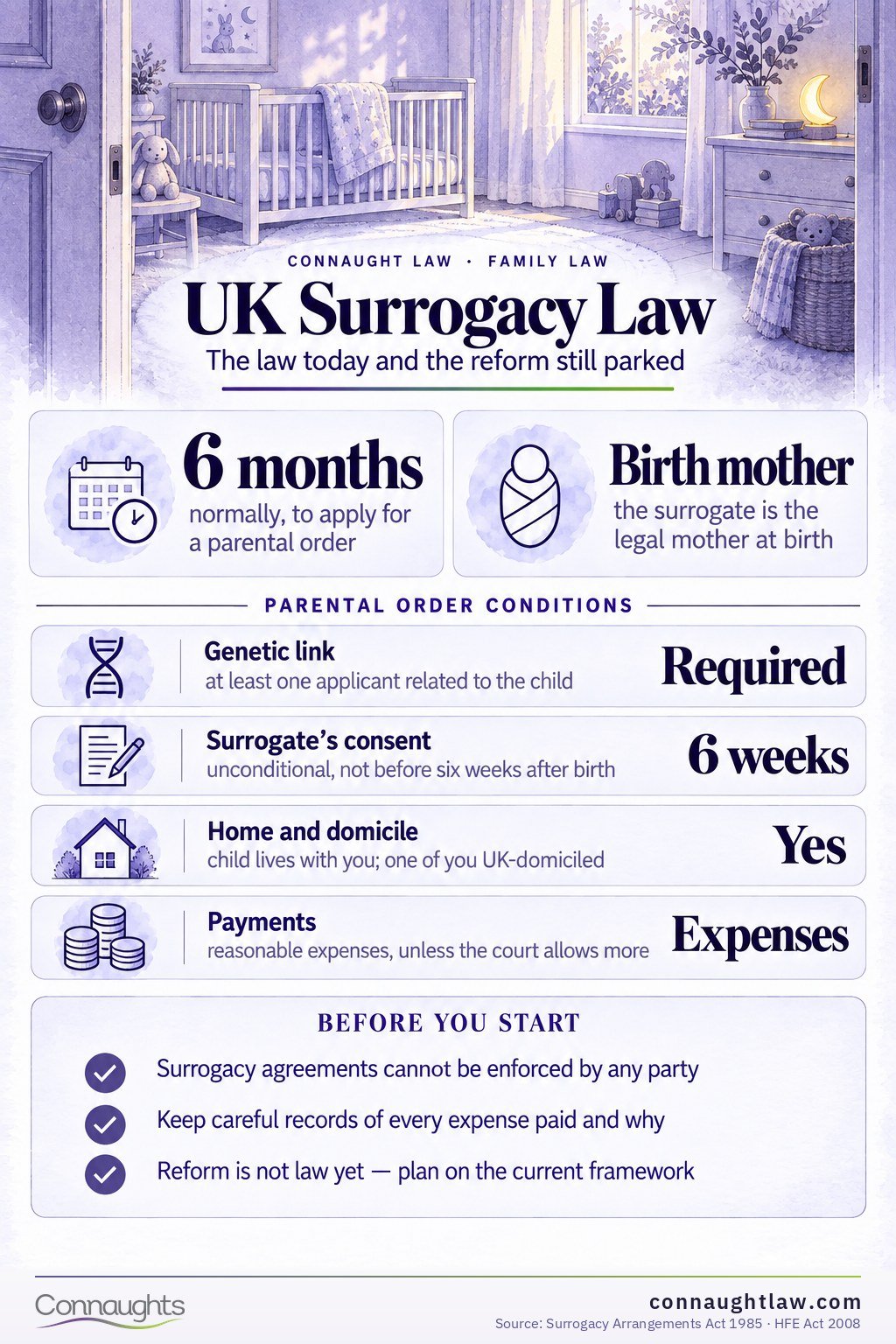
However the child was conceived and whatever anyone agreed, the woman who gives birth is the legal mother, and her spouse or civil partner is usually the second parent. Intended parents become legal parents only through a parental order — or adoption — after the birth. Surrogacy agreements cannot be enforced by any party.
The Current Law
Ground Rules of the 1985 Act
Altruistic surrogacy is lawful; commercial surrogacy is not. Under the Surrogacy Arrangements Act 1985, third parties cannot broker arrangements for profit and advertising is prohibited, while non-profit organisations may operate lawfully. The agreement itself is unenforceable: a surrogate cannot be compelled to hand over the child, and intended parents cannot be compelled to take the child.
Parenthood at Birth
The birth mother rule is absolute: the surrogate is the child's legal mother at birth, and if she is married or in a civil partnership her spouse is normally the second legal parent, displacing the biological father. Intended parents — including a genetic father — hold no automatic parental status until a court order transfers it. The HFEA factsheet summarises the position for clinics and families.
Reform: Written, Published — and Parked
The Law Commission Blueprint
The Law Commission's surrogacy project, jointly with the Scottish Law Commission, reported in March 2023 with a draft Bill. Its centrepiece is a "new pathway": with pre-conception safeguards — screening, counselling, independent legal advice and a regulated surrogacy statement — intended parents would be legal parents from birth, subject to the surrogate's right to object in a defined period, replacing the wait for a parental order in domestic cases.
Where Reform Actually Stands
No government has legislated. Ministers have acknowledged the report but declined to commit parliamentary time, and no surrogacy Bill has been introduced — so the 1985 and 2008 Acts remain the law in force, and families should plan on the current framework rather than an anticipated one. When that changes, the change will arrive as a Bill with its own timetable, not overnight.
Parental Orders: Becoming Legal Parents
Who Can Apply
- At least one applicant genetically related to the child (couples or single applicants)
- Application normally within six months of birth
- The child living with the applicants, and at least one applicant domiciled in the UK
- The surrogate's unconditional consent, given no earlier than six weeks after birth
- No more than reasonable expenses paid, unless the court authorises more
Consent, Welfare and the Court's Approach
The surrogate's free consent is the hinge of the process, and it cannot validly be given in the first six weeks. Once an application is before it, the court's paramount consideration is the child's lifelong welfare — which is why courts have repeatedly found ways to make orders despite technical defects, including late applications, where refusing would harm the child. That judicial flexibility is a safety net, not a plan: get the process right from the start.
Payments and Expenses
What Can Lawfully Be Paid
Intended parents may pay the surrogate's reasonable expenses: lost earnings, travel, maternity needs, insurance, wellbeing costs connected to the pregnancy. There is no statutory tariff — "reasonable" is judged case by case, and careful records of what was paid and why are the best protection at the parental order stage.
When Payments Exceed Expenses
Payments beyond reasonable expenses — common in international surrogacy — do not bar a parental order, but they require the court's retrospective authorisation. Courts consistently authorise them where the arrangement was made in good faith and the child's welfare demands the order, while scrutinising anything that looks like buying a child. International arrangements add immigration and nationality layers on top; take advice before conception, not after birth. Related reading: our guides to adoption requirements and transgender parental rights, where legal parenthood raises similar questions, and our family law team for arrangement-specific advice.
Frequently askedQuestions about surrogacy law and parental orders
Is surrogacy legal in the UK?
Yes — altruistic surrogacy is lawful. Commercial brokering and advertising are prohibited, agreements are unenforceable, and only reasonable expenses should change hands without court authorisation. The framework sits in the Surrogacy Arrangements Act 1985 and the HFE Act 2008.
Who are the legal parents of a surrogate-born child?
At birth, the surrogate is the legal mother, and her spouse or civil partner is usually the second parent. The intended parents acquire legal parenthood through a parental order after the birth, or adoption in cases where a parental order is unavailable.
Has UK surrogacy law been reformed?
Not yet. The Law Commission published its report and draft Bill in March 2023, proposing that intended parents become legal parents from birth on a safeguarded pathway. No government has introduced legislation, so the current law — parental orders after birth — still applies.
What is a parental order and when must we apply?
The court order transferring legal parenthood from the surrogate to the intended parents. Apply normally within six months of birth; the child must live with you, at least one applicant must be genetically related and UK-domiciled, and the surrogate must consent no earlier than six weeks after birth.
Can a surrogate keep the baby?
Legally she is the mother at birth, and the agreement cannot force a handover. If a dispute arises, the family court decides on the child's welfare, and outcomes depend on the facts. Disputes are rare in practice — thorough preparation and screening make them rarer.
What can we pay our surrogate?
Reasonable expenses connected to the pregnancy — lost earnings, travel, maternity costs, insurance — judged case by case. Larger payments, typical in international arrangements, need the court's authorisation at the parental order stage, which courts grant where the arrangement was in good faith.
Tell us where you are in the process, where the surrogate is based and what has been agreed. We will map the parental order route and flag the traps before they cost you.
Get Expert Advice