
A fact-finding hearing is a trial within children proceedings: the family court hears evidence about disputed allegations — most often domestic abuse — and decides what actually happened before any decision about the children is made. Findings shape everything that follows. This guide explains when the court holds one, the K v K and Re H-N framework, the standard of proof, how to prepare, and what proven or dismissed allegations mean for the final hearing.
On This Page

Deciding What Happened Before Deciding the Children
Family courts cannot assess risk from allegations that hang unresolved. Where one parent alleges domestic abuse and the other denies it, and the truth matters to the child's arrangements, the court can list a separate hearing to determine the disputed facts. What it finds — proved or not proved — becomes the factual foundation for every later welfare decision in the case.
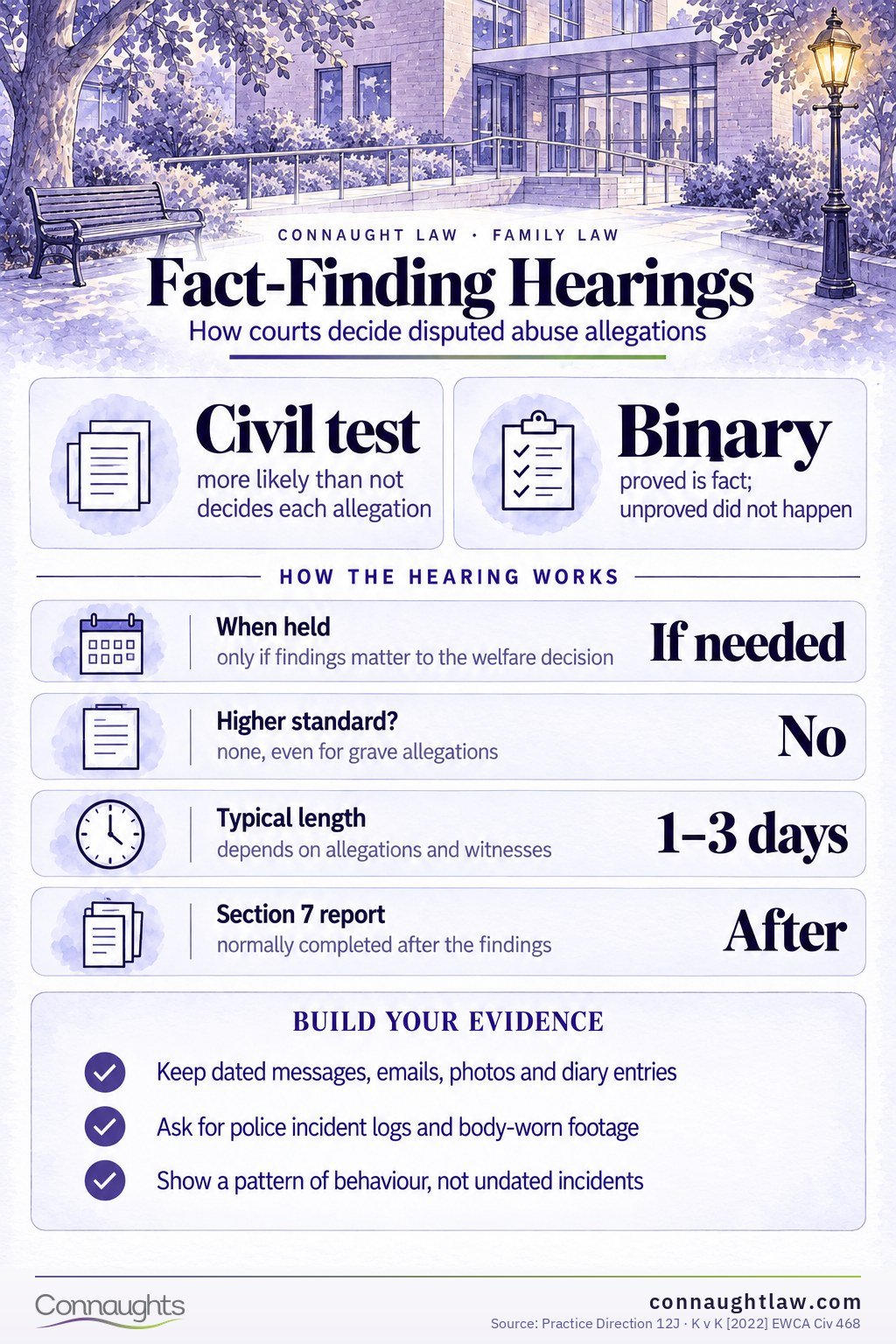
The judge hears evidence from both parties, applies the civil standard — the balance of probabilities — and makes findings on each allegation. An allegation found proved is treated as fact from then on; one not proved is treated as not having happened. There is no jury, and no criminal conviction results.
When the Court Orders a Fact-Finding Hearing
Not every allegation triggers one. Under Practice Direction 12J, the court holds a fact-finding hearing only where the disputed allegations, if proved, would be relevant to the decision about the children, and a determination is necessary to decide the case fairly. The court weighs the nature of the allegations, their relevance to welfare, and whether other evidence — a conviction, an admission — already settles the point.
The Allegations That Usually Qualify
Domestic abuse in all its forms — physical violence, coercive and controlling behaviour, sexual abuse, serious emotional harm — plus child abuse allegations, and serious disputed incidents such as abduction attempts. Since the Domestic Abuse Act 2021 and the appellate guidance that followed, courts look at patterns of behaviour over time, not just incident lists.
Case Law That Frames Modern Fact-Finding
Two Court of Appeal decisions dominate. Re H-N and Others [2021] EWCA Civ 448 held that courts must consider coercive and controlling behaviour as a pattern, and questioned the traditional Scott Schedule's incident-by-incident approach. K v K [2022] EWCA Civ 468 then pulled the other way: a fact-finding hearing is not required in every case where abuse is alleged — only where findings are necessary for the welfare decision. Together they define the modern gateway: pattern-focused where a hearing happens, but no hearing for its own sake.
Abuse Allegations Across the Court's Workload
Allegations of domestic abuse now feature in a substantial share of private children cases, which is precisely why the appellate courts have policed when a separate hearing is justified — court time spent on findings that change nothing is time taken from children waiting elsewhere in the list.
How Courts Apply the Framework Now
The practical consequence is sharper triage. Judges probe at the case-management stage what difference the findings would actually make: allegations going to parenting risk get listed; historic or peripheral matters that would not alter the outcome do not. Parties on both sides should frame their positions accordingly — relevance to the child's arrangements, not grievance, is the currency.
Standard and Burden of Proof
The person making an allegation must prove it on the balance of probabilities — more likely than not. There is no heightened standard for serious allegations. The binary rule then applies: a proved allegation is fact; an unproved one is treated in the proceedings as if it did not happen. That binary is why preparation quality matters so much on both sides.
Presenting a Strong Case
Fact-finding outcomes track the quality of the evidence and the credibility of the account, not the volume of accusation or denial.
Working With the Court's Directions
The court will direct how allegations are to be particularised — often a focused schedule or narrative statement — along with disclosure of police and medical records and any special measures. Follow the directions precisely: cases are damaged more often by late evidence and drifting allegations than by the other side's advocacy. Where abuse is found or admitted, participation directions (screens, separate entrances, a bar on cross-examination in person) protect the alleged victim.
Using the Domestic Abuse Act Framework
The 2021 Act's wide statutory definition — including coercive control and economic abuse — and its recognition of children as victims in their own right give allegations their modern legal shape. Framing evidence as a pattern with examples, rather than a list of undated incidents, matches how PD12J directs judges to think about abuse.
Cafcass's Role Around the Hearing
Cafcass conducts safeguarding checks before the first hearing and reports risk issues to the court, which feeds the decision on whether fact-finding is needed. Importantly, Cafcass does not investigate the truth of allegations — that is the judge's job.
Section 7 Reports Come After the Facts
Where a section 7 welfare report is ordered, it is normally completed after findings, so the officer assesses the family against the court's established facts rather than competing accounts. The Cafcass guidance explains its involvement stages.
Experts Are the Exception
Expert evidence — medical causation, psychological assessment — needs the court's permission and must be necessary to resolve the case. Most fact-finding hearings run on the parties' own evidence, contemporaneous records and police disclosure.
Preparing for the Hearing
Building the Evidence
- Contemporaneous records: messages, emails, photographs, diary entries with dates
- Police disclosure — incident logs and body-worn footage, not just convictions
- Medical and counselling records showing injuries or effects over time
- Witness statements from people who saw or heard events first-hand
- A clear, consistent account: credibility is assessed across every document you have filed
Thinking Past the Findings
Prepare with the final hearing in mind: pursue the allegations that matter to the child's arrangements and let peripheral ones go. Courts notice — and findings reflect — the difference between a parent seeking safety for a child and one prosecuting a grievance. If allegations are made against you, engage with each one specifically; blanket denial reads badly against documented detail.
What Findings Mean for the Final Decision
Where Allegations Are Proved
Proved domestic abuse engages PD12J's protective framework: the court must consider the impact on the child and the victim, and any contact ordered must be safe. Outcomes range from supervised or indirect contact and abuse-focused intervention programmes through, in serious cases, no direct contact. Findings can also ground protective orders for the victim parent.
When Nothing Is Proved
Unproved allegations are treated as not having happened, and the case proceeds on that footing. Courts distinguish honest but unproven accounts from deliberately false allegations; the latter can rebound seriously on the parent who made them, including through findings about their own parenting judgment. Either way the focus returns to rebuilding workable arrangements — often with our family team negotiating the path back from a bruising hearing.
Frequently askedQuestions about fact-finding hearings in children cases
How do you win a fact-finding hearing?
By evidence quality, not volume: contemporaneous records, police and medical disclosure, focused allegations relevant to the child's arrangements, and a consistent credible account under cross-examination. Follow the court's directions exactly — late or drifting evidence damages credibility more than anything the other side says.
What is the standard of proof at a fact-finding hearing?
The civil standard — the balance of probabilities. The person alleging must prove the allegation is more likely true than not. There is no higher standard for grave allegations, and the result is binary: proved allegations become fact, unproved ones are treated as not having happened.
Is a fact-finding hearing always held when abuse is alleged?
No. Following K v K [2022] EWCA Civ 468, the court holds one only where findings are necessary for the welfare decision. Allegations that would not change the outcome, or matters already settled by a conviction or admission, do not get a separate hearing.
How long does a fact-finding hearing take?
Typically one to three days of court time depending on the number of allegations and witnesses, with judgment sometimes reserved to a later date. The listing wait varies by court. The overall case then continues to welfare reports and a final hearing built on the findings.
What happens if allegations against me are not proved?
The proceedings continue as though the alleged events did not happen, and the arrangements are decided on that basis. If the court finds allegations were deliberately fabricated, that finding itself can count against the parent who made them in the welfare analysis.
Tell us the allegations, the evidence each side holds and where the case has got to. We will tell you what the findings fight will actually turn on.
Get Expert Advice