
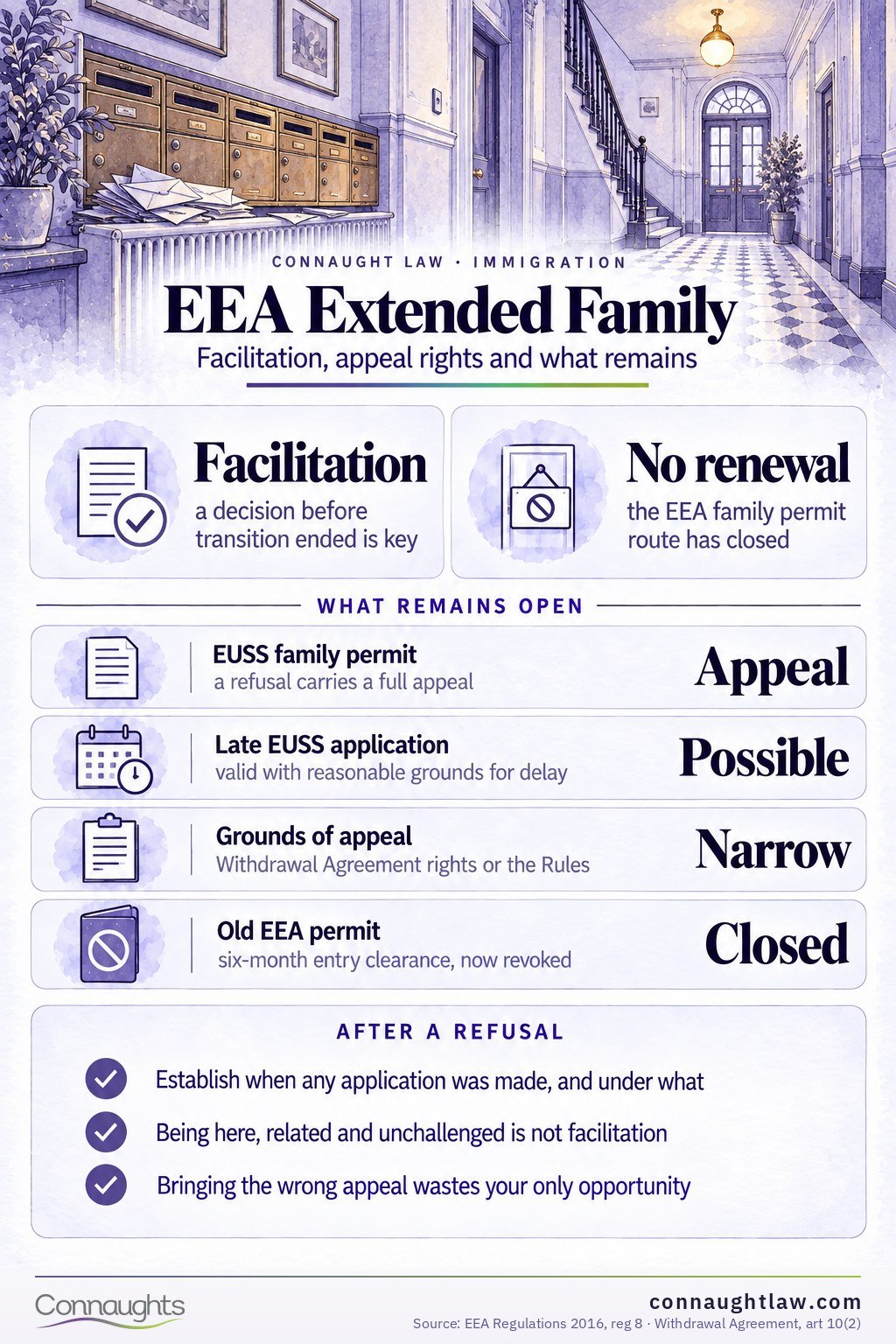
Extended family members are the group free movement treated least generously and Brexit treated worst of all. Their residence was never automatic: it had to be facilitated by a decision, and whether that decision was made before the end of transition now decides almost everything. The EEA family permit route is closed, there is nothing to renew, and what remains sits in the Settlement Scheme.
On This Page

Where Extended Family Members Stand Now
The most common question about this area rests on a mistake. People ask how to renew or extend an EEA family permit, and there is no answer, because it was never a status that could be renewed. It was a six-month entry clearance under regulations that no longer exist. The route closed after 30 June 2021 and nothing replaced it in the same form.
The closure had two dates rather than one, and the difference matters. Extended family members other than durable partners had to apply by 31 December 2020. Direct family members and durable partners had until 30 June 2021 — though for a durable partner the later date only helped if facilitation had already been sought. The Home Office remains obliged to decide applications validly made by those dates, including on appeal, but no new application can be made.
Quick answer — the route closed and there is nothing to renew
If you hold or held an EEA family permit, there is no renewal or extension to apply for. The live routes are the EU Settlement Scheme and, for someone coming to join a family member, the Settlement Scheme family permit. Whether either is open to you turns on what was decided about you before the end of transition.
Who Counted as an Extended Family Member
The category came from regulation 8 of the Immigration (European Economic Area) Regulations 2016, and it is worth knowing precisely because refusals often turn on which limb was relied on. An extended family member was someone who was not a family member under regulation 7 but satisfied one of five conditions.
Five conditions — what regulation 8 covered
- Legal guardianship — a person under 18 subject to a non-adoptive legal guardianship order in favour of an EEA national, living with them, with family life and a relationship of dependency and parental responsibility.
- Dependency or household membership — a relative living outside the UK who was dependent on the EEA national or a member of their household, and who was accompanying or joining them.
- Personal care on serious health grounds — a relative who strictly required the personal care of the EEA national or their spouse or civil partner.
- Dependent relative — a relative who would have met the Immigration Rules for indefinite leave as a dependent relative of the EEA national.
- Durable partner — an unmarried partner in a durable relationship, and that partner's child under 18, able to prove the relationship.
The regulations were revoked on 31 December 2020 by Schedule 1 to the Immigration and Social Security Co-ordination (EU Withdrawal) Act 2020. Savings keep parts of them alive for limited purposes: applications validly made before that date still fall to be decided under them, and appeals brought under them and not finally determined continue.
Facilitation, and Why It Decides Everything
Direct family members had rights. Extended family members had something weaker: a right to have their entry and residence facilitated, meaning considered properly, with an extensive examination of their personal circumstances and a reasoned decision. That difference looked technical while free movement was running. It became decisive at the end of transition.
Article 10(2) of the Withdrawal Agreement protects extended family members whose residence was facilitated before the end of the implementation period. The courts have read facilitation strictly. It means a decision was actually taken about you, under national law, granting you a right to enter or reside. It is not enough that you were living here, related to an EEA national, and unchallenged.
Facilitated, or merely allowed in — the Randhawa line
In Randhawa [2026] EWCA Civ 1008, decided on 30 July 2026, the Court of Appeal held the appellant fell outside Article 10(2) because his residence "had not been facilitated in accordance with domestic law". It distinguished an earlier case where passports had been stamped "Admitted under the Immigration (EEA) Regulations 2016" — there the officer had done something; here the officer "took no equivalent action".
The practical test is therefore documentary. Was a residence card or family permit issued to you as an extended family member, or was an application for one made, before 11pm on 31 December 2020? If the answer is yes, you are in a materially different position from someone who was simply present. If it is no, the authorities below explain why the door is largely shut.
The Cases That Closed the Door
This is one of the few areas where the case law moves in a single direction. Each decision has narrowed the position further, and reading them in order shows why arguments that once looked arguable now do not.
How the Law Narrowed
| Case | What it decided |
|---|---|
| Khan [2017] EWCA Civ 1755 | The tribunal does have jurisdiction over a refusal to issue a residence card to an extended family member. Sala was wrongly decided |
| Batool [2022] UKUT 00219 (IAC) | An extended family member whose residence was not being facilitated before the end of transition, and who had not applied for facilitation, cannot rely on the Withdrawal Agreement or the Rules |
| Celik [2023] EWCA Civ 921 | A person who married an EU national after the end of transition was not residing as a spouse in accordance with EU law at that point. Facilitation means a decision was taken granting a right to enter or reside |
| Siddiqa [2024] EWCA Civ 248 | Where no application had been made under the 2016 Regulations, an appeal under them was bound to fail, and the Withdrawal Agreement did not assist |
| Mustaj [2025] EWCA Civ 663 | A durable partner with no lawful basis of stay in the UK cannot fall within the carve-out in the Appendix EU definition of durable partner |
| Randhawa [2026] EWCA Civ 1008 | Residence not facilitated in accordance with domestic law falls outside Article 10(2). An immigration officer taking no equivalent action is not facilitation |
The narrow opening left by Mustaj is worth understanding because it is where the remaining arguments live. The Appendix EU definition of durable partner allows a person without a relevant document to qualify in limited circumstances — but only where the reason they were not resident as a durable partner was the absence of that document, and they otherwise had a lawful basis of stay. Someone here unlawfully cannot use it.
Appeal Rights Under the 2020 Regulations
There are two appeal regimes and applicants regularly bring the wrong one. Refusals of applications made under the old EEA Regulations before they were revoked are still handled under those regulations, by virtue of the savings. Everything under the Settlement Scheme runs on the Immigration (Citizens' Rights Appeals) (EU Exit) Regulations 2020.
Decisions and Challenge Routes
Under the 2020 Regulations there is a right of appeal against a refusal to grant leave on a Settlement Scheme application, against a decision to vary or cancel leave already granted, and against refusal of a Settlement Scheme family permit. That last point is often missed: a family permit refusal carries an appeal, not merely an administrative review.
The grounds are narrow and should be pleaded as such. An appeal succeeds where the decision breaches rights under the Withdrawal Agreement, or where it is not in accordance with the immigration rules by virtue of which it was made. General unfairness is not a ground, and an appeal arguing the merits of the relationship without engaging the facilitation question tends to fail on the first point. Who can appeal and how sets out the wider framework.
What the Settlement Scheme Still Offers
Late applications to the Settlement Scheme remain possible. Appendix EU requires an application to be made by the required date, and where the deadline was missed it can still be valid if the Secretary of State is satisfied there are reasonable grounds for the delay, assessed at the date of application. The longer the delay, the harder that becomes, but there is no absolute cut-off for most cohorts.
One provision helps a group that had been losing. Section 45 of the Border Security, Asylum and Immigration Act 2025, in force since 2 December 2025, provides that relevant citizens' rights are capable of accruing and applying notwithstanding that the residency relied on "was not relevant residency". For a joining family member it is the sponsor's residency that counts, not their own.
Pre-settled status under review — since April 2026
From 9 April 2026 the Home Office began removing pre-settled status from people who have clearly stopped maintaining continuous residence, working from tax, benefit and travel data and starting with the longest absences. There are safeguards: contact through the UKVI account, an opportunity to provide evidence, a proportionality assessment, and a right of appeal.
The same update improved automatic conversion to settled status. Since 9 April 2026 the system checks for thirty months of tax and benefit payments in the last sixty rather than applying the fuller Withdrawal Agreement test. Several groups are excluded from automation, including non-EEA national family members, joining family members and those with derivative rights — which covers most people reading this page.
After a Refusal, What Actually Helps
Start with the date and the document. Establish exactly when any application was made, under which instrument, and whether any decision was ever taken facilitating residence. A residence card, a family permit, or even a refused application made before the end of transition changes the analysis. A stamped passport may do so, depending on what the stamp says.
Then read the refusal against the right test. If it refuses a Settlement Scheme application, the questions are whether the Withdrawal Agreement is engaged and whether the Rules were correctly applied. If it refuses under the old regulations, the savings apply and the appeal runs under those. Bringing the wrong appeal wastes the only opportunity you have.
One point of relief is worth knowing. Appendix EU expressly disapplies the exceptions for overstayers in Part Suitability, so the overstaying rules that defeat other applications do not bite on a Settlement Scheme application in the same way. The scheme keeps its own suitability code instead.
Frequently askedQuestions about extended family members and EEA family permits
Can I renew or extend an EEA family permit?
No. It was a six-month entry clearance under regulations that were revoked, and the route closed after 30 June 2021. There is nothing to renew. The live equivalent is the EU Settlement Scheme family permit, which is a different application.
What made someone an extended family member?
Regulation 8 of the 2016 Regulations set five routes: legal guardianship of a child, dependency or household membership abroad, needing personal care on serious health grounds, meeting the dependent relative rules, or being a durable unmarried partner.
Why does facilitation matter so much?
Because extended family members never had automatic rights, only a right to have residence facilitated. Withdrawal Agreement protection depends on a decision having actually been taken about you under national law before the end of transition, not on your having lived here.
Can I appeal a refused Settlement Scheme family permit?
Yes. The Citizens' Rights Appeals Regulations 2020 give a right of appeal against refusal of a scheme entry clearance. The grounds are that the decision breaches Withdrawal Agreement rights or was not in accordance with the applicable immigration rules.
Is it too late to apply to the Settlement Scheme?
Not necessarily. A late application can still be valid where there are reasonable grounds for the delay, assessed at the date of application. Delay makes it harder rather than impossible, and the reasons need to be evidenced rather than asserted.
Can pre-settled status be taken away?
It can, where continuous residence has clearly not been maintained. Since April 2026 the Home Office has been reviewing long absences using tax, benefit and travel data. You should be contacted first and given a chance to respond, and any removal decision carries a right of appeal.
Send us the refusal and anything showing what was applied for and when. We will tell you whether facilitation was ever decided in your case, and which appeal route is the right one.
Get Expert Advice